Kubera
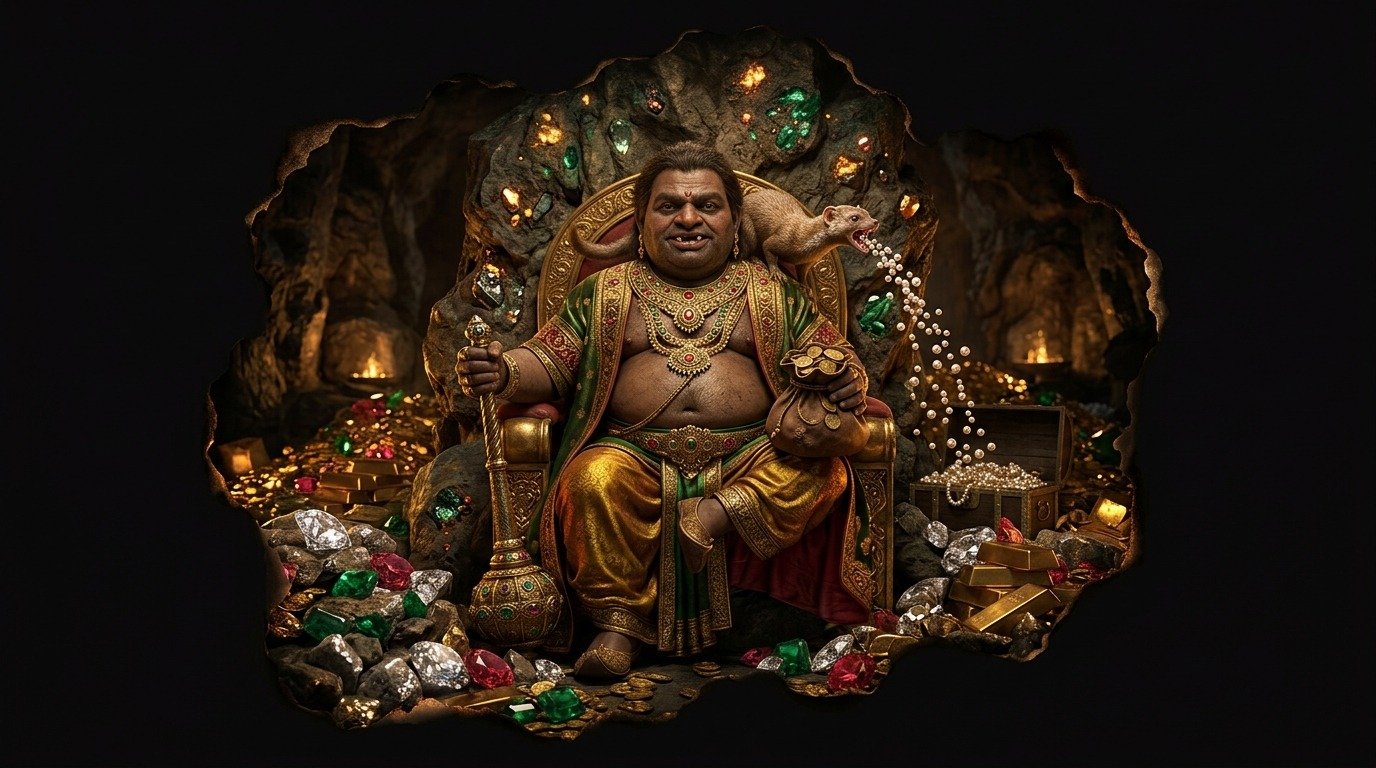
Kubera: The Guardian of the Earth's Treasures
The Sovereign of Hidden Riches
In the darkest depths of the earth, where the light of the sun cannot penetrate but the glow of precious gems creates its own constant day, Kubera reigns. Originally a simple mortal who performed extreme penances for centuries, his devotion caught the attention of the creator, who elevated him to the rank of deity of material wealth and guardian of the treasures of the cosmos. His physical appearance breaks with the canons of traditional divine beauty: he is short, with a prominent belly that denotes opulence, has three legs and only eight teeth, characteristics that recall his earthly origin and his connection to the chthonic forces of nature. As king of the Yakshas, the spirits of the forests, rivers, and roots, Kubera is not a god who creates wealth, but rather its supreme administrator. He controls the veins of gold, the diamond mines, and the secrets of abundant harvests. He travels in the Pushpaka Vimana, an aerial chariot of gold and jewels that flies according to the desires of its occupant, and is usually depicted holding a mace and a bag overflowing with coins, accompanied by a magical mongoose that spits pearls every time it opens its mouth.
The Exile to the Northern Peaks
The story of Kubera is marked by loss and reinvention. He originally ruled the idyllic island of Lanka, a city built entirely of gold by the divine architect. However, his younger half-brother, the ambitious and fearsome demon king Ravana, coveted Kubera's wealth and position. With an army of demons, Ravana invaded Lanka and banished his brother, also seizing his flying chariot. Far from seeking a war that would bleed the world dry, Kubera retreated to the north, establishing his new kingdom in Alaka, a mythical city suspended on the slopes of Mount Kailash in the Himalayas. There, surrounded by eternal snows and under the direct protection of his great friend Shiva, he built an even more splendid empire. Alaka became a sanctuary of unmatched beauty, where celestial gardens bloom despite the extreme cold and fountains flow with water enriched with sandalwood essences, proving that Kubera's true wealth lies in his ability to make abundance flourish even in icy deserts.
The Banquet of Humility
The accumulation of wealth brought with it the poison of pride. On one occasion, believing himself to be the most generous and prosperous being in the cosmos, Kubera organized a monumental banquet for the gods, with the hidden intention of impressing Shiva. The god of ascetics, perceiving the vanity of the treasure guardian, declined the invitation, but sent in his stead his young son, Ganesha, the elephant-headed god. Kubera received the child condescendingly, assuring him that he could eat as much as he wished from his imperial tables. However, Ganesha's appetite proved to be insatiable. He devoured mountains of rice, pools of curry, and warehouses of sweets in a matter of minutes. Running out of cooked food, the child began to eat the gold plates, the palace furniture, and finally threatened to devour Kubera himself to satisfy his hunger. Terrified and with his pride shattered, Kubera ran to take refuge at Shiva's feet, understanding that material wealth is infinite in the eyes of men, but insignificant before the immensity of the divine.
The Flow of Abundance
Despite his lessons in humility, Kubera remains a fundamental deity for the balance of the cosmos. He does not represent the greed that stagnates money, but rather the healthy circulation of resources. In ancient thought, wealth that does not flow becomes cursed; therefore, Kubera works in tandem with Lakshmi, the goddess of spiritual and material fortune, ensuring that the goods of the world reach those who need them to perform good deeds. His presence is invoked at the start of business transactions, in the construction of new homes, and during harvest seasons. Looking upon his image, fortune seekers are reminded that the earth's gold belongs to the earth itself, and that the role of human beings, just like that of the prominent-bellied one himself who watches from the Himalayas, is to be temporary and generous guardians of the gifts that the universe entrusts to them.
Comments
Share information, an experience, or a source to help enrich this entry. They are automatically reviewed before being published.
Loading comments...