Kali
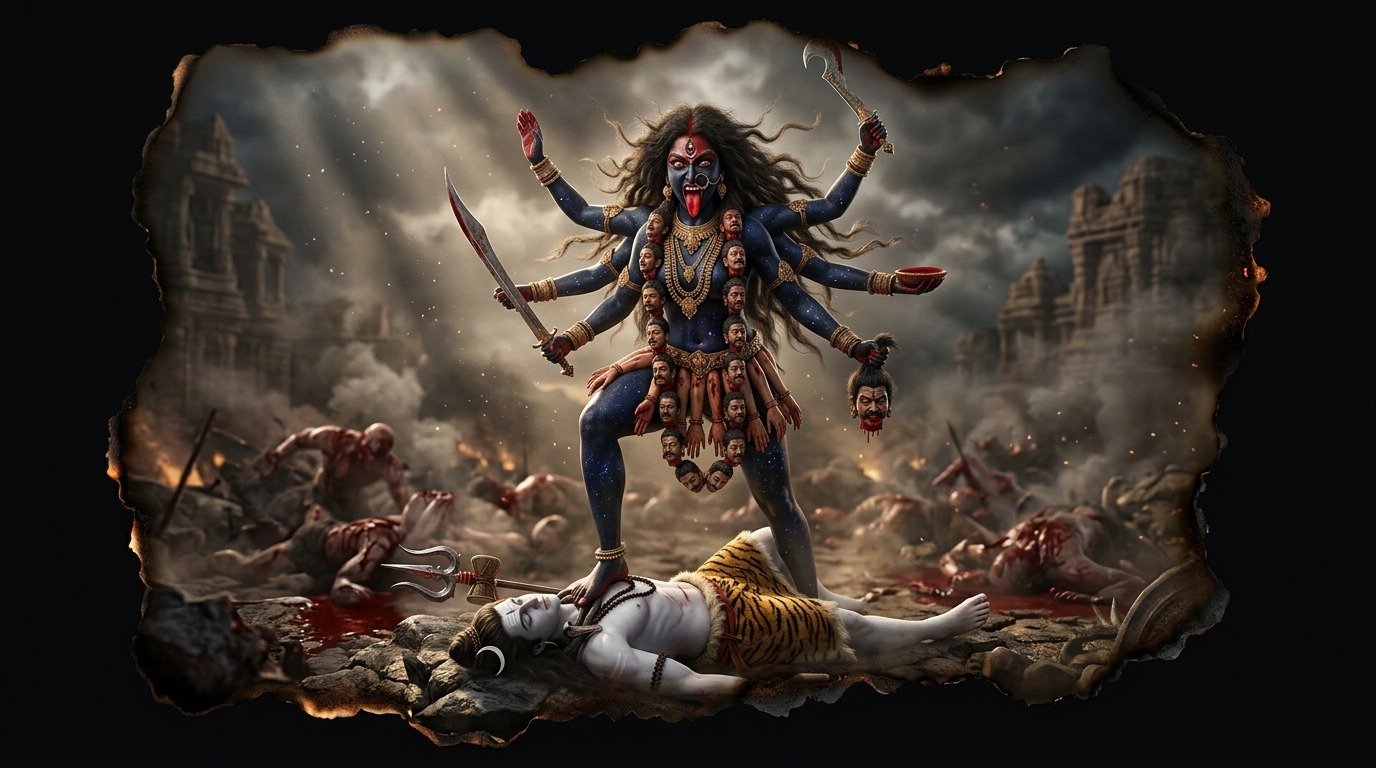
Kali: The Dark Mother and Devouring Time
The Fury That Springs from the Light
Kali does not emerge from the external darkness, but from the concentration of divine wrath in the face of forces that threaten the cosmic order. During a desperate battle in which the demons seemed invincible, the forehead of the goddess Durga darkened with pure rage and, from that wrinkle of tension, Kali emerged. She was born with a cry that shook the three worlds. Her skin is of the darkest blue or the deep black of a starless night; her hair is disheveled and wild, floating like storms of ash. With her bloodshot eyes and her red tongue protruding from between sharp fangs, Kali represents the primordial force of nature in its most untamed and destructive state, the manifestation of the feminine energy (*Shakti*) that destroys in order to recreate.
The Dance Upon the Battlefield
The myth that defines Kali's supremacy is her confrontation against the demon Raktabija. This enemy possessed a fearsome blessing: every drop of his blood that touched the ground instantly became a clone of himself, multiplying his army to infinity. Seeing the other gods despair, Kali intervened. With her multiple arms wielding divine weapons, the goddess lifted the demon, cut off his head, and, stretching out her immense tongue, drank every drop of blood before it could touch the earth. She devoured all of Raktabija's clones in a frenzy of destruction. However, the victory filled Kali with an intoxication of blood and battle so intense that she began to dance a victory dance that shook the foundations of the universe. Her dance threatened to disintegrate the entire creation beneath her feet.
The Body of the Beloved Beneath Her Feet
To save the cosmos, the god Shiva, her husband, realized that no one could defeat Kali in physical combat without unleashing the apocalypse. So he decided to lie down on the ground, in silence, directly in the path of the goddess's dance. In her destructive delirium, Kali did not see him and stepped on Shiva's chest. Upon feeling her husband's body beneath her bare foot, the goddess instantly awoke from her trance of fury. Understanding the gravity of her action, she stuck out her tongue in a classic gesture of embarrassment and reverence, stopping her dance of death. This iconic image—the black goddess standing on the white, serene body of Shiva—symbolizes the relationship between static consciousness (Shiva) and dynamic, temporal energy (Kali); without the firm foundation of consciousness, pure energy runs the risk of destroying itself in chaos.
The Necklace of Skulls and Limitless Time
Kali wears a belt made of severed human arms and a necklace of fifty severed heads, which represent the letters of the Sanskrit alphabet and the destruction of the illusions and ego of her devotees. Her name derives from *Kala*, which means both "time" and "black." She is time itself, the force that devours all: empires, stars, and gods. But for those who manage to see beyond her terrifying appearance, Kali is not death, but the ultimate mother. By destroying the ego and material illusions, the goddess frees her devotees from the cycle of suffering, offering a compassion so radical and direct that it can only be represented by the edge of her sword, which cuts the chains of ignorance in a single blow.
Comments
Share information, an experience, or a source to help enrich this entry. They are automatically reviewed before being published.
Loading comments...