Durga
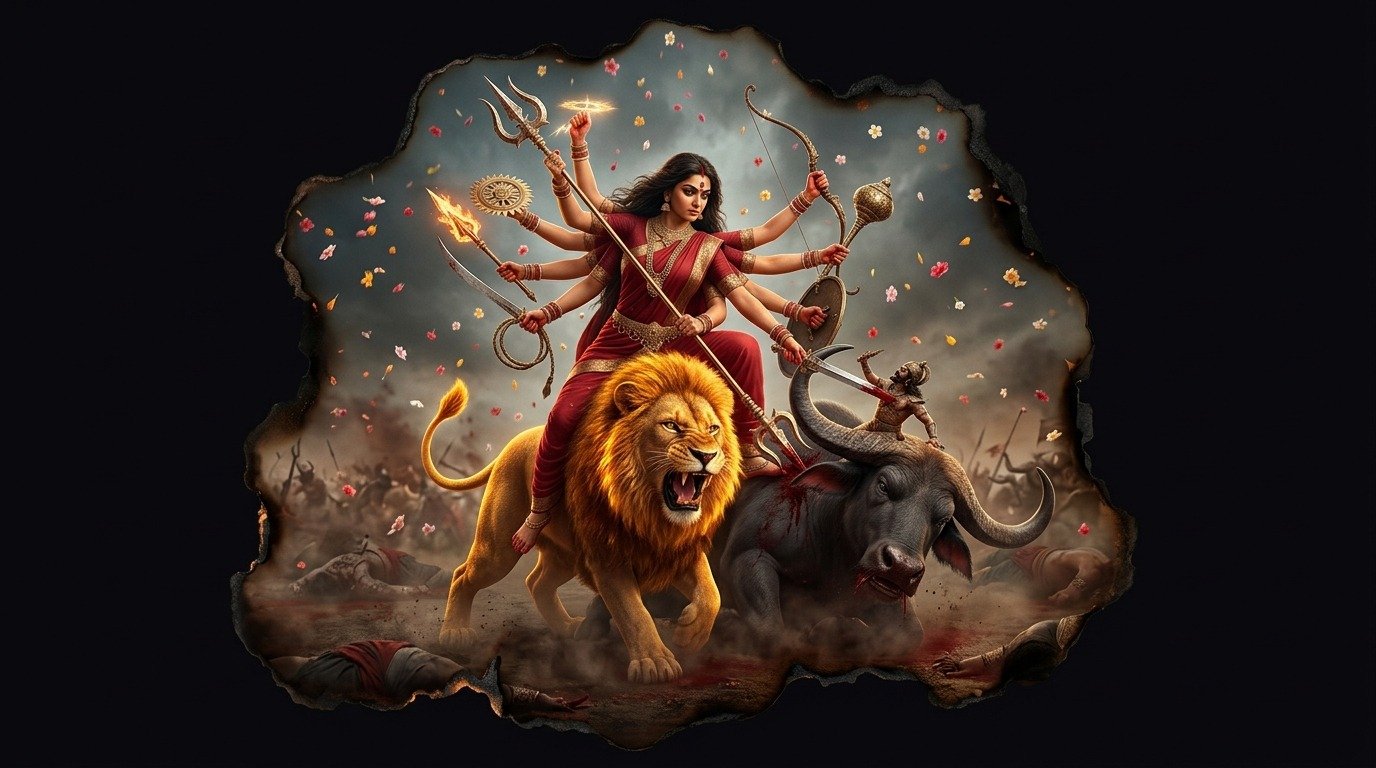
Durga: The fiery wrath that sustains the cosmos
The birth of the golden storm
The universe trembled beneath the hooves of Mahishasura, the giant buffalo-shaped demon who had obtained a deceptive boon: no man, god, or male beast could take his life. Confident in this apparent immortality, he expelled the gods from their celestial realms and sowed chaos throughout the three worlds. In their desperation, the creating, preserving, and destroying trinity gathered in a sacred valley. From their mouths emerged not words, but a concentrated fury in the form of rivers of purest light. The radiances of all the deities merged into a single burning mass, a supernova of energy that took the form of a woman of superhuman beauty and a stormy gaze.
She was born dressed in red, the color of action and of blood spilled for justice. She was not begotten by a mother's womb, but by the absolute need for balance. The gods, marveled and terrified by their own creation, divested themselves of their attributes to arm her: Shiva gave her a replica of his trident; Vishnu, his serrated disc of energy; Varuna, an inescapable cord; Agni, a spear of fire; and Indra, his cloud-shattering thunderbolt. With ten arms to wield the arsenal of the cosmos and mounted upon a roaring lion whose fur gleamed like molten gold, the goddess charged into the battlefield with a laugh that shook the very foundations of creation.
The dance of the ten weapons
Durga does not fight with the clumsiness of mortals; her combats are a cosmic choreography of destruction and order. Each of her ten arms moves independently but in perfect harmony, tracing arcs of light in the air as she dispatches entire armies of demons. The roar of her lion disorients the enemy hosts, while she, with a terrifying calm upon her face, wields the bow, the sword, the mace, and the shield.
When Durga acts, nature itself responds to her call. The wind accelerates with the spinning of her disc, and the earth splits open wherever her trident strikes. She does not represent gratuitous violence, but rather the active force of the universe's self-defense (Shakti). She is the protective mother who transforms into an implacable predator when her children are in danger. Her enemies do not see in her a common opponent, but the personification of their own inevitable destiny, a force of nature that cannot be deflected or appeased with pleas.
The twilight of the usurper
The plain of the final battle was covered by a mist of dust and blood. Mahishasura, seeing his generals decimated, lunged at Durga, constantly changing shape to confuse her. He turned into an enraged elephant that tried to crush the goddess's lion, but she severed his trunk with her sword in a single blow. Then he transformed into a lion with sharp claws, and later into an armed warrior, but Durga dismantled each of his illusions with icy precision.
Finally, the demon returned to his original form of a wild buffalo, charging with his colossal horns capable of splitting mountains. With an agile leap, Durga planted herself upon the beast's back. The impact of her sacred feet left the usurper breathless. With one hand she held his head, and with the other, she drove Shiva's trident into his chest. As the demon's spirit attempted to escape from the wound in the form of a small, half-emerged warrior, Durga, without blinking, drew her sword and severed his head. Silence returned to the universe, and a rain of celestial flowers fell upon the warrior who had restored light to the heavens.
The eternal mother on the battlefield
Although her most well-known facet is that of the destroyer of demons, Durga is revered as the compassionate aspect of the feminine absolute. Her name means "the inaccessible" or "she who alleviates suffering." Her figure transcends war: she is the inner strength that allows human beings to overcome their own invisible obstacles, such as fear, ego, and ignorance.
Her legacy is kept alive in festivals where the earth is filled with drums, torches, and dances that recreate her victory. In temples and altars, she is depicted with a serene smile amidst the chaos of battle, reminding those who look upon her that, even in the heart of the fiercest conflict, inner peace and divine order always prevail over darkness.
Comments
Share information, an experience, or a source to help enrich this entry. They are automatically reviewed before being published.
Loading comments...