Hanuman
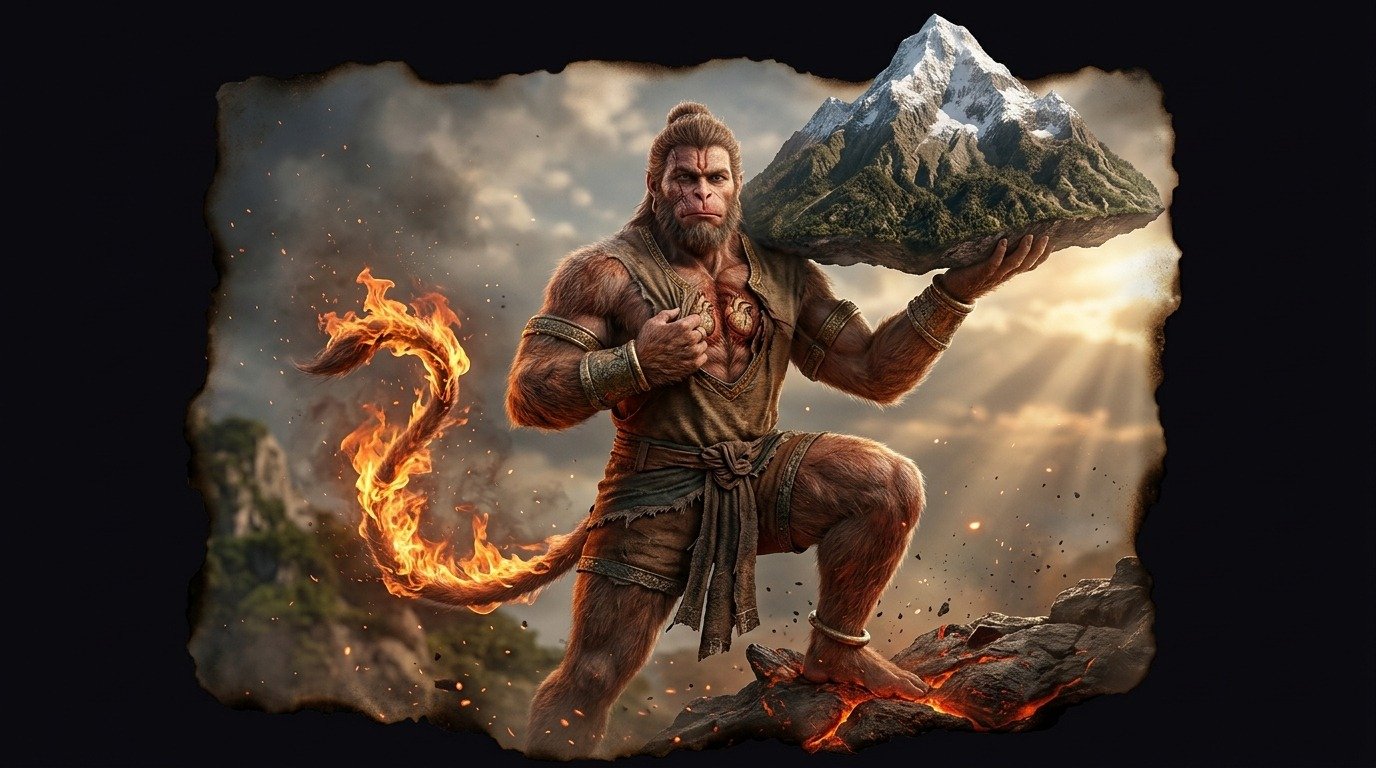
Hanuman: The Divine Breath of Unwavering Devotion
The Leap That Defied the Sun
Hanuman's birth was marked by wind and audacity. The son of Anjana, a celestial nymph cursed with the form of an ape, and Vayu, the god of the wind, the little one inherited the lightness of air and colossal physical strength. While still a mere infant, he awoke with a voracious hunger and, looking up at the sky, mistook the rising sun for a ripe, golden fruit. Without hesitation, he took a colossal leap that carried him beyond the clouds, ascending straight toward the sun.
The gods, fearing the child would devour the universe's source of light, intervened. Indra, the king of the heavens, hurled his thunderbolt at him, striking him in the jaw and sending him crashing back to earth. Seeing his son unconscious and wounded, an infuriated Vayu withdrew the air from the three worlds, suffocating creation. To appease the wind god, the deities gathered at the bedside of little Hanuman and blessed him with extraordinary gifts: immortality, immunity to any physical or magical weapon, the ability to change size at will, and a speed that rivals thought. From that day on, his broken jaw remained as the mark of his original audacity, naming him forever.
The Strength That Lifts Mountains
Hanuman's power is so vast that he often forgets his own magnitude due to a childhood curse designed to keep him humble; he only remembers what he is capable of when someone reminds him of his sacred purpose and his love for Prince Rama. When his strength awakens, it knows no physical limits. His body can grow to reach the clouds, his footsteps crack solid rock, and his arms are capable of holding back raging rivers.
The episode that best defines this colossal power occurred during the great war against the demon king. Rama's brother lay dying on the battlefield, and the only cure was a medicinal herb that grew only on the peaks of the Himalayas. Hanuman flew thousands of kilometers (miles) in the blink of an eye to reach the snow-capped mountain. Once there, unable to identify the exact plant among the dense vegetation, he made a drastic decision: he thrust his gigantic hands beneath the foundations of the mountain and, with a roar that echoed through the heavens, ripped the entire peak from the mountain range to carry it back to the camp in the palm of his hand.
The Messenger of Fire
When Princess Sita was kidnapped and imprisoned on the island fortress of Lanka, it was Hanuman who crossed the ocean in a single leap to find her. Upon being captured by enemy troops after destroying their royal gardens, the demon king Ravana ordered the divine ape's tail to be set on fire as punishment. However, what was intended as a humiliation became the city's undoing.
Far from being cowed by the flames, Hanuman used his agility to slip out of his chains. Leaping from rooftop to rooftop with his tail wrapped in a sacred fire that caused him no pain but consumed everything else, he reduced the golden palaces and fortifications of Lanka to ashes. That fire not only destroyed the enemy defenses but also sent an unmistakable message to the usurper: heaven's justice was on its way, and it was driven by the wind.
The Silent Immortal
Unlike other heroes who ascend to the heavens after fulfilling their mission, Hanuman chose to remain on Earth. When the era of Prince Rama came to an end, the wind deity preferred to renounce the celestial abode to stay among mortals in a state of active immortality. It is said that he dwells in the most remote jungles and mountains of the world, meditating in silence and protecting the weak.
Hanuman is the embodiment of selfless service. On altars, he is often depicted tearing open his chest with his hands to show that the names of those he loves and protects are engraved in his heart in letters of fire. He does not seek worship for himself; his colossal strength is entirely at the service of others, making him the ultimate refuge for those seeking courage in the face of fear and strength in the face of adversity.
Comments
Share information, an experience, or a source to help enrich this entry. They are automatically reviewed before being published.
Loading comments...