Teotihuacán
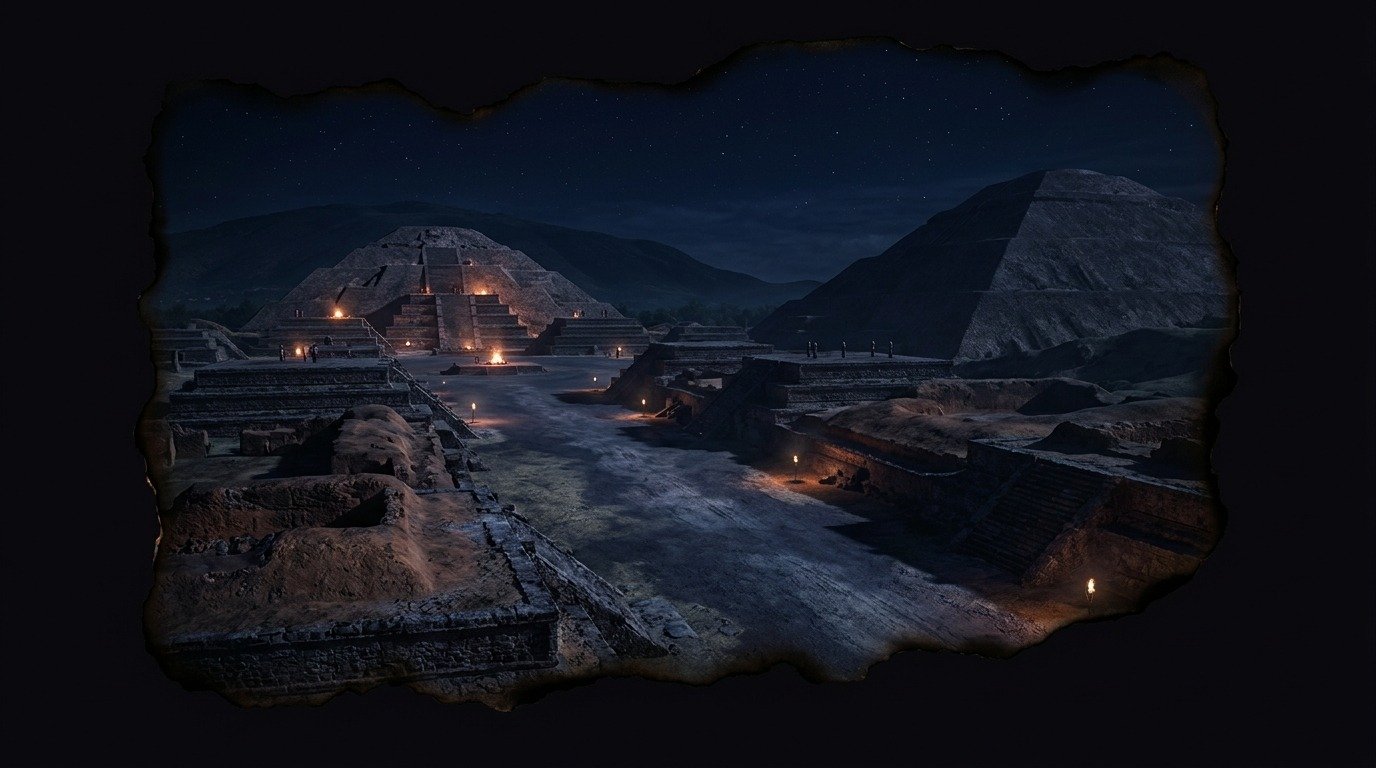
Teotihuacán: The City Where the Gods Are Born
When the Aztecs arrived in the Valley of Mexico in the 13th century, they encountered an imposing and terrifying sight. Before them rose an abandoned metropolis of colossal proportions, with perfect avenues and pyramids that mimicked the shape of sacred mountains. There was no trace of its builders; the city had been empty for centuries, devoured by vegetation and silence. Faced with such magnitude, the Aztecs believed that this place could not have been built by ordinary men, but was instead the stage where the gods themselves had gathered to create the Fifth Sun, the world in which they now lived. They named it Teotihuacán.
The Layout of the Cosmos on Earth
Founded around 100 BCE, Teotihuacán became the largest city on the American continent, housing more than one hundred and twenty-five thousand inhabitants at its peak. The city's urban planners did not build at random; they aligned every temple, street, and house according to a precise grid based on astronomical observations, using the passage of the sun and stars over the horizon as a guide.
The Avenue of the Dead, an avenue 40 meters (131 feet) wide and more than 2 kilometers (1.2 miles) long, connects the main monumental complexes. At the northern end rises the Pyramid of the Moon, a structure destined for fertility and sacrifice rituals. In the center of the urban layout stands the colossal Pyramid of the Sun, a mass of earth and stone 65 meters (213 feet) high built directly over a natural flower-shaped cave that the Teotihuacanos considered the womb of creation.
The Sacrifice of Fire and the Feathered God
The theology of Teotihuacán revolved around the renewal of the cosmic order through blood. The Mexica legend of the Fifth Sun tells that the gods gathered in Teotihuacán around an immense pyre. The proud god, Tecuciztécatl, hesitated before throwing himself into the flames, while the humble and diseased Nanahuatzin cast himself into the fire without hesitation, emerging in the sky transformed into the brilliant Sun. Seeing his courage, the first god followed him, transforming into the Moon.
In the Temple of the Feathered Serpent, the city's most ornate building, the walls are decorated with the sculpted faces of Quetzalcoatl and a crocodile-like being representing the earth and rain. Excavations in the foundations of this temple revealed the skeletons of more than one hundred sacrificed warriors, placed on their knees, with their hands tied behind their backs and wearing necklaces made of carved human jaws.
The Energy of the Subsoil
Travelers walking today under the midday sun along the Avenue of the Dead report a strange sensation of fatigue and heaviness, popularly attributed to the altitude and the heat reflected by the stucco of the platforms. However, researchers have discovered real physical anomalies beneath the city's soil.
In the year 2003, after heavy rains, a hole opened at the foot of the Temple of the Feathered Serpent. Years later, upon descending, archaeologists found a tunnel sealed nearly two thousand years ago that led to a series of underground chambers. The walls of the tunnel were impregnated with pulverized pyrite and magnetite which, when a torch was lit, sparkled to mimic the night sky. At the back of the chamber, offerings of jade, anthropomorphic figures, and large deposits of liquid mercury were found, placed to simulate lakes and rivers of the underworld.
The Mysterious Collapse
Despite its immense military and commercial power, Teotihuacán collapsed around the year 550 of our era, when its ceremonial center burned; the city gradually emptied over the following centuries. The history written in the ashes reveals that the city did not fall to a foreign invasion. The temples and palaces of the ruling class along the Avenue of the Dead show severe burn marks and systematic destruction, while the dwellings of the working classes remained intact.
This discovery suggests to many archaeologists a violent internal revolt, fueled by scarcity, deforestation, and famine, against the priests and rulers who failed to bring about rain from the gods.
The Whisper of the Stones
At dusk, when tourists withdraw from the archaeological zone, the wind blows strongly between the pyramids of the Sun and the Moon. Those who remain near the structures claim to hear a constant whisper running along the stone staircases. It is the echo of a civilization that erased its own name from history, leaving only its monuments as an eternal portal to the origin of the world.
Comments
Share information, an experience, or a source to help enrich this entry. They are automatically reviewed before being published.
Loading comments...