Uluru
Uluru: The Red Sandstone Heartbeat in the Heart of the Desert
The Blood Change of the Great Rock
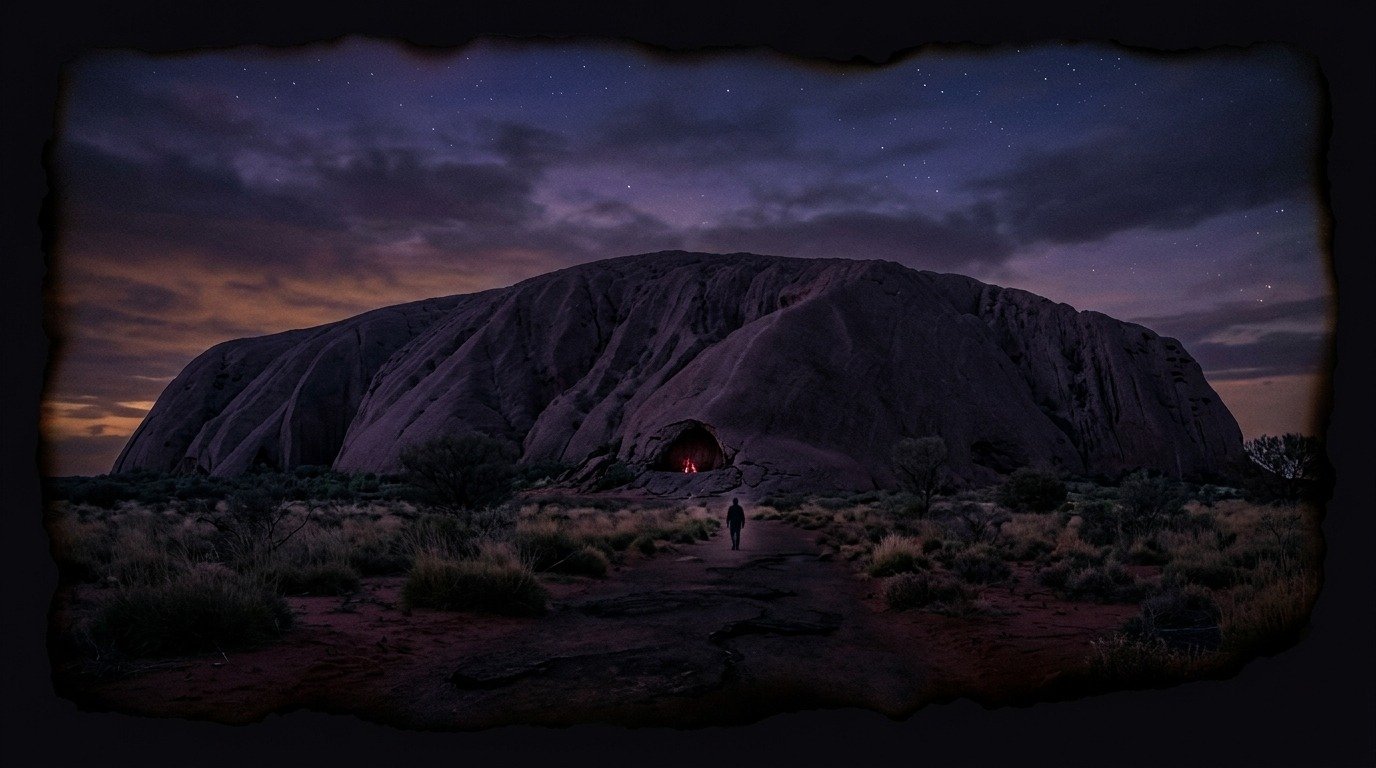
At five in the afternoon, the sun of the central Australian desert begins to fall over the red sand plain. At that instant, the colossal stone mass of Uluru, rising 348 meters (1,142 feet) above the flat ground, begins to transform. It shifts from a dull ochre to a brilliant orange, and then to a red so intense that it seems illuminated from within, like a glowing ember fresh from the fire. As night falls, the rock slowly dims until it adopts a purplish-gray, almost black color. For the Anangu, the original inhabitants of this land for more than thirty thousand years, this color change is not an optical effect of sunlight: it is the breath and pulse of the ancestors who dwell within the stone.
The Dreamtime Written in Stone
To Westerners, Uluru was baptized as *Ayers Rock* in 1873, a geographical feature in the middle of the desert. To the Anangu people, it is the physical record of the *Tjukurpa*, the Dreamtime, the creation epoch where ancestral beings in the form of plants, humans, and animals walked the barren land, shaping the landscape through their battles, songs, and journeys.
Every crack, every cave, every striation on the surface of Uluru is the mark of a sacred story. Some marks are the wounds from the battle of the lizard-men; others, the remains of the creators' campfires. Next to the Mutitjulu waterhole, on the southern face, the rock preserves the traces of the combat to the death between Kuniya, the python-woman, and Liru, the poisonous snake. The Anangu do not need sacred books; their bible is carved into the geology of the great rock, and every corner has specific laws that determine who can approach and what rituals must be performed there.
The Curse of the "Sorry Rocks"
For decades, thousands of tourists climbed to the summit of Uluru despite the pleas of the traditional owners of the land, who considered that climb a desecration of their ancestors' path. Many of those visitors decided to take a small piece of stone as a souvenir.
Shortly after, the national park's tourism offices began receiving packages from all over the world. Inside the envelopes were red stones and desperate letters. Stories of sudden divorces, serious car accidents, financial bankruptcies, and terminal illness diagnoses that began exactly the day they returned from Australia with the stone in their pocket. Today, the park keeps hundreds of these "sorry rocks" returned by mail by tourists seeking to rid themselves of what they called the curse of Uluru.
The Whisper of the Wind in the Caves
Since October 26, 2019, climbing to the summit of Uluru has been permanently banned. Today, visitors can only walk around its base, a journey of about ten kilometers (6.2 miles).
Those who make the journey on foot describe a dense atmosphere. The desert heat exceeds forty degrees Celsius (104 degrees Fahrenheit), but as you approach the entrances of the sacred caves, the temperature drops suddenly, and a freezing air is felt, smelling of damp dust and old stone. In areas like the Kantju Gorge, where rainwater cascades down the red rock during storms, the silence is so deep that the buzz of an insect resounds like an amplified echo. Signs clearly indicate the sacred sites where taking photographs or recording videos is prohibited, areas reserved exclusively for the male or female initiation rites of the Anangu.
The Colossus Buried in the Plain
Western geology confirms that Uluru is an extraordinary anomaly. It is an inselberg, an "island mountain" composed of arkose sandstone, a type of rock rich in feldspar that gives it that characteristic reddish color when oxidized by the air.
The rock was formed about five hundred million years ago under an inland sea. What we see today above the desert is only the tip of a stone iceberg: the sandstone layers continue beneath the ground, tilted almost vertically, extending into the Earth's crust to a depth of more than six kilometers (3.7 miles). Uluru does not rest upon the desert; it is a gigantic needle sprouting from the heart of the continent.
The Rest of the Red Giant
As night falls, when the last tourist bus departs and the desert is left under the mantle of the Milky Way, Uluru reclaims its sovereignty. The rock creaks slightly due to the sudden change in temperature, a dull cracking sound that is lost in the immensity of the outback, reminding those who listen that the stone giant remains awake in the gloom.
Comments
Share information, an experience, or a source to help enrich this entry. They are automatically reviewed before being published.
Loading comments...