Machu Picchu
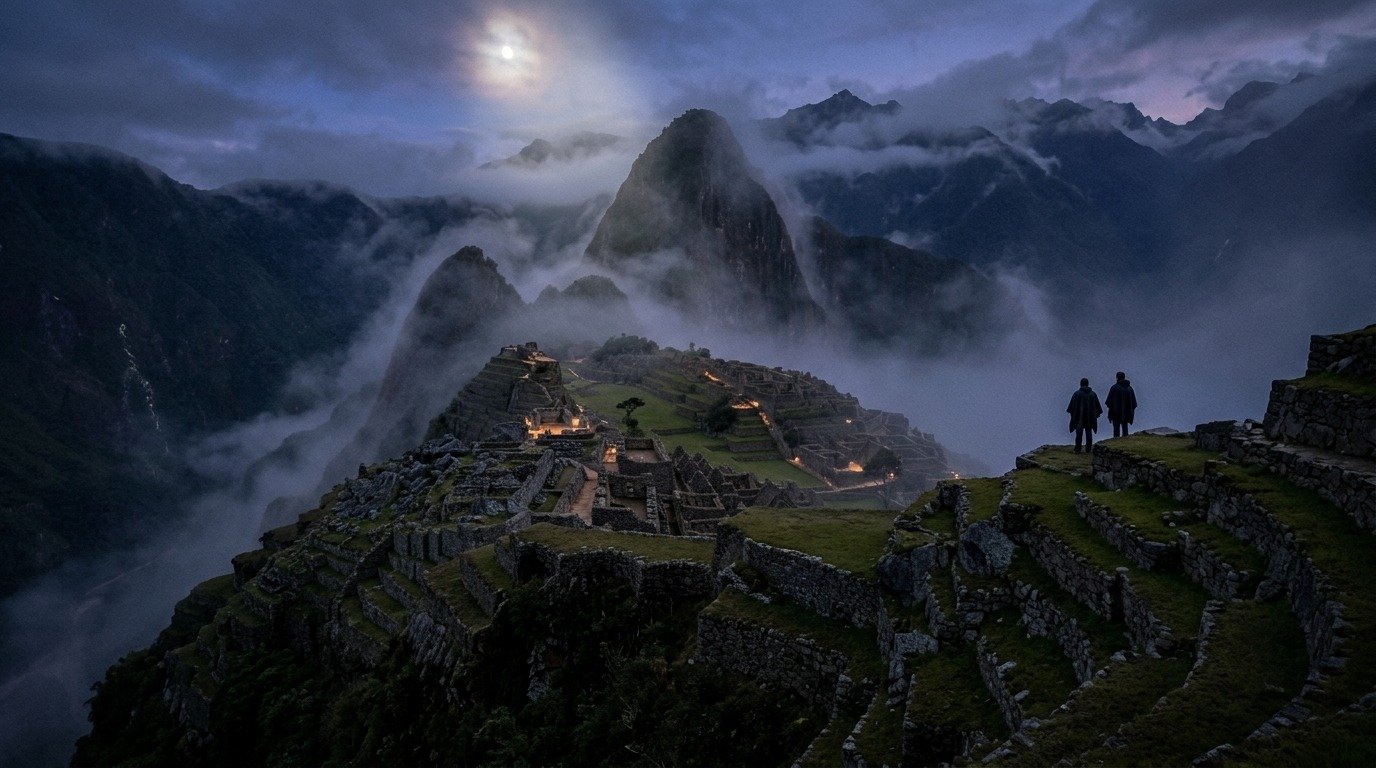
Machu Picchu: The Stone Sanctuary Among the Clouds
On July 24, 1911, under a persistent rain and shrouded in the dense mist of the Urubamba Canyon, American historian Hiram Bingham climbed the mountainside guided by a local boy. After hacking his way with machetes through the dense tropical forest that covered the rocky ridge, Bingham came face to face with perfectly aligned stone agricultural terraces and white granite walls that fit together with millimetric precision. Amidst the silence of the Andes, the mythical Inca citadel of Machu Picchu emerged from its four-century slumber.
The Palace of the Son of the Sun
Machu Picchu, whose name means "Old Mountain," was built around the year 1450 by order of the Inca Pachacútec, the great transformer of the empire. Situated at two thousand four hundred meters (7,874 feet) above sea level, on a narrow ridge connecting the mountains of Machu Picchu and Huayna Picchu, the citadel served as a royal retreat and, at the same time, as a major ceremonial center dedicated to the worship of Inti, the Sun god.
The imperial architects designed the city respecting the natural shapes of the mountain. They used the ashlar construction technique with polished granite, where the rocks were carved in such a way that they fit together perfectly without the need for mortar. The joints between the stones are so narrow that it is impossible to slide a sheet of paper between them. This flexible assembly system allowed the structures to withstand the constant earthquakes that shake the Andean region without suffering significant damage.
The Stone That Binds the Sun
The spiritual heart of Machu Picchu is the Intihuatana, a sacred rock carved directly into the summit of a natural hill within the citadel. The term, which translates as "Where the sun is bound," consists of a polished stone base with a granite column pointing to the sky at its center.
During the equinoxes, at noon, the sun falls almost vertically upon the stone, and the column casts barely any shadow. Inca priests performed rituals at this altar to "bind" the sun to the stone, preventing the sun king from continuing his downward path and ensuring his return to nourish the empire's crops.
The layout of the main temples, such as the Temple of the Sun and the Room of the Three Windows, is perfectly aligned with the sunrise points during key astronomical events of the year, serving as a great celestial observatory amidst the peaks.
The Energy of the Apus
Pilgrims and travelers who arrive at the citadel today after walking the Inca Trail describe a deep sense of serenity and an unusual energetic charge that they attribute to the proximity of the *Apus*, the protective spirits of the sacred mountains surrounding the site, such as Salkantay and Huayna Picchu.
In the Intihuatana sector, local guides used to invite visitors to place their hands a few centimeters (a few inches) from the sacred stone without touching it. Many claim to have felt an emanation of heat and a vibration that seemed to come from the granite. Today, the stone is protected and can no longer be touched.
The Sanctuary Protected by the Jungle
Historical documents confirm that Machu Picchu was never a "lost city" to the local populations of the nearby valleys, who continued to cultivate some of its peripheral terraces. However, the Spanish conquistadors never knew of its existence.
When the empire collapsed with the civil war and the European invasion in the 1530s, the inhabitants of the citadel abandoned it. No one knows exactly why or how; one tradition holds that they destroyed the access trails so that the Spanish would never find it. The cloud forest vegetation took care of hiding the ruins for centuries, preserving the sanctuary from colonial looting.
The Guardian of the Mist
As evening falls over Machu Picchu, low clouds rise rapidly from the Urubamba River and envelop the citadel in a gray shroud that erases the contours of the terraces. At that moment, the profiles of the stone temples blur, returning Pachacútec's fortress to the realm of myth and clouds, where the ancient Incas believed their most feared gods dwelt.
Comments
Share information, an experience, or a source to help enrich this entry. They are automatically reviewed before being published.
Loading comments...