Miguel
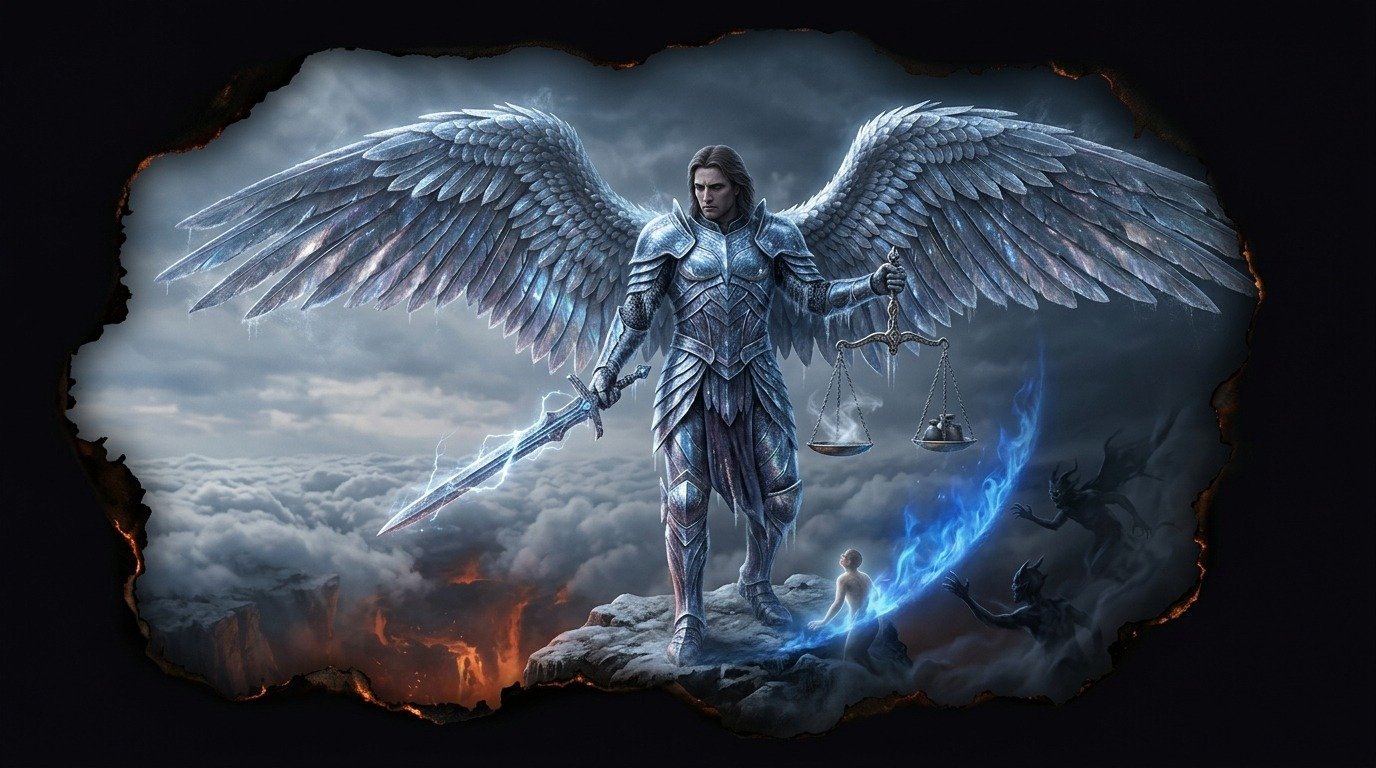
Miguel: the steel of divine will
The first cry of creation
Before time had a name and the stars were nothing more than a thought in the mind of the Creator, an immense void threatened to devour the newborn order. In that moment of rupture, when the pride of the brightest of the cherubim dragged a third of the stars down with him, it was not divine wrath that descended directly, but a voice. A roar of absolute fidelity that echoed in the abyss: "Who is like God?". That cry was not just a challenge; it was the birth of an identity. The being who uttered it was forever sealed with those words, assuming the name Miguel as a shield and a banner. He was not born for passive contemplation or mystical whispering. His very essence is rigor, the contained force that holds up the pillars of the universe so they do not collapse under the weight of chaos. His armor is not made of earthly metals, but of the dense light of the first stars, tempered in the waters of the upper firmament. Those who have brushed against his presence do not describe warmth, but a solemn and purifying cold, similar to the air of the highest peaks where oxygen is scarce and only what is truly pure survives.
The general of invisible scars
Miguel's authority does not come from a bureaucratic decree, but from the weight of his battles. He is the generalissimo of the heavenly hosts, the only one who holds the banner of Order against the tides of dissolution. His sword does not cut flesh; it cuts through lies, tears away illusions, and separates light from shadow with surgical precision. It is said that when he brandishes his weapon, space itself creaks, recalling the moment he cast the great dragon out of heaven and confined him to the earth. But this military role does not make him a ruthless being. His gaze, fixed on the confines of the cosmos, carries the melancholy of one who must eternally fight against those who were once his brothers. There is no joy in his victory, only an unshakeable determination. When he walks through the invisible battlefields of the human soul, his presence is felt as a sudden weight on the chest, a demand for righteousness that admits no excuses or weaknesses. It is he who holds the scales of justice at the final judgment, measuring the true weight of actions with an impartiality that is more terrifying than any punishment.
The guardian of the last breath
Miguel's domain extends far beyond celestial borders; it descends into the mire of mortality. He is the supreme psychopomp, the guardian who stands between the helpless soul and the collectors of the abyss at the exact instant of death. When the body expires, the spirits of darkness claim their rights over the sins committed by man; it is at that threshold where the colossal silhouette of Miguel rises, interposing his shield of blue fire between the deceased and their accusers. His cult is not one of tender supplication, but of a covenant of honor. He is invoked when human strength has been exhausted, when the siege of fear or oppression seems unbearable. His response is never a soft miracle, but an injection of pure will: the miracle of standing tall when everything invites you to fall. He is the sentinel who watches over the gates of lost Eden, the one who ensures that the distance between the sacred and the profane remains inviolable until the cycle of the world comes to an end.
The prince of the spiritual frontier
While other beings of light administer the laws of nature or carry the messages of the Creator, Miguel shoulders a burden of historical proportions: the physical and spiritual survival of an entire people. He is the patron, the wall of fire, and the legal defender of the people of Israel in the heights of the firmament. His presence is not limited to the apocalyptic battles of the end of times; it is a perpetual guard waged in the heavenly courts and in the blurred boundaries of human history. When the nations of the Earth clash in the material world, an identical and more terrible war occurs in the subtle realms. Each empire, each earthly dynasty, has its own guardian angel, a spiritual prince who fights for the supremacy of his proteges. In that invisible senate, Miguel is the solitary litigant of the chosen people, the one who rises against the influence of the princes of Persia, Greece, and Rome, halting decrees of extermination before they manifest in the flesh and blood of history.
The defense in the court of accusations
Miguel's role as protector of his people is, above all, an act of cosmic advocacy. His great opponent is not a human army, but the Accuser, Samael, who constantly presents before the divine tribunal the sins, doubts, and rebellions of the lineage of Jacob to demand their destruction. Miguel intervenes in every session of this eternal court. With a voice that rings like tempered metal, he exposes the suffering of the righteous, the faith of the patriarchs, and the tears of the oppressed, counterbalancing the scales of judgment with the weight of mercy. This defense translates into concrete miracles on earth. When enemy armies surround the walls or when exile seems like the end of the road, Miguel's hand moves in the shadows. It is he who infuses an irrational panic into the hearts of the oppressors, he who deflects arrows in the heat of battle, and he who whispers mercy into the ears of foreign kings. His protection does not prevent the suffering of the people—frequently interpreted as a purifying fire—but it guarantees that the flame is never completely extinguished.
The guardian of the remnant
Miguel's gaze is fixed on the future, guarding the seed from which final redemption must spring. In the darkest moments of the people's dispersion, when the very identity of the lineage runs the risk of dissolving into oblivion, the presence of this archangel becomes denser. He guards the secrets of the ancient covenant, keeping the memory alive in the hearts of the wise and the simple. His protection is an invisible shield that surrounds places of prayer and study. Those who invoke his name in times of national danger do not call upon an abstract warrior, but upon the oldest celestial relative, the one who was present in the burning bush, the one who guided the pillar of fire in the desert, and the one who, it is said, holds the collective soul of Israel between his golden hands until the world is restored.
Comments
Share information, an experience, or a source to help enrich this entry. They are automatically reviewed before being published.
Loading comments...