La Catrina
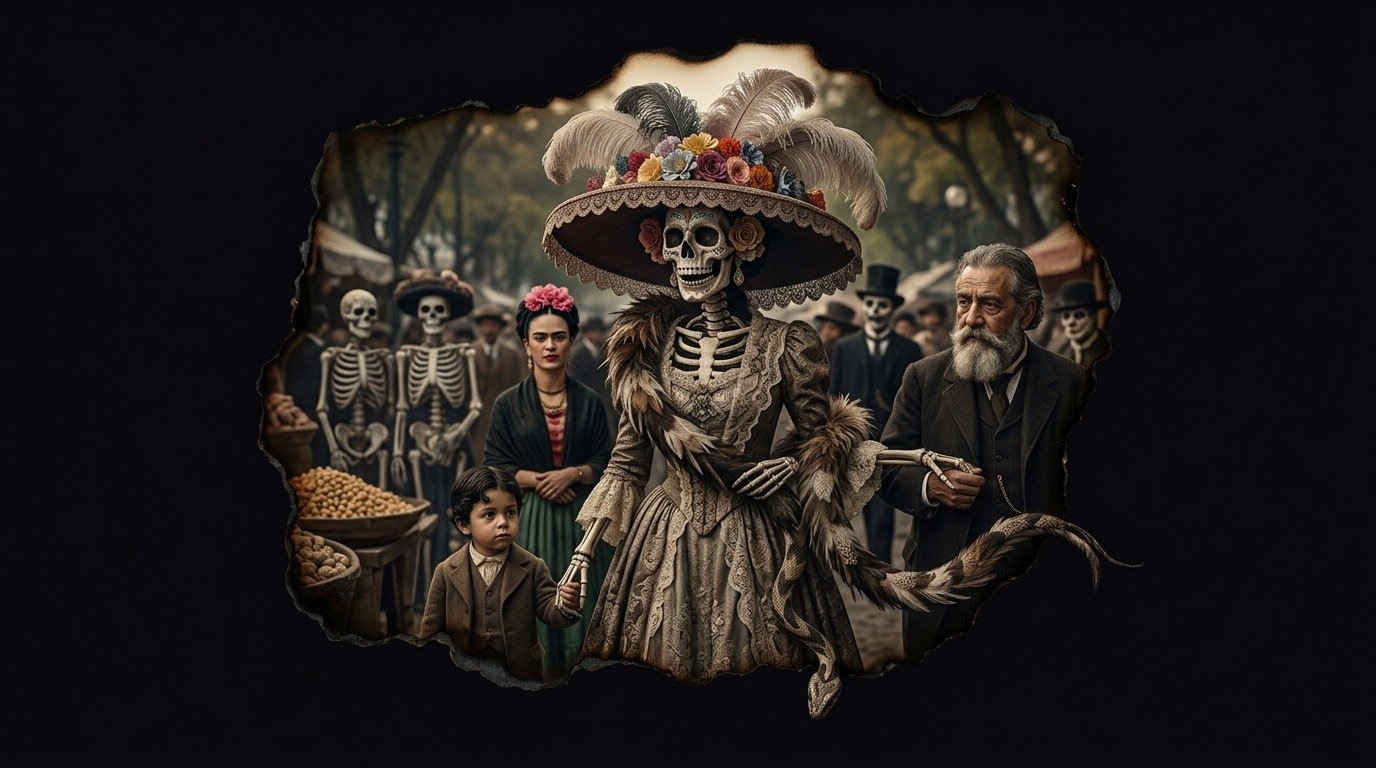
La Catrina: the elegant skull who laughs at everyone
What is La Catrina
La Catrina is a female skull dressed as a high-society lady, wearing an enormous hat adorned with feathers. She is the most famous symbol of the Day of the Dead in Mexico and around the world. But she was not born as a party decoration: she was born as a mockery. She was created at the beginning of the 20th century by the Mexican printmaker José Guadalupe Posada to make fun of those who, despite having humble roots, dressed in the European style and denied their origins. Her message is brutal and simple: beneath the expensive clothes, we are all bones.
Posada, the man who drew skulls
José Guadalupe Posada was born in Aguascalientes in 1852 and spent a good part of his life in Mexico City making prints for cheap popular newspapers. He illustrated crimes, catastrophes, miracles, executions, and, above all, skulls. In his broadsheets, the skeletons danced, got drunk, rode horses, fought, and played politics. They were the way to say out loud what the serious press did not dare to say about the rich and powerful of the Porfirio Díaz era.
Around 1910 or 1912, he published the image that would make him immortal: a female skull showing only her bust, wearing a large wide-brimmed hat loaded with flowers and ostrich feathers. He did not call her Catrina. He called her **La Calavera Garbancera**.
The garbancera: a mockery with its own name
In the Mexico of that time, "garbanceras" was the name given to indigenous or mestizo women who sold chickpeas (garbanzos) in the markets and who, upon prospering, tried to pass as European: they powdered their faces to look whiter, dressed in the French fashion, and denied their origin. Posada's skull was a satire of that eagerness: no matter how much you paint yourself, dress up, and change your last name, death is going to leave you just like everyone else.
Posada is credited with a phrase that summarizes his work: death is democratic, because in the end, blonde or brunette, rich or poor, all people end up as skulls.
Posada died in 1913, poor and almost forgotten. His garbancera skull was on the verge of being lost with him.
Diego Rivera gave her a name and a body
Decades later, the muralist Diego Rivera rescued the figure and turned her into a legend. In 1947, he painted the mural *Dream of a Sunday Afternoon in the Alameda Central*, in Mexico City. In the center of the scene, among dozens of characters from Mexican history, appears Posada's skull, now full-bodied, with a long dress and a feather boa in the shape of a serpent. At her side, Posada himself holds her arm. On the other side, a child-aged Diego Rivera takes her hand, and behind him appears Frida Kahlo.
It was Rivera who called her **La Catrina**, the female version of "catrín," the word used for an elegant and conceited man. Since then, the skull of mockery became the lady of death.
Catrina and Mictecacíhuatl
Many see in La Catrina an echo of Mictecacíhuatl, the Lady of the Dead of the Mexica, who presided over the festivals they dedicated to their deceased. There is no direct relationship: Posada was not inspired by the goddess. But the association makes sense and became popular: both are a woman made of bones who reigns over the world of the dead and who, each year, returns to look upon the living.
La Catrina today
Today La Catrina is everywhere. There are giant papier-mâché catrinas in parades, clay figures in markets, catrina parades and contests, and millions of people who every November paint their faces like skulls with flowers and dress like her. The original satire has softened, but her lesson remains intact: in the face of death there are no social classes, there is no disguise that works, and the only thing left is to laugh at her before she laughs at us.
Comments
Share information, an experience, or a source to help enrich this entry. They are automatically reviewed before being published.
Loading comments...