Poveglia Island
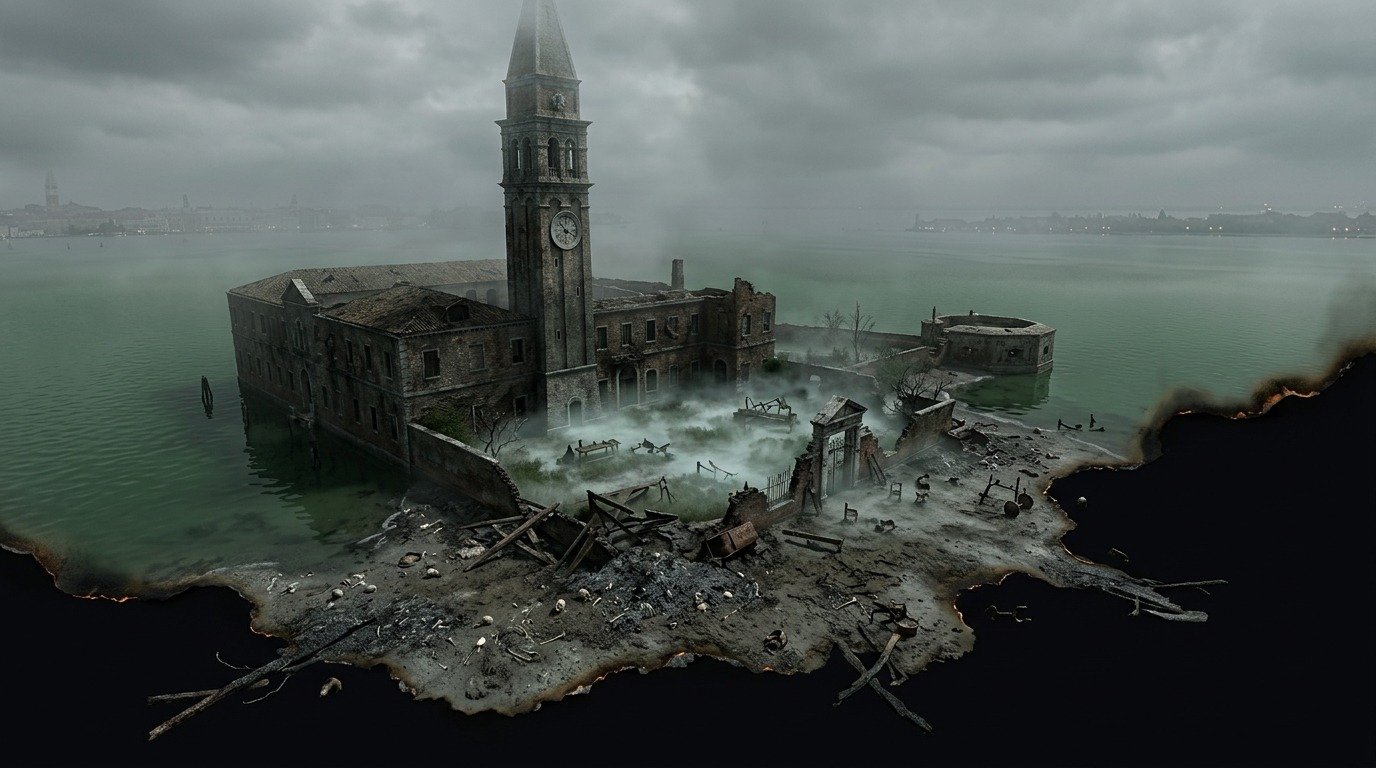
Poveglia Island: The Purgatory of Mud and Plague in the Venetian Lagoon
A Military Bastion Turned into a Mass Grave
Poveglia is a small fragment of land surrounded by the greenish waters of the Venetian Lagoon, situated between the Lido and the port of Malamocco. Its history began in the year 421, when it served as a refuge for families fleeing the barbarian invasions of the Lombards and the Huns. For centuries, it was a prosperous and fortified community, a strategic bastion for the Republic of Venice. However, its fate changed drastically in the 14th century, during the War of Chioggia, when the island was evacuated and its fortifications were transformed into an artillery octagon. The true horror of Poveglia began to take shape in 1776, when the Venice Public Health Office converted it into a checkpoint for all vessels arriving in the city. With the arrival of the Black Death, the island went from being a customs port to a "lazaretto," a forced confinement center where thousands of sick people were abandoned to their fate to prevent infection in the metropolis.
The Ashes of the Lazaretto and the Hospital of Horror
During the bubonic plague epidemics, Poveglia became a human slaughterhouse. The seriously ill, and even those who only showed mild symptoms, were dragged from their homes in Venice and thrown into the pits of Poveglia. Historical records suggest that bodies were piled up and burned on gigantic pyres to keep up with the death rate. The island's soil, according to geological and archaeological analyses conducted in the lagoon, is composed of an alarming percentage of human bone ash and decayed remains, a grayish sediment that local fishermen avoid touching with their nets. It is estimated that more than one hundred thousand people drew their last breath on that strip of land.
The horror did not end with the plague. In 1922, the existing buildings were repurposed into a psychiatric hospital, an asylum for the mentally ill and helpless elderly. The mythology of the place centers on the figure of a medical director of the institution, whose name has been erased from official records but whose cruelty remained engraved in the collective memory. This doctor, taking advantage of the island's isolation, performed lobotomies and brutal experiments using rudimentary carpentry tools in the clinic's tower. The story goes that, tormented by the spirits of the plague victims and his own patients, the doctor went mad and threw himself—or was pushed by an invisible force—from the top of the hospital tower. A nurse of the time claimed that the doctor survived the fall, but that a strange mist emerged from the ground and suffocated him in the garden.
Investigations in the Silence of the Lagoon
Poveglia has been the target of numerous paranormal investigation teams, including international television shows such as *Ghost Adventures*. Those who have managed to step onto its crumbling docks describe an almost physical atmospheric oppression, a heaviness that makes breathing difficult. Testimonies agree on hearing distant wails, rhythmic banging mimicking the sound of the old church bells (whose clapper was removed decades ago), and gusts of freezing wind in completely closed rooms.
Skeptics and Venetian historians warn that many of the stories about the psychiatric hospital and the sadistic doctor have been embellished by contemporary horror literature to feed tourist morbid curiosity. They argue that the 1922 building functioned primarily as a home for the elderly and convalescent, and that the lack of detailed medical records from the period makes it impossible to confirm the existence of large-scale neurological experiments. Nonetheless, no one disputes the archaeological reality of the plague mass graves, confirmed by excavations on neighboring islands such as Lazzaretto Nuovo and Lazzaretto Vecchio, which demonstrate the magnitude of the health tragedy that ravaged the lagoon.
Ruina and restriction
Today, Poveglia Island is completely abandoned, and the Italian government bans access to the general public. The hospital buildings, kitchens, laundry, and chapel are in a state of imminent collapse, overgrown with weeds and trees sinking their roots into the ashen soil. Although in 2014 the Italian state attempted to auction the island for tourism development and the construction of a luxury hotel, the project failed due to public backlash and the immense cost of restoration. Poveglia remains a forbidden territory, a stain of pain and silence watching from a distance over the Malamocco canal.
Comments
Share information, an experience, or a source to help enrich this entry. They are automatically reviewed before being published.
Loading comments...