Pluckley, the most haunted village in England
Pluckley: Mist, whispers and the record of fear in Kent
The idyllic corner of the Kent countryside
Pluckley is a small village in the county of Kent, in southeast England, known for more than seventy years as "the most haunted village in England." Depending on who tells it, between ten and seventeen ghosts roam its lanes, its church, its pub and its woods: a highwayman run through with a sword, a lady buried with a red rose on her breast, a man who screams in a clay pit, an old woman who burned alive by a bridge. In 2025, an academic study traced the origin of every one of those stories and reached a surprising conclusion: behind almost all of them stands a single man.
At first glance, Pluckley looks like the setting of a Victorian postcard. Surrounded by orchards, ancient woods and gentle hills, it keeps the red-brick architecture and clay-tiled roofs that evoke an unbroken peace. Its written history began in 1086, when it was recorded in the Domesday Book under the name Pluchelei. Behind its ivy-covered facades lies a cursed geography. In 1989, the Guinness Book of Records mentioned it as the village with the most ghosts in England; it was never an official record, because such a thing cannot be measured, but the mention was enough to burn Pluckley's reputation into British folklore.
The shadows of the crossroads and the woods
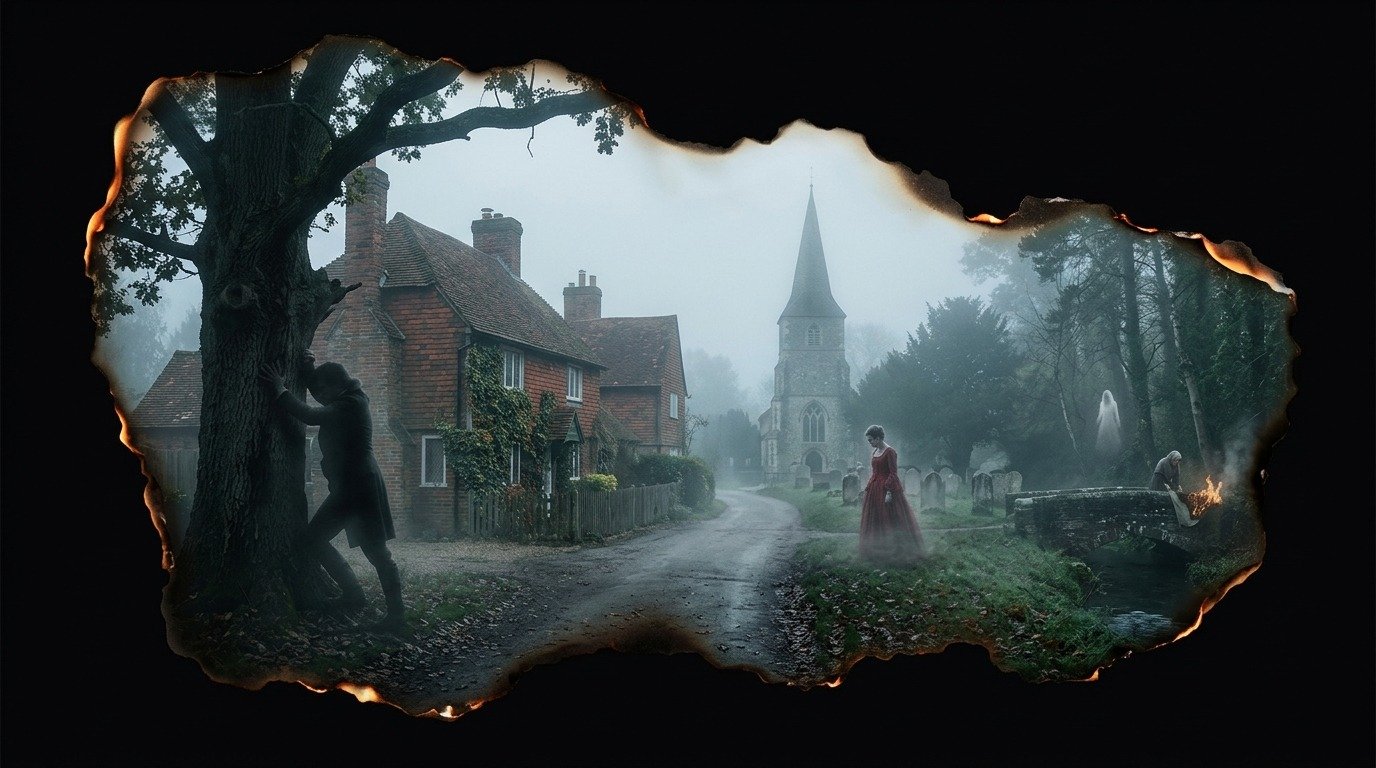
Pluckley's apparitions are not confined to a single house or a cemetery; they seem woven into the very fabric of the land, appearing on country lanes, in taverns and at corners the locals prefer to avoid after nightfall. One of the most famous spots is "Fright Corner," a bend in the road where, according to legend, a highwayman lay in wait for travelers hidden in the hollow of an old oak, until he was discovered and killed, run through with a sword against the tree itself. Modern versions give him a name, Robert Du Bois, and place him in the eighteenth century; travelers claim to see the silhouette of a man reenacting his death throes, trapped in an eternal replay of his last fight.
Not far away, in the churchyard of St. Nicholas, wanders the "Red Lady," a woman of the aristocratic Dering family, owners of much of Pluckley since at least the sixteenth century. The story goes that she was exceptionally beautiful and that, when she died, her husband laid her in the family vault with a red rose on her breast, inside a coffin of seven layers of lead so that her body would not decay. Later versions added that her specter searches for the unmarked grave of a stillborn child. Her counterpart, the "White Lady," another woman of the same dynasty, haunts the site where Surrenden Dering, the family mansion, once stood before it was destroyed by fire in 1952. In the early twentieth century it was leased by the American millionaire Walter Winans, a big-game hunter and Olympic shooting champion, who, as the tale goes, sat up one night in the library to confront her: when she appeared, he fired his revolver at her, and the bullets passed through her as she vanished through a shelf. A local man's mother, who worked at the mansion at the time, used to say the lady had died falling down the nursery staircase on her way to bid her children goodnight. Her silhouette, they say, can still be seen against the trees that now cover the site.
The gallery of lost souls also includes real tragedies, with names and dates. The "Screaming Man" of the old clay pit at the brick and tile works, whose wail is said to still echo on windy evenings, has a documented origin: on January 1, 1899, Richard Bridgland, aged 35, was digging clay with two companions when part of the pit wall collapsed on him; he was quickly dug out, but his neck was broken. He left a widow and five children. The old watercress seller who appears wrapped in flames, crying for help near a bridge, was real too: her name was Sarah Sharp, and in August 1911 her charred body was found by the roadside between Smarden and Pluckley; her clothes had caught fire, probably from her own lit pipe. And then there is the hanged man of Dicky Buss's Lane, the path that climbs to Mill Hill between a stand of laurels the village has called "the Haunted Laurels" ever since: in August 1919, the old miller Richard Buss was walking through the grove when he walked face-first into the body of a man who had been hanging from a tree for weeks. Tradition says he was the schoolmaster. He was not.
The list is completed by the ghost of the Mill Hill windmill, seen sometimes dressed in white and sometimes in black (the mill finally burned down after a lightning strike in 1939); the Colonel who hanged himself in Park Wood, whose path villagers avoided at night; the lady of Rose Court, who poisoned herself in that house; and the Devil's Bush, a stump in Dering Wood around which you only had to circle while reciting the right rhyme (three times and backwards, according to locals) for Satan himself to appear.
Who created the ghosts of Pluckley
There is a detail that bothers anyone who looks into the village: no old guidebook mentions its ghosts. Neither the memoirs of the Reverend Ashton Oxenden, who was vicar of Pluckley for twenty years (published in 1891), nor the travel books on Kent from 1907, 1921 and 1924 mention a single apparition in the village. Suspicions grew over the years. In 2000, the actor and BBC radio presenter Desmond Carrington, who lived in Pluckley in the 1950s, told a newspaper that he and a journalist had made up almost all the stories for a TV Times feature. Other residents said locals told the tales to journalists at the Black Horse pub in exchange for free beer.
In 2025, researcher Simon Moreton, a professor at the University of the West of England (UWE Bristol), published in the academic journal Folklore (volume 136) the most thorough study on the subject to date. He went through newspaper archives, death certificates, parish registers and censuses, and found that the first written version of almost all of Pluckley's ghosts came from the pen of Frederick William Thomas Sanders (1908-1996), a man born in the village who worked at the Chatham dockyards, wrote about Kent's history and dialect, and described himself as a "ghost hunter." Sanders began searching for specters in 1939: on July 24 of that year, the Daily Herald published an account of his midnight vigil at St. Nicholas Church, the earliest known written mention of a Pluckley ghost. In December 1950 he published an article in the Kentish Express listing nine ghosts and Satan himself, and it was there that he called Pluckley, for the first time, "the most haunted village in England." In 1955 he added his childhood memoir, Pluckley Was My Playground.
But Sanders did not invent the stories: he collected them. The Red Lady came from his grandfather, Jesse Pile, whose family had kept it to themselves for years; the watercress seller, from his grandmother; the Colonel, from his schoolteacher, Henry Turff. And Carrington, in his famous 1962 feature, actually retold Sanders's ghosts and added only three: the phantom coach and horses heard on the lanes, the monk of a house called Greystones, and a poltergeist at Surrenden Dering. Those three, according to Moreton, were almost certainly his own inventions. After that, the ghost books of the 1970s kept adding more: a poltergeist at the Black Horse pub, a woman in modern dress in the churchyard, another poltergeist at Elvey Farm. By the early 1980s there were at least seventeen.
The most unsettling finding concerns the hanged man. The man of the Haunted Laurels was not a schoolmaster: his name was Henry Edgar Martin and he worked at a paper mill in neighboring Little Chart; his body was found on August 15, 1919. Sanders confused him with Harry Martin, a Smarden schoolmaster who took his own life in 1923 by drowning himself in a pond, and merged the two into a single story. That mistake has been copied in every book published since. The same happened with the lady of Rose Court: the tales turned her into the mistress of a Tudor-era Dering who poisoned herself with ivy berries, but the woman who died in that house was Mary Ann Bennett, aged 31, on August 8, 1862, of an opium overdose, after two years of illness. And the Black Horse ghost, which according to the pub's landlady in 1973 made objects disappear and sent vases flying across the bar, was blamed on a murdered woman; the actual record tells of a man, Jesse Spicer, who in 1772 was dealt a fatal blow to the head while two other men were bowling for a wager in the pub's yard. It was an accident.
There are more twists. Sanders never claimed to have seen a ghost: in fact, he himself debunked the lights and noises he had recorded in the church (they were a car's headlights and his own breathing). And during his research, Moreton discovered that Sarah Sharp, the watercress seller, was a distant cousin of his. His study does not try to prove that Pluckley's ghosts are false: it shows how a legend is born, from one family's memories to the pages of a newspaper, and from there to books, television and the internet.
The tension between myth and village peace
The controversy is not merely academic, but intensely local. The people of Pluckley have an ambivalent relationship with their ghosts. In the early 1990s, Halloween nights turned into a nightmare of vandalism, with hordes of curious visitors invading St. Nicholas churchyard and blocking the streets. Local police had to set up roadblocks, and the landlords of the famous Black Horse pub, where floating glasses and gusts of icy air are reported, had to close their doors on key dates to protect the peace of the community. Skeptics argue that the wind from the English Channel, seeping through the valleys of Kent, is the real culprit behind the noises and whispers that visitors mistake for lost souls.
The village today
Today, Pluckley is still a living village, protective of its quiet but aware of its legend. Respectful tourists can still walk through Fright Corner or have a beer at the Black Horse, under the watchful eye of regulars who would rather not say too much about what happens when the mist settles over the hop fields. Dering Wood, popularly renamed by visitors as the "Screaming Woods," is still there, closed off at night under the whisper of branches that, for many, hide laments that do not belong to this world.
Comments
Share information, an experience, or a source to help enrich this entry. They are automatically reviewed before being published.
Loading comments...