Armageddon
Armageddon: The Battlefield Where History Will Die
Armageddon is the place where, according to the prophecies of the Book of Revelation, the final battle between the forces of light and the armies of darkness will be fought at the end of days. This confrontation is not presented as an invisible spiritual conflict, but as an armed and geographical clash in which the rulers of the entire Earth, influenced by spirits of demonic origin, will gather their troops to fight directly against the Messiah and his heavenly army.
The term comes from the Hebrew *Har Megiddo*, which means "Mount Megiddo," a fortified hill located in northern Israel, in the Jezreel Valley. Biblical scriptures point out that this plain, historically covered in blood due to countless military campaigns of antiquity, will serve as the geographical funnel where human pride will gather for its ultimate destruction under the weight of divine judgment.
The Herald of the Frogs and the Rift in the Euphrates
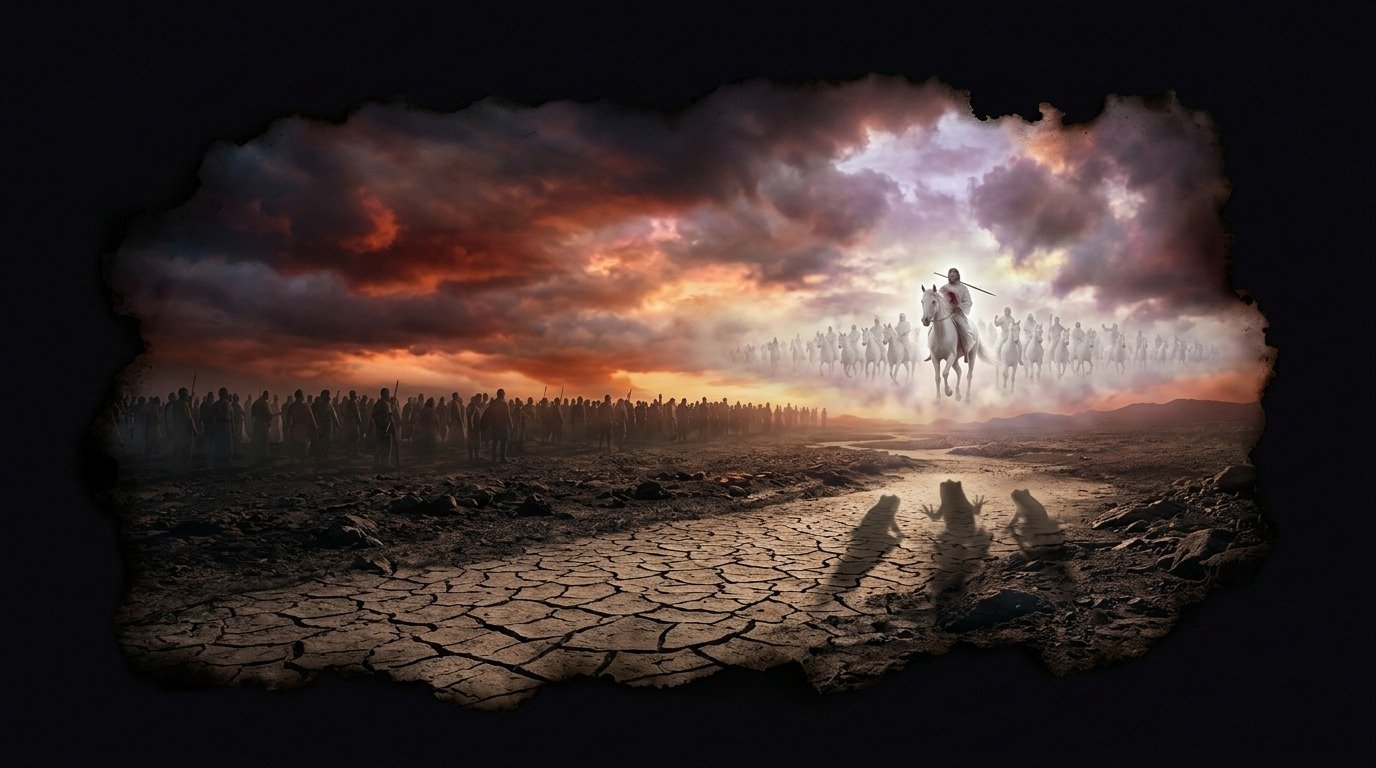
Chapter sixteen of Revelation details the precise sequence leading to this confrontation. The sixth angel pours out his bowl of wrath upon the great river Euphrates, causing its waters to dry up completely. This event aims to open a direct route so that the "kings of the east" can march with their armies westward without natural obstacles. The disappearance of the river acts as the first tactical move on the chessboard of the end-of-the-world war.
Immediately after, from the mouth of the Dragon, from the mouth of the Beast, and from the mouth of the False Prophet emerge three unclean spirits resembling frogs. These beings perform miraculous signs and travel to all the courts and governments of the Earth with a specific purpose: to summon the political and military leaders of the world to unite in a global coalition against the sovereignty of God. The rulers of the nations, blinded by these spiritual manifestations, accept the call and begin the largest military mobilization in history, concentrating their divisions in the vicinity of Megiddo.
When the armies are positioned on the plain, the heavens open and a white horse appears, whose rider is called Faithful and True. His eyes are like flames of fire, he wears many crowns on his head, and he is clothed in a robe dipped in blood. From his mouth comes a sharp sword with which to strike down the nations, and behind him follow the heavenly armies mounted on white horses. The battle concludes without giving any opportunity for a military defense: the Beast and the False Prophet are captured alive and thrown into the lake of fire, while their immense armies are destroyed by the word of the heavenly rider.
The Bloody Stones of Megiddo
The choice of Megiddo as the setting for the end of times was not an arbitrary decision by the author of Revelation. This hill dominates the strategic pass of the *Valley of the Kings*, the commercial and military route that connected the ancient empires of Egypt, Syria, Mesopotamia, and Anatolia. Whoever controlled Megiddo controlled the passage between continents. Due to this strategic importance, the area witnessed decisive battles for more than three thousand years.
There, Pharaoh Thutmose III defeated a Canaanite coalition in the 15th century BC in the first battle documented in detail in human history. There also died King Josiah of Judah while trying to halt the advance of Pharaoh Necho II in the year 609 BC, an event that plunged Jerusalem into mourning and despair. For the Jewish mind of the first century, Megiddo was synonymous with carnage, the clashing of empires, and national tragedies. It was the logical place where the conflict between earthly powers and divine power had to be resolved, once and for all.
From the Dust of Galilee to the Nuclear Button
For centuries, Armageddon was interpreted as a physical battle that would imminently occur in the geography of Palestine. During the Crusades, European knights marching toward Jerusalem gazed upon the Jezreel Valley with the conviction that at any moment the heavens would open to join their fight against the forces of Islam. However, after the fall of the Crusader kingdoms, the physical interpretation of the battle gave way to more symbolic visions within Catholicism, which saw in Armageddon the internal struggle of the Church against sin and heresy.
The concept experienced a literal revival in the twentieth century, especially after the invention of nuclear weapons and the creation of the State of Israel in 1948. Sectors of American evangelical Protestantism reformulated the prophecy, arguing that Armageddon would not be a battle with swords and horses, but a global thermonuclear conflict where the Soviet Union (and later China or other Eastern coalitions) would invade the Middle East, provoking the intervention of Western powers and culminating in the armed self-destruction of humanity just before the return of Christ.
The Silence on the Hill
Despite the constant use of the term in contemporary political and military rhetoric to describe the possibility of a nuclear catastrophe, the Jezreel Valley remains today a fertile and peaceful agricultural valley. The archaeological site of Megiddo is a tourist destination where archaeologists excavate the ruins of twenty superimposed cities, seeking to understand the past rather than anticipate the end.
Armageddon has not yet summoned the kings of the Earth. However, its name has become independent of the biblical text to become the universal metaphor for the worst-case scenario: the moment when humanity's technological and military ingenuity surpasses its capacity for moral restraint, unleashing a destruction that no army will be able to win.
Comments
Share information, an experience, or a source to help enrich this entry. They are automatically reviewed before being published.
Loading comments...