Rapture
Rapture: The Silent Disappearance of the Chosen
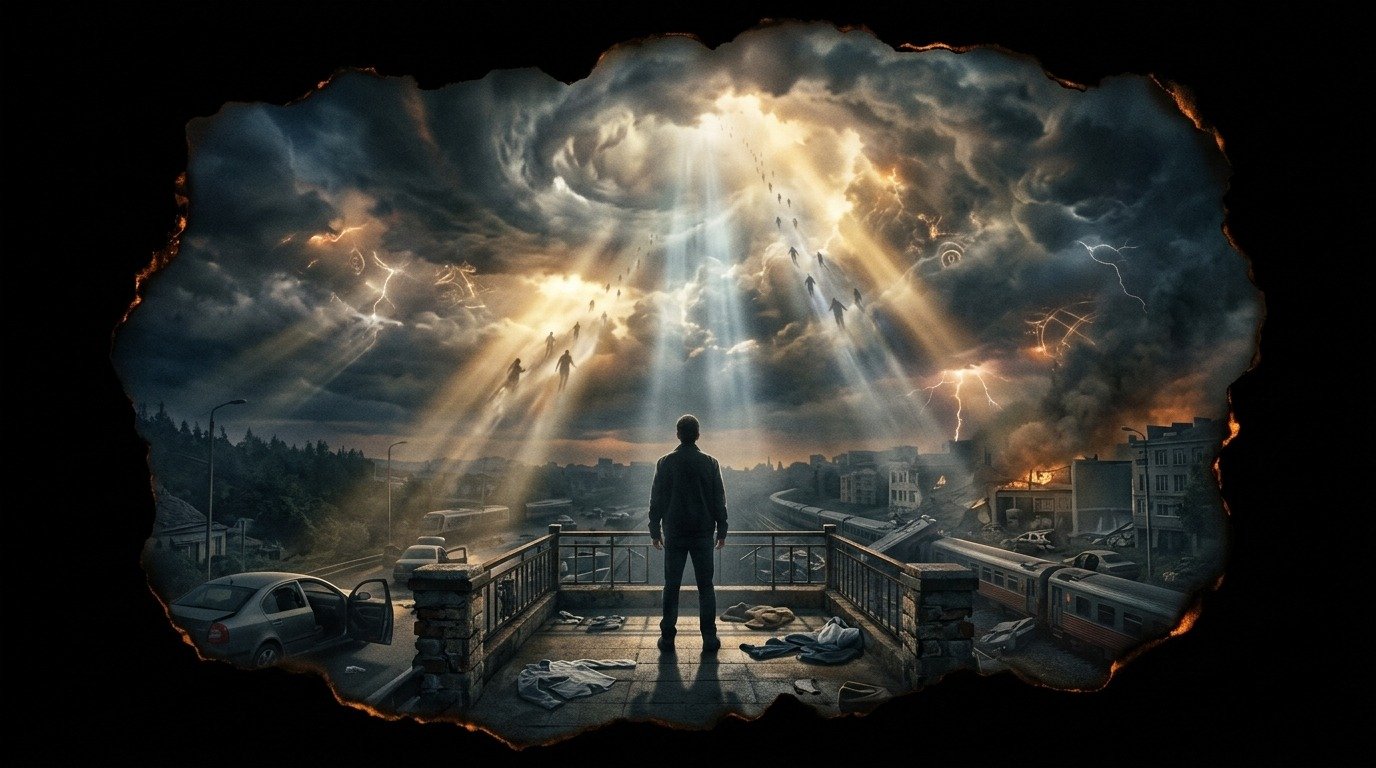
The Rapture, also known as the Catching Away, is a Christian eschatological doctrine of modern origin which holds that, before the destructive judgments of the Great Tribulation begin on Earth, Jesus Christ will descend from heaven invisibly to rescue his faithful. In a fraction of a second, millions of devout Christians, both the living and the newly resurrected dead, will physically disappear from the planet, ascending into the air to meet their Savior in the clouds and be taken directly to heaven. This event will leave the rest of humanity plunged into absolute and baffling chaos. Christian airplane pilots will vanish from their cockpits, train engineers and car drivers will leave their vehicles drifting, and entire families will discover that their loved ones have vanished from the dinner table, leaving behind only their clothes, jewelry, and dental fillings. This social and political vacuum will facilitate the rise to power of the Antichrist, who will unify the planet under his dictatorship.
In the Twinkling of an Eye
The biblical basis used by proponents of this doctrine is found primarily in Paul's First Letter to the Thessalonians, chapter four, where the apostle writes that the Lord will descend from heaven with a shout, the dead in Christ will rise first, and then the living will be "caught up together with them in the clouds to meet the Lord in the air." Rapture theologians complement this passage with Paul's words in the First Letter to the Corinthians, where he states that "we shall not all sleep, but we shall all be changed, in a moment, in the twinkling of an eye, at the last trumpet." According to the dispensationalist sequence, the Rapture occurs in absolute secrecy from the rest of the world. Unlike the Second Coming, where Christ physically descends to set foot on the Mount of Olives in a public and visible manner to all nations, in the Rapture Christ does not touch the Earth; he remains suspended in the clouds. Unbelievers will only perceive the collateral effects of the mass disappearance of people and the subsequent wave of panic, accidents, and global bewilderment. For those left behind on Earth, the Rapture marks the beginning of a seven-year period of tyranny and catastrophes known as the Great Tribulation. During this time, the world's governments will integrate into a single economic and political system under the control of the Beast, who will force everyone to receive a mark on their right hand or on their forehead in order to buy or sell. Those who convert to Christianity after the Rapture will face relentless persecution and execution by beheading.
The Origin of a 19th-Century Doctrine
Despite its immense popularity today, the "pretribulation" Rapture doctrine (the rescue of believers before the sufferings of the Apocalypse) was completely unknown to the theologians of the early Church, the Middle Ages, and the Protestant Reformation. For nearly eighteen centuries, mainstream Christianity taught that believers had to go through the trials of the end of the world and that the resurrection and judgment would occur in a single public event at the end of time. The modern framework of the Rapture was formulated in the 1830s by John Nelson Darby, an influential leader of the Plymouth Brethren in the United Kingdom. Darby developed a system of Bible interpretation called dispensationalism, which divided the history of God's relations with humanity into distinct eras or "dispensations." Darby argued that God had two distinct plans: one for the nation of Israel and another for the Christian Church. In order for God to resume his historical plan with the Jewish people during the Tribulation, the Church had to be completely removed from the Earth, giving rise to the concept of the secret rapture.
The Scofield Bible and Seventies Pop Culture
Darby's doctrine quickly crossed the Atlantic and found highly fertile ground in the United States. The key factor in its mass propagation was the 1909 publication of the *Scofield Reference Bible*, an edition that included explanatory notes in the margins presenting dispensationalism and the Rapture as indisputable truths directly associated with the sacred text. This Bible became the study standard for thousands of theological institutes and evangelical preachers across the country. In the second half of the 20th century, prophecy jumped from the ecclesiastical realm into mass entertainment. In 1970, writer Hal Lindsey published *The Late Great Planet Earth*, a book that connected Cold War tensions and the creation of the State of Israel with the imminence of the Rapture, selling tens of millions of copies. Decades later, the fictional novel series *Left Behind*, written by Tim LaHaye and Jerry B. Jenkins, turned the experience of those left behind on Earth after the Rapture into a multi-million dollar publishing phenomenon, adapted for film and definitively rooted in global popular culture.
Waiting in the Present
Rapture theology continues to be rejected by the Catholic Church, the Orthodox Church, and mainline Protestant denominations such as Lutherans and Presbyterians, who view this division of Christ's return into two stages as a modern doctrinal invention with no solid historical basis. However, for millions of people worldwide, the imminence of the Rapture is a daily driving force. Every geopolitical crisis in the Middle East, every technological advancement in digital payment systems, or every global pandemic is read as a sign that the rescue is about to happen, keeping believers in a constant state of expectation and detachment from a world they believe they are about to leave in the blink of an eye.
Comments
Share information, an experience, or a source to help enrich this entry. They are automatically reviewed before being published.
Loading comments...