Last Judgment
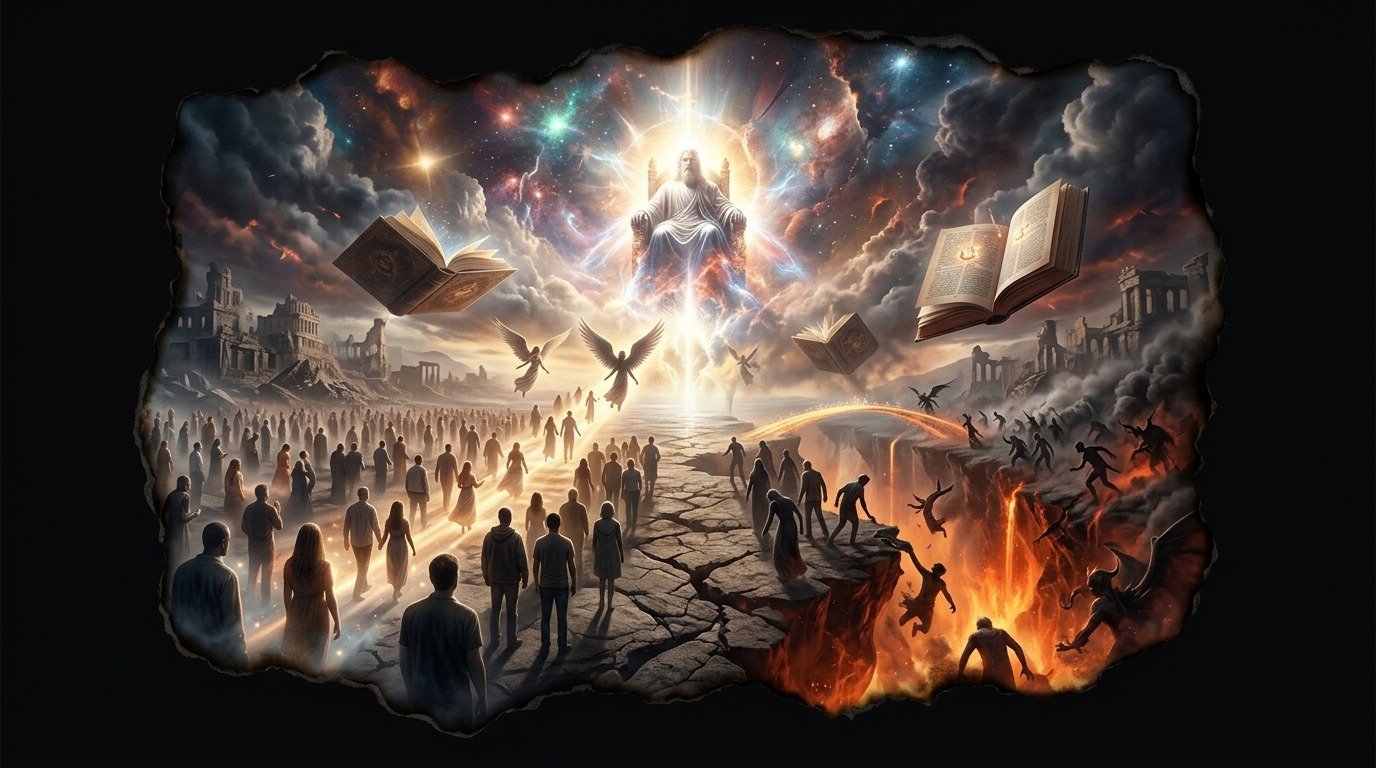
Last Judgment: The Ultimate Scale of Souls
The Last Judgment is the cosmic judicial process described by the Abrahamic religions in which God will resurrect every human being who has ever existed to evaluate their earthly actions and decree their eternal destiny. This event represents the definitive closure of human history: there will be no more births, deaths, or second chances. Those found righteous will receive immortality in a paradise free of suffering, while the wicked will be cast into an eternal punishment of fire and divine separation.
Judeo-Christian and Islamic traditions agree that this judgment occurs publicly, massively, and simultaneously. Tombs will open, the ocean will give up its dead, and corrupt bodies will reunite with their souls in an assembly of incalculable proportions. God Himself, or His messianic envoy, will preside over the court from a throne of light, opening the records where every thought, word, and deed in the history of humanity is detailed.
The Resurrection of the Dead and the Opening of the Books
The process begins with an acoustic signal that shakes the foundations of the universe. In Christian eschatology, it is the archangel's trumpet; in Islamic eschatology, the blowing of the horn of Israfil. When this call sounds, the earth will crack open, releasing the ashes and bones of billions of people from Adam to the last inhabitant of the planet. All will appear with their bodies restored, yet visibly marked by their spiritual condition: the saved will shine with their own light, while the damned will appear darkened and trembling.
In the Christian vision described in the Gospel of Matthew and the Book of Revelation, Christ descends surrounded by angels and separates people as a shepherd separates the sheep from the goats. The sheep, placed on His right, are those who showed compassion to the needy; the goats, on the left, are the selfish. In parallel, the books of life are opened, and souls are judged according to what is written in them. No one can lie or hide anything, as their own consciences and their own bodies will testify for or against them.
In Islamic tradition, the Day of Judgment (*Yawm al-Qiyamah*) includes an extreme physical test: crossing the *Sirat*, a bridge thinner than a hair and sharper than a sword that spans the abyss of hell (*Jahannam*). The souls of the righteous will cross it at the speed of lightning or the wind, sustained by the light of their good deeds, while sinners will lose their balance and fall into the roaring flames below, unless they receive divine mercy or the intercession of the Prophet Muhammad.
From the Fields of Persia to the Valley of Jehoshaphat
The idea of a definitive moral examination after death did not emerge in isolation, but developed over millennia. The earliest antecedent is found in the Zoroastrianism of ancient Persia, which as early as the first millennium BCE taught the existence of the Chinvat Bridge and a final purification of the world through a river of molten metal. During the Babylonian exile, these ideas influenced Jewish thought, which began to shape the notion of a "Day of Yahweh," a historical moment in which God would intervene to judge the nations oppressing Israel.
For the Hebrew prophets, this judgment would be staged in the Valley of Jehoshaphat, a geographical location that tradition places in the Kidron Valley, between the Mount of Olives and the eastern wall of Jerusalem. With the birth of Christianity, the figure of the judge shifted directly to Jesus Christ, and the judgment ceased to be a purely national victory for Israel, becoming instead a universal and individual verdict on the soul of every man and woman on the planet.
The Terror That Shaped Art and Law
During the Middle Ages, the fear of the Last Judgment became the most powerful tool of social and moral cohesion in Europe. The portals of Gothic and Romanesque cathedrals sculpted the scene of the judgment in stone so that every person entering the temple would remember their destiny: to the viewer's left, grotesque demons dragging chained kings, bishops, and peasants toward the mouth of a monster representing hell; to the right, angels guiding the chosen toward the heavenly gates.
In the sixteenth century, Michelangelo captured this collective anguish on the altar wall of the Sistine Chapel. His *Last Judgment* shows a young, athletic, and wrathful Christ, whose raised arm seems to dictate an implacable sentence that shakes saints and sinners alike. The work reflected an era of deep spiritual crisis, marked by the rupture of the Church and the wars of religion, where the certainty of salvation had vanished and only the fear of the divine scale remained.
The Verdict of History
Although thousands of generations have lived under the shadow of the imminence of this tribunal, the day of collective physical resurrection has not occurred. The world's cemeteries continue to house the remains of the deceased, and the Valley of Jehoshaphat remains a stone cemetery under the Jerusalem sun.
Despite this, the mental framework of the Last Judgment survives in a secularized form. The concept that human history has a moral direction and that, at a final point, evil will be exposed and the disadvantaged will receive justice, remains the conceptual basis of many modern legal systems and philosophies of history that seek a just outcome for the human adventure on Earth.
Comments
Share information, an experience, or a source to help enrich this entry. They are automatically reviewed before being published.
Loading comments...