Four Horsemen of the Apocalypse
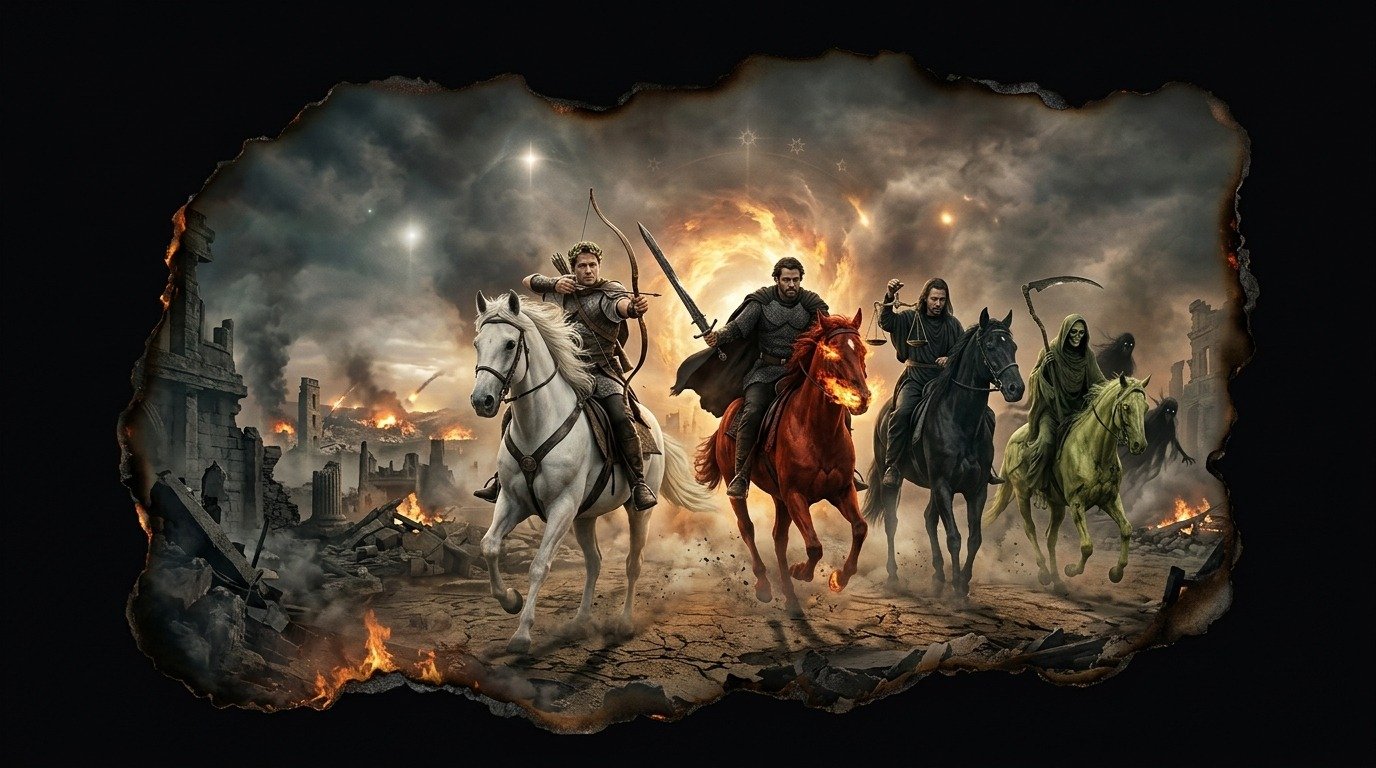
The Four Horsemen of the Apocalypse: the heralds who unleash the final destruction
At the end of the first century, on the Greek island of Patmos, a Christian exile named John wrote a vision of the end of the world that included four horsemen on horses of different colors. The biblical text of Revelation details that these horsemen represent conquest, war, famine, and death, and that they receive the power to destroy a fourth of the Earth's population through plagues and swords. La prophetic scene begins when a lamb with seven horns and seven eyes opens the first four seals of a sacred scroll. With the opening of each seal, a living creature with a voice of thunder commands: "Come." One by one, the horsemen burst onto the world stage to dismantle human civilization before the final judgment, acting consecutively so that the disaster is total.
The executors of divine judgment
The first horseman rides a white horse. He carries a bow in his hand, receives a crown, and rides out as a conqueror bent on conquest. Although some medieval interpreters saw in him a representation of the spread of the Gospel, most traditions identify him as the personification of military conquest or the deceptive victory that precedes open violence. Immediately afterward, the second horseman appears on a horse red as fire. This warrior is granted a great sword and the power to take peace from the Earth, causing human beings to kill one another in civil conflicts and global wars. The third horseman rides a black horse and holds a pair of scales in his hand. A voice among the living creatures announces exorbitant prices for wheat and barley, but commands not to damage the oil or the wine. This image describes a devastating famine where basic foods become inaccessible to the common citizen, while luxury items are preserved, showing a profound inequality before the collapse. The fourth and final horseman rides a pale horse, of a yellowish color associated with decaying corpses. His name is Death, and Hades, the realm of the dead, follows close behind. This horseman is given authority over a fourth of the Earth to kill with sword, with hunger, with plague, and by the wild beasts of the earth.
The historical origin on the island of Patmos
The author of the vision, John of Patmos, wrote this text during the reign of the Roman emperor Domitian, around the year 95 of our era. At that time, Christian communities were suffering persecution, and the Roman Empire seemed like an unstoppable and destructive force. The symbols used by John reflected real and everyday threats of his time. The rider of the white horse, with his bow, recalled the feared Parthian archers, the only border enemies that Rome had been unable to subdue. The red horse represented constant internal rebellions, the black alluded to crises of inflation and poor harvests under Domitian's decree on vineyards, and the pale embodied the recurring plagues that decimated the port cities of the Mediterranean.
The echo of the hooves throughout the centuries
The image of the horsemen captured the imagination of humanity during times of crisis. In the year 1498, the German artist Albrecht Dürer made a famous woodcut showing the four horsemen sweeping away clergy and peasants alike. This art spread throughout a Europe terrified by the bubonic plague, religious wars, and the widespread belief that the year 1500 would bring the end of the world. During the First World War and the subsequent Spanish flu epidemic in 1918, theologians and preachers used the figure of the horsemen to explain global suffering. The technological and military advancement of the era was interpreted as the ultimate expression of the red horse, while shortages and disease confirmed the passage of the black and pale horses.
The verdict of time
Despite the numerous occasions on which the physical passage of the horsemen was announced, history continued its course. Contemporary exegetes point out that the text of Patmos did not intend to give an exact date for the end of the world, but rather to describe the destructive forces that operate cyclically within human history when empires collapse. Today, the figure of the horsemen remains in popular culture as the definitive representation of man-made and natural catastrophes, a constant reminder of the fragility of civilization in the face of war, famine, and plague.
Comments
Share information, an experience, or a source to help enrich this entry. They are automatically reviewed before being published.
Loading comments...