Beast of the Apocalypse
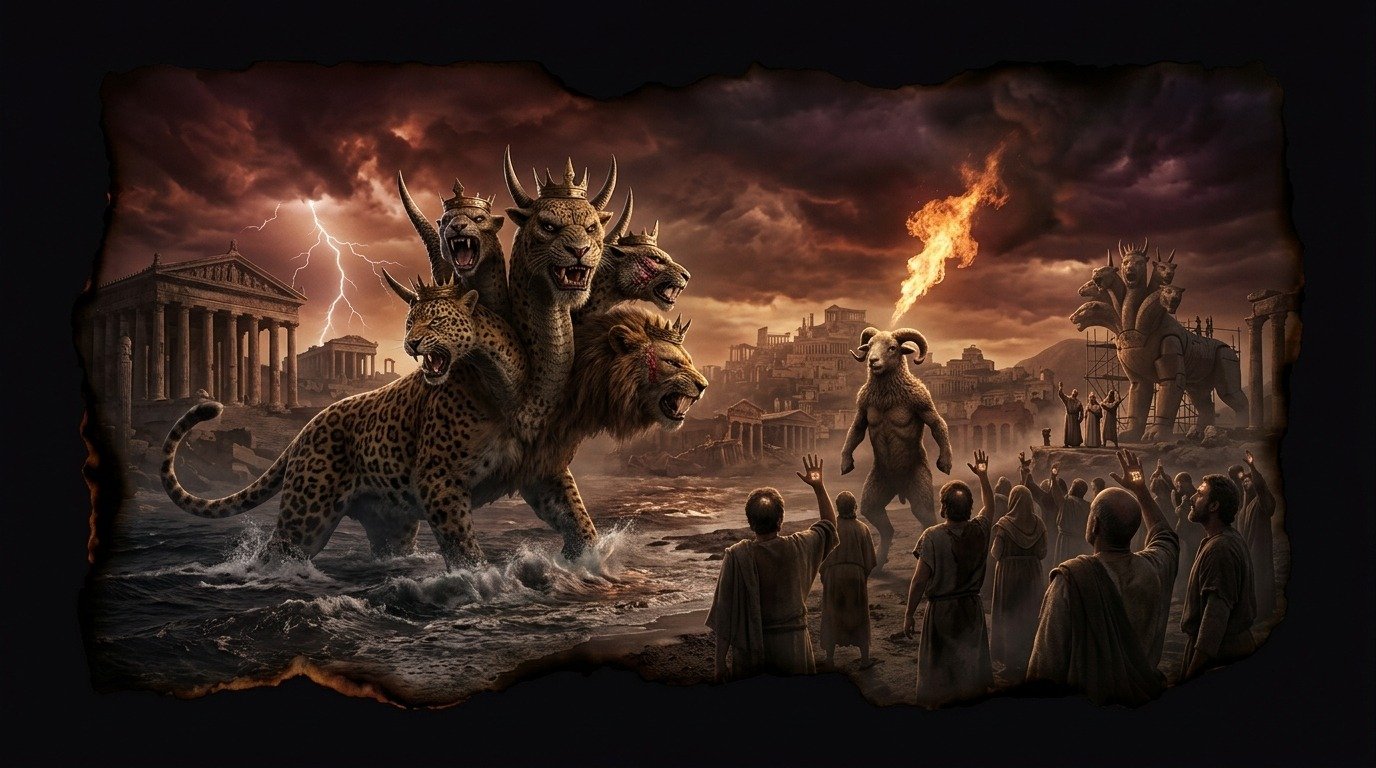
The Beast of the Apocalypse: the empire of evil and the mystery of the number 666
In the year 95 of our era, the author of the Book of Revelation described the appearance of two monstrous beasts that would take political, religious, and economic control of the planet before the final judgment. The first rises from the sea with seven heads and ten horns to rule the Earth, while the second springs from the earth and forces all inhabitants to bear a mark on their right hand or on their forehead with the number 666. This prophecy introduced the concept of a global totalitarian system in which no one can buy or sell unless they submit to the authority of the Beast. For nearly two thousand years, readers of various eras have attempted to calculate the meaning of the number 666 and have identified empires, rulers, and modern technologies as the real faces of this eschatological threat.
The two forces of the abyss
La first beast combines characteristics of a leopard, a bear, and a lion, animals that represent ancient oppressive empires in Old Testament prophecies. Its seven heads bear blasphemous names, and one of them appears to have been mortally wounded, but is miraculously healed, earning the admiration and worship of the entire world. This beast receives its power directly from the dragon, who represents Satan, and is allowed to act with arrogance for forty-two months. The second beast, also known as the False Prophet, has two horns like those of a lamb, but speaks like a dragon. Its function is purely propagandistic and religious: it performs great heavenly signs, such as making fire come down from heaven, to convince humanity to worship the first beast. Additionally, it orders the construction of an animated statue that has the power to cause anyone who does not worship it to be killed. The ultimate control mechanism is executed through the mark of the Beast. This seal, which contains the name of the monster or the number of its name, is imposed on rich and poor, free and slave. Without this mark, any individual is excluded from the basic commercial system, facing starvation or state persecution.
The numerical code of ancient Rome
Historical research places the origin of this vision in the Christian persecution under the Roman Empire. In antiquity, both the Greek and Hebrew alphabets used letters to represent numbers, a coding system known as gematria. When translating the name of the Roman emperor "Nero Caesar" into Hebrew, the sum of the numerical values of the letters equals exactly 666. If the Latin spelling of the name translated into Hebrew is used, the result is 616, a variant that appears in some of the oldest manuscripts of Revelation discovered by archaeology. The seven heads of the beast represent, according to the text itself, seven hills upon which the great corrupting city sits, a clear reference to the seven hills of Rome, and to seven emperors of the Julio-Claudian dynasty.
From the Reformation to barcodes
With the fragmentation of Christianity during the Protestant Reformation in the 16th century, the interpretation of the Beast changed drastically. Martin Luther and other reformers identified the Beast and the Papacy of Rome as one and the same entity, pointing out that the structure of the Roman Catholic Church demanded a total submission comparable to the worship required by the biblical monster. In response, Catholic theologians argued that the prophecy referred exclusively to the pagan Rome of the past or to a future dictator who would appear just before the end of the world. In the 20th century, the fear of the mark of the Beast shifted to the technological realm. With the introduction of the UPC barcode system in the 1970s, popular theories emerged pointing out that the system's guard bars concealed the number 6. Subsequently, the appearance of credit cards, RFID identification microchips, and digital currencies revived the fear of a centralized global financial control that would make the impossibility of buying or selling without state approval a reality.
The enduring relevance of a symbol of control
Despite constant predictions regarding the physical arrival of the False Prophet or the implementation of a literal mark, none of these technological interpretations has been established as the definitive fulfillment of the prophecy. Historians recall that the original text referred to Roman coins minted with the effigy of the deified emperor, which Christians of the era could not use without committing what they considered idolatry. The myth of the Beast survives as the most powerful metaphor for individual resistance against systems of state and ideological oppression that demand the total surrender of conscience and freedom in exchange for economic security.
Comments
Share information, an experience, or a source to help enrich this entry. They are automatically reviewed before being published.
Loading comments...