Saoshyant
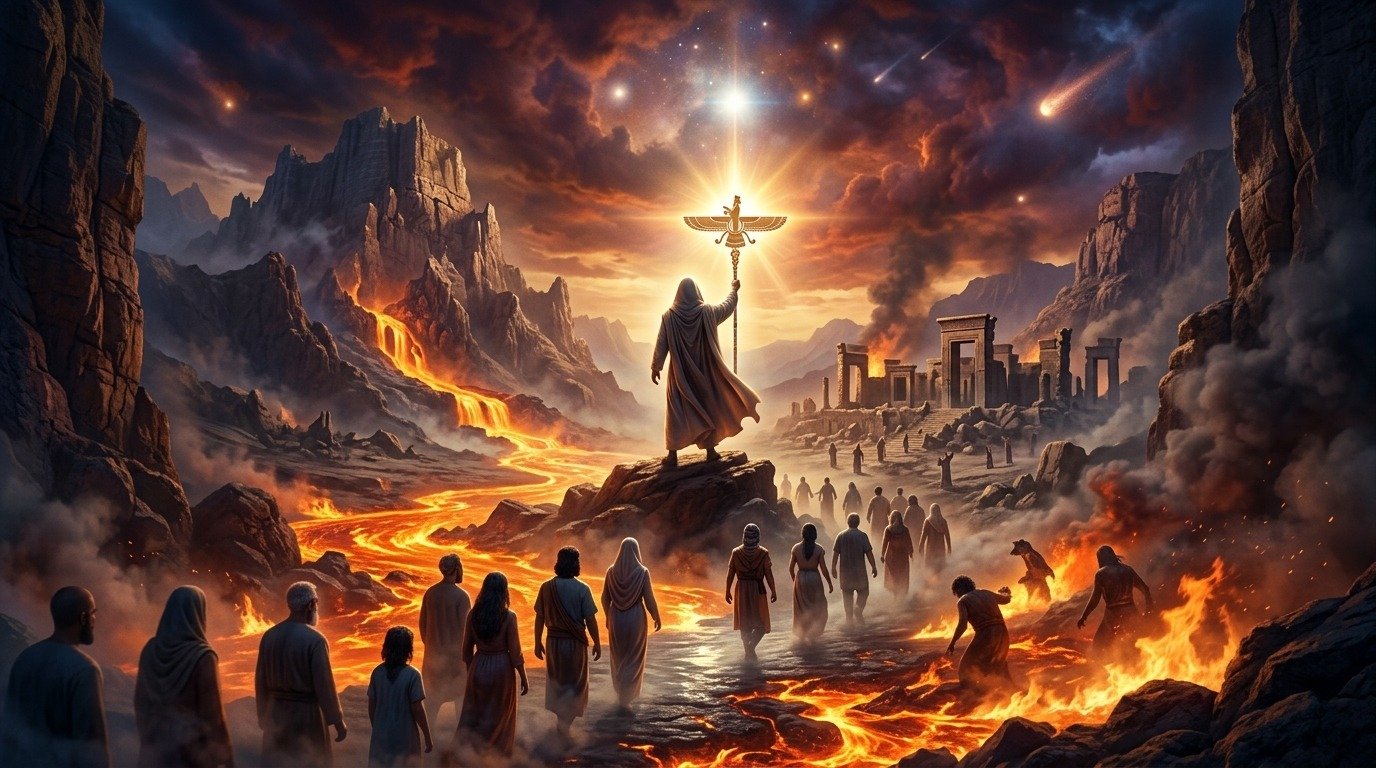
Saoshyant: The Redeemer Who Will Purify Creation with Liquid Fire
In the arid lands of ancient Persia, the prophet Zoroaster revealed a cosmic vision that would forever change the way humanity understands the end of the world. He announced the arrival of Saoshyant, the final savior who will be born of a virgin impregnated by the preserved seed of the prophet himself while she bathes in the sacred lake Kansava. Saoshyant will lead the army of the righteous in the ultimate battle against Angra Mainyu, the spirit of absolute evil, initiating the process of *Frashokereti*: the perfect restoration of the universe where death and pain will cease to exist.
Zoroastrian prophecy describes Saoshyant as the executor of the will of the supreme god of light, Ahura Mazda. His arrival will mark the collapse of the forces of falsehood, the purification of the cosmos through a river of molten metal, and the physical resurrection of all human beings who have ever walked the Earth. He is the figure who will bring an end to linear time to inaugurate an eternity of incorruptible light.
The Judgment of Metal and the Defeat of Evil
The advent of Saoshyant will trigger events of colossal proportions. According to the sacred text *Bundahishn*, a comet named Gozihr will fall to Earth, and the fire of its impact will melt the mountains, creating an immense river of liquid bronze. All of humanity, both the living and those resurrected by the power of Saoshyant, will have to cross this fiery torrent.
For the righteous, the liquid metal will feel like a bath of warm milk and will purify the last remnants of imperfection in their bodies and souls. For the wicked, the pain will be the ultimate punishment that will consume their evil to the root. Once this trial is complete, Saoshyant will offer humanity a sacred brew made from the fat of the mythical ox Hadhayans and the sacred plant Haoma, granting them eternal physical immortality.
The Legacy of Zoroaster's Revelation
The prophecies about Saoshyant were originally written in the sacred scriptures of the *Avesta*, composed over the centuries before and after the beginning of the Christian era. Zoroastrianism was the state religion of the Achaemenid, Parthian, and Sasanian empires, profoundly influencing the theological development of other religions that shared its geographical space, such as Judaism, Christianity, and Islam.
The idea of a savior born of a virgin, a final cosmic battle between light and darkness, the final judgment, and the resurrection of the flesh are concepts that the Abrahamic world adopted from the Persian vision of the Saoshyant. In this way, Zoroaster's redeemer became the invisible mold upon which the West built its own myths about the end of the world.
The Resilience of a Waning Faith
Following the Islamic conquest of Persia in the 7th century, Zoroastrianism was persecuted and marginalized, reduced to small communities in Iran and the Parsis of India. Amid this oppression, faith in Saoshyant became a beacon of desperate hope. The religion's later texts focused on detailing the signs of his arrival to comfort persecuted believers, promising them that their suffering was not in vain and that the oppressors would ultimately be destroyed.
Today, although followers of Zoroastrianism are a small minority in the world, the figure of Saoshyant remains intact in their daily liturgy. Each daily prayer before the sacred fire is an invocation to hasten the arrival of the day when the savior descends, shadows are banished forever from creation, and the light of truth reigns unopposed over a renewed Earth.
Comments
Share information, an experience, or a source to help enrich this entry. They are automatically reviewed before being published.
Loading comments...