Mahdi
The Mahdi: The Supreme Guide Who Will Purify the World Before Judgment
On June 29, 1881, on Aba Island on the Nile River, a religious leader named Muhammad Ahmad declared himself the Mahdi, the savior prophesied by Islam. Ahmad announced that the final hour was near and that his mission was to purify the faith and overthrow corrupt rulers before the collapse of the world. This figure, whose name means "the Guided One," is the eschatological figure destined to appear in the last days of humanity to restore absolute justice, rule the Earth, and set the stage for the return of Jesus Christ.
Islamic prophecy teaches that the Mahdi is not a new prophet, but rather a political and military leader arising from the lineage of Muhammad. He will appear at a time of absolute chaos, global tyranny, and moral decay, when the practice of religion is but a nominal memory. His arrival will initiate a campaign of unification lasting between seven and nine years, during which the world will experience unprecedented material and spiritual abundance, before facing the great final battle against the False Messiah, the Dajjal.
The Black Banner and Justice on Earth
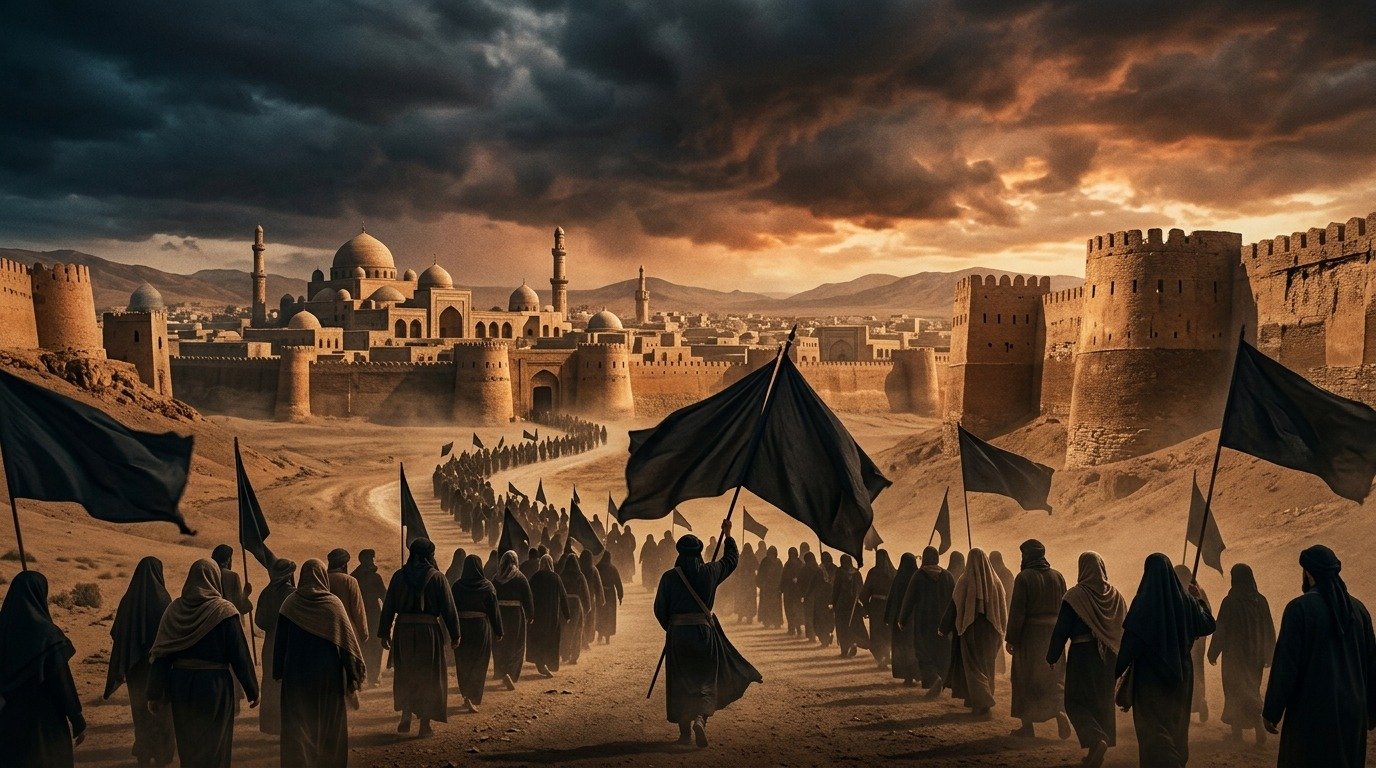
Tradition describes the appearance of the Mahdi as a sudden event. The prophetic account places his manifestation in Mecca, where believers will swear allegiance to him between the corner of the Kaaba and the Station of Abraham, even against his own initial will to assume such a burden. From the east, soldiers carrying black banners will advance to support him, uniting the community of believers under a single banner of justice.
The Mahdi will eradicate oppression at its roots. Traditional texts assert that under his rule, the Earth will release its hidden treasures and the heavens will send copious rains. There will be no poverty; money will lose its value before the immensity of shared wealth. This era of earthly splendor will serve as humanity's last breath before the trumpets of the apocalypse begin to sound.
Roots in the Sands of History
The figure of the Mahdi developed strongly after the death of the Prophet Muhammad and the internal divisions of the caliphate. Although the Quran does not mention him directly by name, the Hadiths—sayings attributed to Muhammad—and subsequent theological texts detailed his lineage, his physical appearance, and the signs of his arrival.
For Sunni Islam, the Mahdi is an as-yet-unborn leader who will emerge when God wills it. For Shia Islam, the figure is even more mystical: he is the Twelfth Imam, Muhammad al-Mahdi, who entered a state of miraculous occultation in the year 874 to escape his persecutors and will return from his invisible sanctuary when the world hits rock bottom in its own self-destruction.
The Echo of False Saviors
Throughout the centuries, the promise of the Mahdi ignited revolutions and armed uprisings. Muhammad Ahmad's movement in Sudan managed to defeat British and Egyptian forces, establishing a theocratic state that lasted until 1898. The weight of the prophecy was so real that thousands of soldiers charged against modern weapons, convinced they were fighting on the side of cosmic destiny.
In November 1979, a group of extremists led by Juhayman al-Otaybi seized the Grand Mosque in Mecca. Among them, they brought Muhammad al-Qahtani, whom they proclaimed as the expected Mahdi. The siege lasted two weeks and ended in a massacre inside Islam's holiest site. The event demonstrated that the mere mention of his name retains the power to unleash chaos and mobilize crowds willing to die for the end of times.
Belief in the Mahdi remains alive in the heart of the Islamic world. Millions of believers view the conflicts in the Middle East as the fulfillment of the signs preceding his arrival: the drying up of rivers, the fall of regimes, and the division of nations. The Mahdi remains in the collective memory as the last bastion of justice, the man who will ride at the head of the armies of light before the world closes forever.
Comments
Share information, an experience, or a source to help enrich this entry. They are automatically reviewed before being published.
Loading comments...