Cockatrice
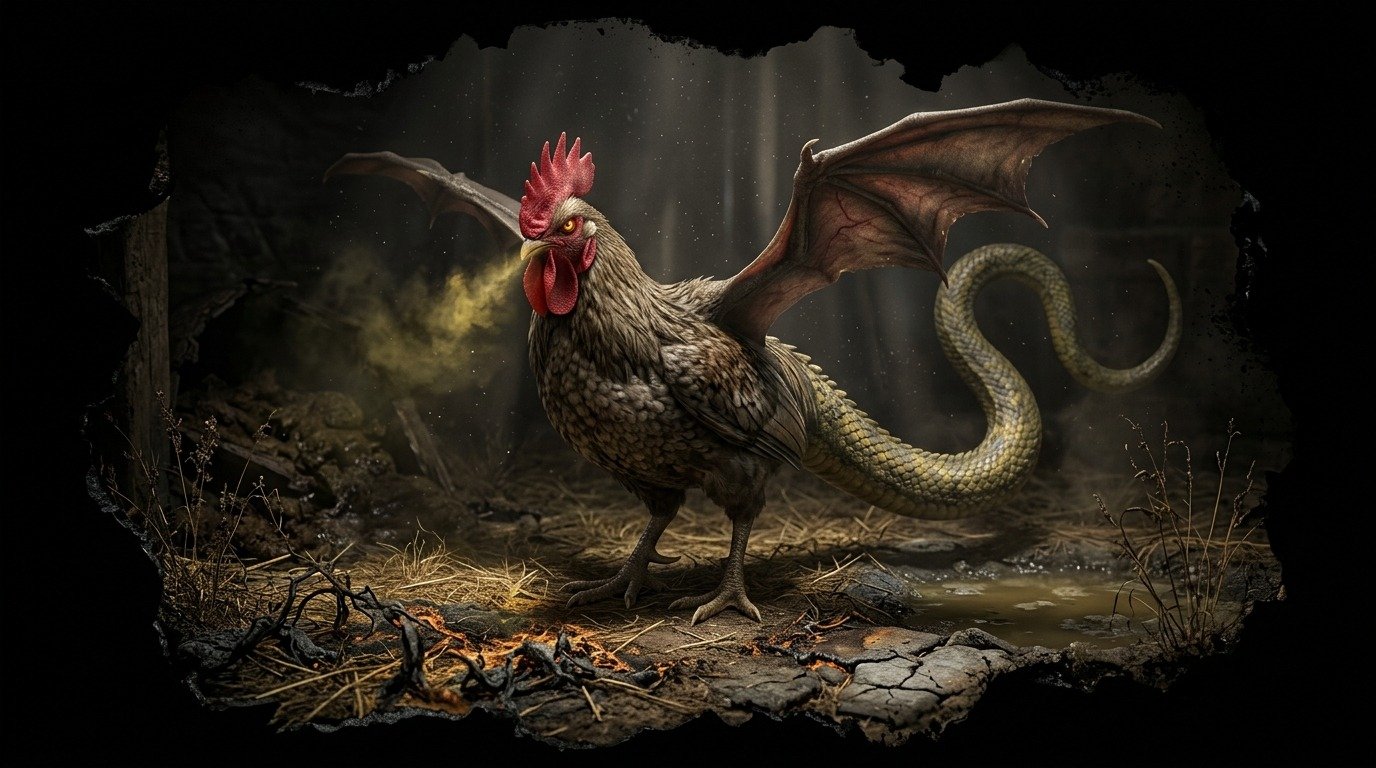
The Cockatrice: The Venom Born from the Egg of Aberration
The Egg of the Serpent and the Rooster: Genesis of an Aberration
The Cockatrice (from the Medieval Latin *calcatrix*, a translation of the Greek *ichneumon*, although its etymology and concept merged closely with the *basiliskos* or basilisk) represents the quintessence of unnatural monstrosity. Unlike the hybrids created by the gods of antiquity, the Cockatrice is the product of a corruption in nature's reproductive order, an alchemical and biological aberration. European folkloric tradition, consolidated from the twelfth century onward, details an extremely specific and terrifying gestation process for this creature. A Cockatrice can only be born under highly precise astrological and physical conditions: 1. **The Progenitor**: An old rooster, generally seven or nine years of age, must lay a shell-less egg, covered only by a leathery and damp membrane. This anomalous egg (known in English folklore as a *cock's egg*) usually lacks a yolk and is produced when the star Sirius is at its zenith. 2. **The Incubator**: The egg must be deposited in a warm dungheap or a damp, dark corner of the farm. There, it must be incubated for several weeks by a toad or by a venomous serpent (a viper or an asp). 3. **The Birth**: Upon the rupturing of the membrane, a small being emerges, yet one endowed with a concentration of cosmic venom unparalleled in the animal kingdom.
The Power of the Eye and Atmospheric Death
Physically, the Cockatrice is described as a grotesque hybrid of rooster and reptile. It possesses the head, chest, comb, and legs of a rooster, but its body ends in a long, sinuous tail of a serpent or a winged dragon, often covered in greenish or yellowish scales. Its wings are leathery, similar to those of a bat, and its gaze glows with a fiery red or a bilious yellow. The offensive arsenal of the Cockatrice does not lie in its physical strength, but in its metaphysical and chemical lethality: * **The Look of Death (*Look of Death*)**: Just like the Basilisk, the Cockatrice can kill any living being merely by staring into its eyes. This gaze acts as a beam of invisible force that disintegrates vital fluids and instantly coagulates the blood. * **The Withering Breath**: Its breath is so acidic and hot that it withers the grass in its path, burns bushes, cracks limestone, and poisons the water of nearby wells. * **The Conduction of Venom**: The creature's toxicity is so extreme that it defies the laws of physics. A story was told of a Templar knight who pierced a Cockatrice with his lance from the safety of his horse; the beast's venom traveled up the wooden shaft with such speed that it killed both the knight and his mount in a matter of seconds, leaving the lance corroded as if it had been submerged in sulfuric acid.
Hermetic Symbolism and Moral Theology
In medieval and Renaissance theology, the Cockatrice was used as the supreme symbol of hidden sin, treachery, and the "Evil Eye" (destructive envy). It represented the internal corruption that destroys its surroundings without the need for direct physical contact. Its birth from a rooster's egg embodied the inversion of natural values: the male that engenders death instead of life, incubated by the coldness of the reptile. In the realm of Hermetic alchemy, however, the Cockatrice possessed an operational value of great importance. The so-called "Basilisk or Cockatrice Ash" was a legendary ingredient used in the transmutation of metals, specifically in the preparation of Spanish gold (*Spanish Gold*). To obtain it, the creature had to be hatched under controlled laboratory conditions, fed with viper flesh for a lunar cycle, and then burned in a sealed clay crucible until reduced to fine ashes. These ashes were capable of penetrating the atomic structure of copper to bestow upon it the physical and spiritual properties of pure gold.
Defenses, Vulnerabilities, and Methods of Containment
Despite its divine power of destruction, the Cockatrice possessed three specific weaknesses that folklore took care to record as the only effective survival protocols: 1. **The Mirror of Reflection**: Since its own gaze was the source of its lethal power, if a Cockatrice looked at itself in a mirror or a perfectly polished metallic surface, its gaze was reflected back at it, killing it instantly by its own venom. Cockatrice hunters of the fourteenth century used to wear polished silver plate armor for this purpose. 2. **The Rooster's Crow**: The sound of a common rooster's crow caused violent convulsions in the Cockatrice that ended in its death by cardiac or cerebral collapse. Travelers crossing areas suspected of harboring these creatures used to carry roosters in wicker cages to use them as alarms and sonic defense weapons. 3. **The Weasel and the Rue**: The weasel was the only animal capable of physically fighting the Cockatrice and defeating it. If the weasel was bitten or poisoned during the combat, it would temporarily retreat to eat rue leaves (the herb of grace, immune to the beast's venom), which neutralized the poison and allowed it to return to the fight to bite the creature's neck and suck its corrupt blood until it died.
Comments
Share information, an experience, or a source to help enrich this entry. They are automatically reviewed before being published.
Loading comments...