Eastern Dragon
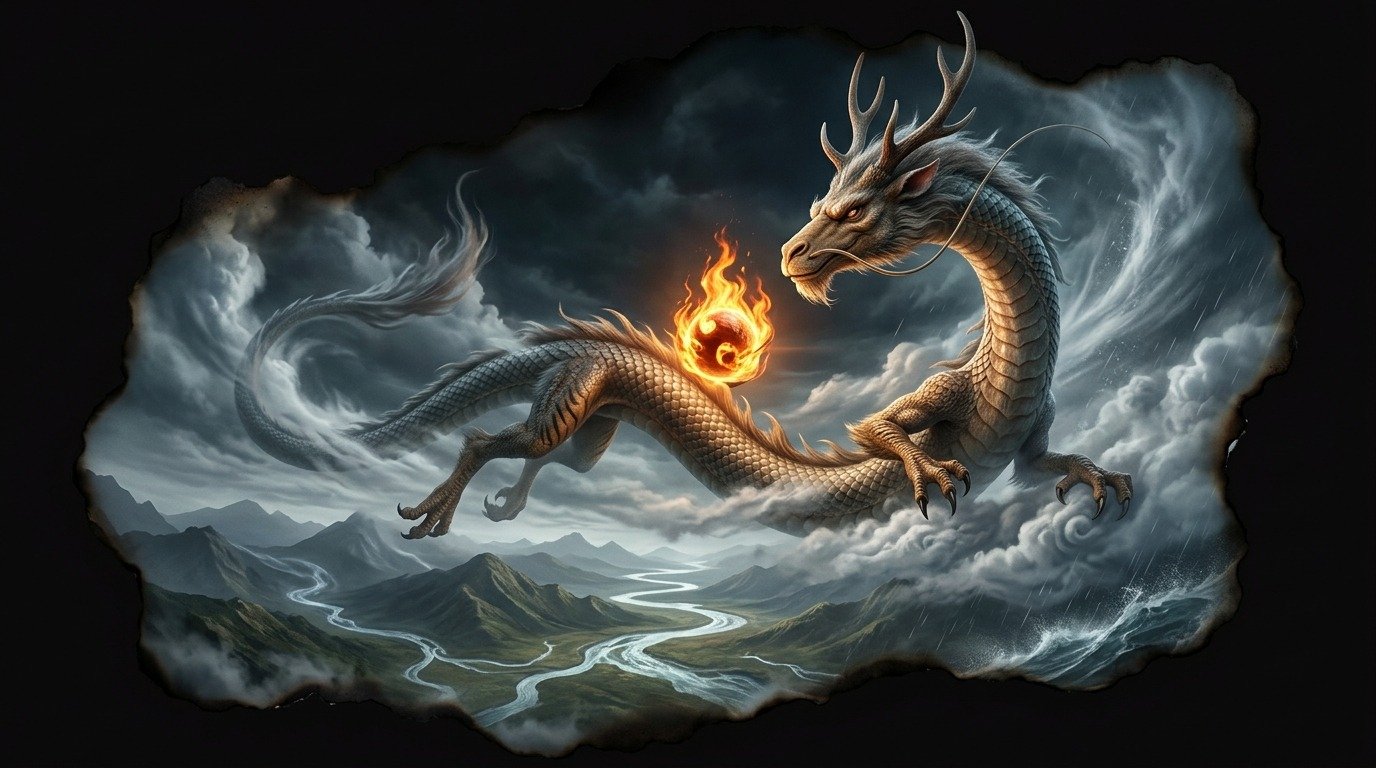
Long: The Cosmic Breath of Water and Heaven
Origin and Cosmogony of the Long
The *Long* (龙) shares no ontological or moral kinship with the dragon of Western cultures. While the European specimen represents chaos that must be subjugated, the Eastern dragon is the very embodiment of natural order, cosmological balance, and the sovereignty of Heaven (*Tian*). The earliest archaeological records of its worship date back to the Hongshan culture (c. 4700-2900 BC), where "pig dragon" jade artifacts have been found—curved ceremonial figures that associate the entity with the fertility of the earth and rain.
The canonical morphology of the *Long*, definitively established during the Han dynasty, is a marvel of zoological synthesis known as "the nine analogies" (*Jiusha*). It is described as having the head of a camel, the horns of a stag (a symbol of longevity), the eyes of a demon or hare, the ears of an ox, the neck of a serpent, the belly of a giant clam (*Shen*), the scales of a carp (exactly 117, of which 81 are Yang in nature and 36 are Yin in nature), the claws of an eagle, and the paws of a tiger. It lacks bat wings; it flies by means of a bony appendage on the crown of its head called *Chimu* or *Boshu*, which allows it to ascend directly to the heavens through pure spiritual affinity.
Typologies and the Flaming Pearl
Chinese cosmology classifies these entities according to their function and their hierarchy within the celestial bureaucracy: - **Tianlong (Celestial Dragon):** Custodian of the mansions of the gods and bearer of divine chariots. - **Shenlong (Spiritual Dragon):** Controller of wind and rain, upon whose temper the survival of the empire depends. - **Dilong (Earth Dragon):** The one who rules the course of rivers, springs, and underground channels. - **Fuzanglong (Dragon of Hidden Treasures):** Guardian of precious metal and gem deposits deep within the earth.
In almost all of its artistic and liturgical representations, the *Long* is depicted chasing or guarding a pearl enveloped in flames. This jewel is not physical gold; it represents the *Zhenzhu* (the pearl of wisdom, pure spiritual energy, the moon, thunder, or the elixir of immortality). The dragon's eternal pursuit of the pearl symbolizes the constant dynamics of the universe, the movement of *Qi* seeking its ultimate perfection and balance.
Esoteric Meaning and the Flow of Qi
In Taoism and *Neidan* (internal alchemy), the *Long* represents pure spiritual energy (*Shen*) and the Yang principle (associated with the Wood element and the east). It is constantly contrasted with the Tiger (*Hu*), which embodies the Yin principle (associated with Metal and the west). The copulation or perfect balance between the Dragon and the Tiger within the alchemist's body is the indispensable prerequisite for giving birth to the "immortal embryo."
In traditional geomancy (*Feng Shui*), landforms, especially mountain ranges and winding rivers, are called "Dragon Veins" (*Longmai*). Locating and channeling the flow of these veins allows human constructions to be harmonized with the vital breath of the earth (*Sheng Qi*). A blockage or desecration of a dragon vein results in natural disasters, barren fields, and dynastic ruin.
Manifestation and Sovereign Practice
Unlike the armed confrontation demanded by the Western dragon, contact with the *Long* is achieved through attunement, respect, and ritual supplication. It does not manifest as a destructive monster, but as seasonal change: it ascends to heaven at the spring equinox (bringing regenerating rain) and plunges into watery abysses at the autumn equinox.
For practitioners of internal sovereignty, invoking the *Long* involves: 1. **The Cultivation of Flexibility (Water):** The dragon can shrink to the size of a silkworm or expand to fill the firmament. The operator's mind must imitate this adaptability, free of rigidity. 2. **The Offering of Purity:** The *Long* detests filth, the blood of violent sacrifice, and falsehood. Taoist rain rituals are performed with pure incense, burned paper scriptures, and a state of strict fasting. 3. **The Use of Jade:** As a mineral that condenses the essence of celestial Yang, jade acts as a talisman of attraction and attunement to the beneficial energies of these aquatic deities.
Comments
Share information, an experience, or a source to help enrich this entry. They are automatically reviewed before being published.
Loading comments...