Manticore
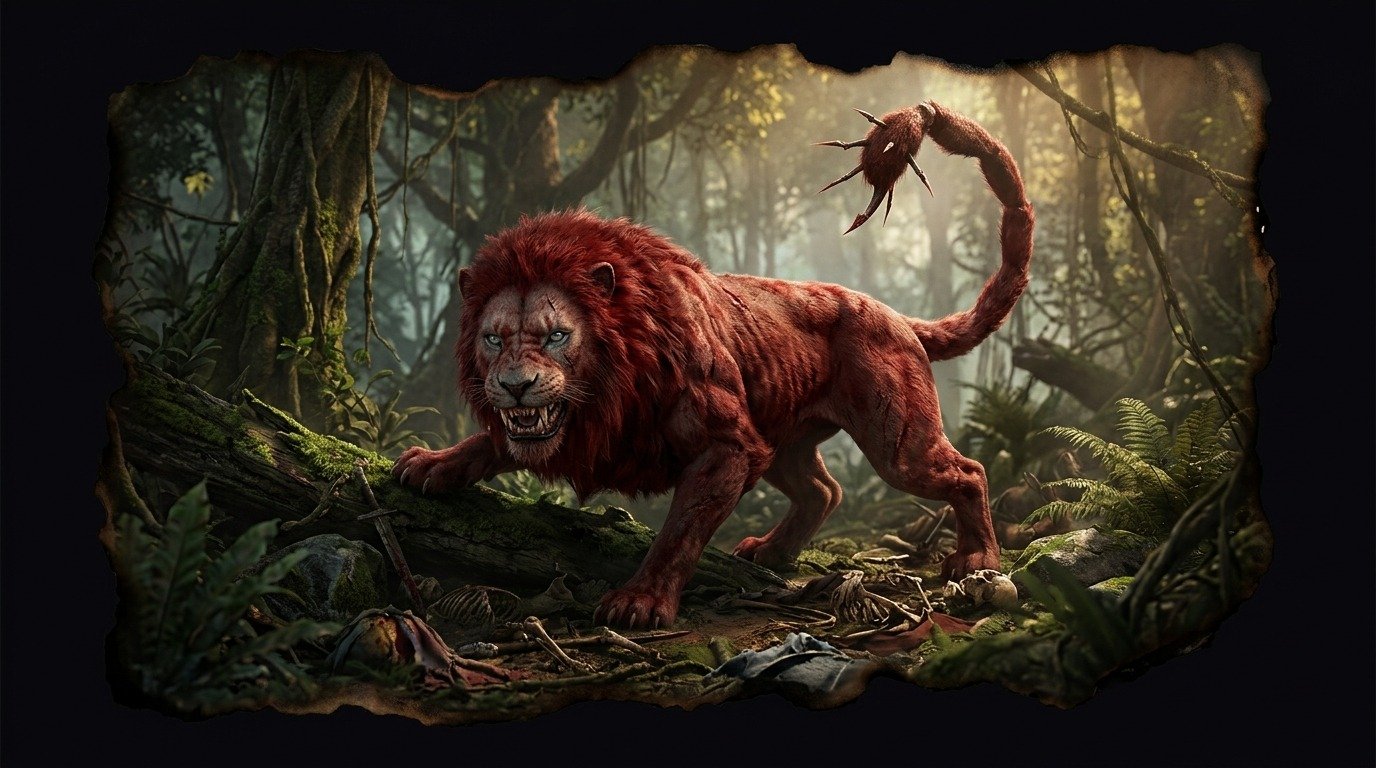
The Manticore: The Man-Eater of the Indus Jungles
Origin in Ctesias of Cnidus and Persian Tradition
The Manticore is a creature whose myth straddles the line between a flawed zoological report and absolute archetypal terror. Its name comes from Old Persian *Martyakwar* (or *Mardykhor* in Middle Persian), which literally translates to "man-eater." The creature was introduced to the European imagination by Ctesias of Cnidus, a Greek physician who spent seventeen years at the court of the Persian king Artaxerxes II Memnon in the fourth century BC. In his lost work *Indica*, fragments of which are preserved thanks to citations by Photius and Pliny the Elder, Ctesias described the Manticore as a real animal that inhabited the jungles of India. Although Aristotle, in his *History of Animals*, doubted the physical existence of the creature and suggested that Ctesias had misinterpreted local accounts of the Bengal tiger, highly influential later authors such as Pliny the Elder (*Naturalis Historia*, Book VIII) and Claudius Aelianus popularized the myth throughout the Roman Empire. During the Middle Ages, Latin bestiaries assimilated this description without critical filters, elevating the Manticore to the category of one of the most fearsome and symbolically dark monsters of the known world.
Anatomy of Hybrid Horror
The classic description of the Manticore is a mosaic of traits that immediately trigger the alarms of human evolutionary survival: * **The Body**: It has the size and musculature of an imposing lion, with a coat of a bright red color, similar to fresh blood or desert embers. * **The Face**: Uncannily human in appearance, with very bright pale blue or grayish eyes. Its mouth, stretching from ear to ear, hides a lethal secret: three rows of sharp, interlocking teeth in each jaw, fitting together like the pieces of an iron trap to crush bone and flesh with equal ease. * **The Tail**: Similar to that of a land scorpion or armed with a series of sharp, horny spikes, resembling the quills of a porcupine. The Manticore could shoot these spikes over a great distance and in any direction, like arrows propelled by an invisible bow. These spikes were said to contain an instantaneous neurotoxic venom for which no antidote existed on earth, with the sole exception of the elephant, which was immune to its effects. * **The Voice**: It emitted a hybrid sound that Ctesias describes as a mixture between the sound of a pipe and a trumpet, a melodic whistling that lured curious travelers into the thicket, mistaking it for human music or the song of an exotic bird. La Manticora possessed extreme agility, capable of making prodigious, gravity-defying leaps, allowing it to ambush its prey from treetops or canyon ledges. Its appetite was exclusively anthropophagous; it devoured its victims whole, along with their clothes, weapons, and belongings, leaving no trace of its passage, which explained the mysterious disappearances of entire caravans in the jungles of Asia.
Symbolic Evolution and Involution: From the Medieval Bestiary to the Fear of the Wild
Unlike the Griffin or the Sphinx, which possess solar or protective aspects, the Manticore is a creature devoid of redemption in moralizing literature. In medieval Europe, it was classified as a direct representation of the Devil, of Heresy, or of the sins of Gluttony and Lust. Its human face symbolized the deceitful cunning of the tempter, while its lion body and scorpion tail embodied brutal violence and the poisonous end of false doctrines. From a depth psychology perspective, the Manticore represents the atavistic fear of being consumed by the wild. It is the archetype of absolute biological regression: a being with the face of a man but lacking a soul, empathy, or human self-awareness, governed solely by predatory instinct. It is the personification of the jungle devouring civilization, the creature that leaves neither remains nor a grave, condemning its victim to total dissolution within its red entrails.
The Trail of the Beast and the Reverse Hunt
Ancient hunting manuals and accounts from Scythian and Indian travelers offered guidelines for identifying a Manticore's territory and surviving an encounter with it: 1. **The Absence of Traces**: If in a jungle area rich in game no bones or remains of missing animals or people were found, the presence of the Manticore, which swallowed everything, was suspected. 2. **The Whistling of the Wind**: When the jungle air vibrated with a frequency similar to the sound of an out-of-tune flute in the absence of actual wind, the guides would order absolute silence and the immediate preparation of wooden shields reinforced with wet leather, the only ones capable of stopping the venomous spikes of its tail. 3. **Offspring Control**: According to Claudius Aelianus, Indian hunters attempted to capture young Manticores when their tail spikes were not yet developed. To neutralize their future danger, they crushed their tails with flat stones, permanently preventing the growth of the venomous weapons and partially domesticating them for the service of local rajahs, although this practice was always considered highly risky.
Comments
Share information, an experience, or a source to help enrich this entry. They are automatically reviewed before being published.
Loading comments...