Sphinx (Greek and Egyptian)
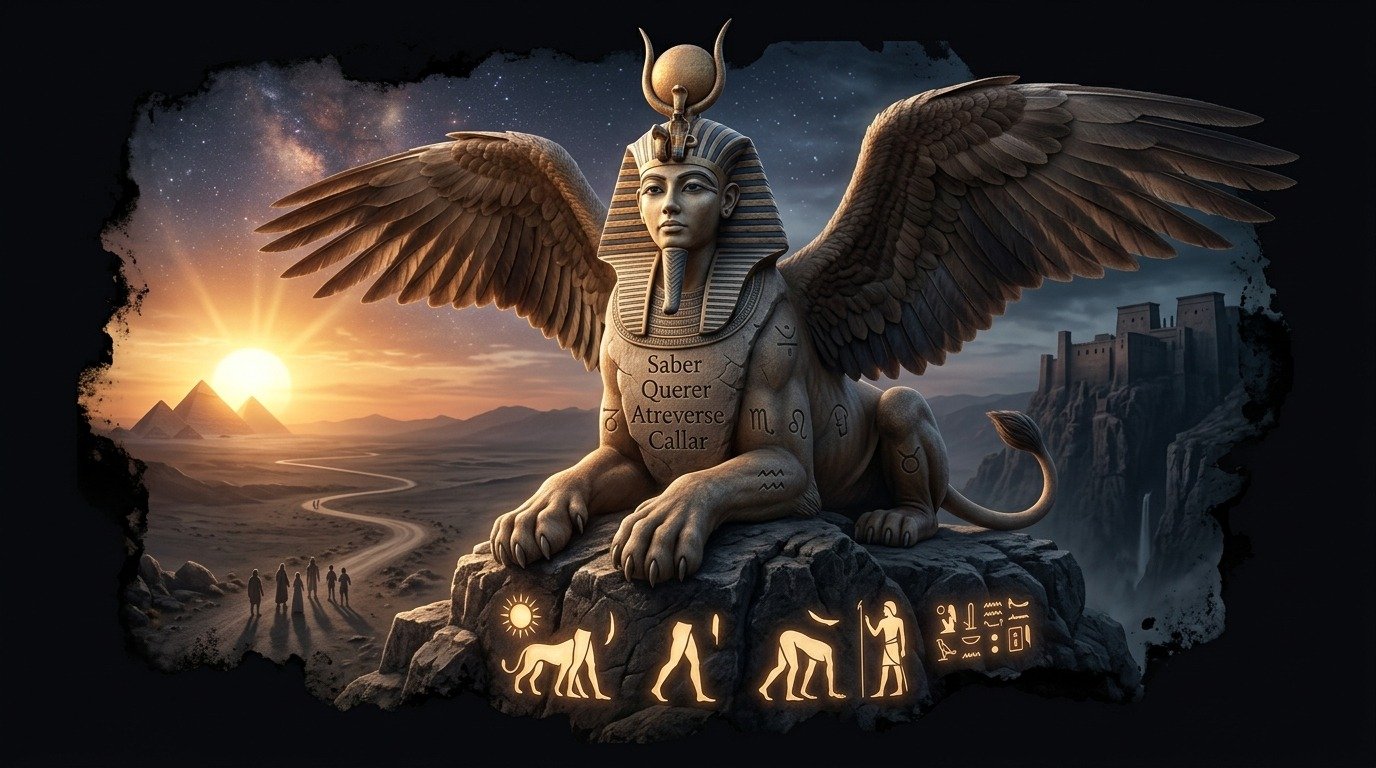
The Sphinx: The Petrified Enigma Between the Sun of Giza and the Abyss of Thebes
Two Faces, Two Lands: The Egyptian Sphinx versus the Greek Sphinx
The figure of the Sphinx presents one of the most dramatic conceptual bifurcations in the history of universal folklore. Its origin is unquestionably Egyptian, where it is known as *Shesep-ankh* ("living image") or, in the New Kingdom, under the invocation of *Hor-em-akhet* (Harmachis, "Horus on the Horizon"). For the Egyptians, the Sphinx is a solar and masculine symbol, a guardian of temples and necropolises, representing the physical strength of the lion united with the wisdom of the pharaoh or the solar deity (frequently depicted with a human, falcon, or ram head). It is a protective being of divine order, static, imperturbable, and beneficent. Conversely, when the Sphinx migrated to the Hellenic world through Bronze Age trade contacts, it underwent a demonic mutation. The Greeks renamed it *Sphinx* (derived from the verb *sphingein*, "to squeeze" or "to strangle") and transformed it into a female, winged, destructive entity of a chthonic nature. Daughter of Orthrus and the Chimera (or of Typhon and Echidna according to other sources), the Greek Sphinx is a monster of chaos sent by Hera or Ares to Thebes as a divine punishment. It is not static; it is active, rapacious, and devouring, a highway robber that perches on Mount Phicium to devour travelers unable to solve its riddles.
The Riddle of Thebes and the Geometry of Being
In the Greek tradition, the Sphinx does not attack with the brute force of an ordinary lion, but with the sharp edge of the intellect and the trap of language. The famous riddle it posed to the Thebans—recorded by Apollodorus—is an initiatory key disguised as a popular riddle: *"What being, endowed with a single voice, walks first on four legs, then on two, and finally on three, being all the slower the more legs it has?"*. The answer given by Oedipus—Man—destroyed the power of the beast, causing it to cast itself down from the heights of the acropolis of Thebes into the abyss. However, this encounter holds a deeper metaphysical mystery. The riddle of the Sphinx is not simply about the physical development of the human being; it is a lesson on the ontic constitution of humanity. The "four legs" of the morning represent the animal and elemental state (the four elements of matter); the "two legs" of noon represent upright reason and the duality of the conscious soul; the "three legs" of evening represent spiritual maturity assisted by the staff of wisdom or the inner trinity. By deciphering the riddle, Oedipus demonstrated that man is the microcosm that summarizes the entire creation.
Esoteric Archetype: The Four Elements and Silence
In the Western esoteric tradition, masterfully summarized by occultists like Éliphas Lévi and reflected in Tarot cards (especially in The Wheel of Fortune), the Sphinx is the hieroglyphic compendium of the Great Work and the supreme guardian of the Mysteries. Its composite anatomy brings together the four forms of the biblical Tetramorph and the fixed signs of the zodiac: 1. **The bull / lion paws (Taurus / Leo)**: They represent Earth and Fire, willpower and material perseverance to act upon the dense plane. It is the precept: **To Know** and **To Will**. 2. **The eagle's chest and wings (Scorpio / Aquarius)**: They represent Water and Air, the ability to rise above low passions and expand consciousness through the celestial realms. It is the precept: **To Dare**. 3. **The human head (Aquarius / The Magician)**: It represents the Spirit that governs and coordinates the animal forces of the other three elements. It is the supreme precept of the Sphinx: **To Keep Silent**. As the "Guardian of the Threshold", the Sphinx challenges the neophyte before they can access the secrets of initiation. If the aspirant lacks mental balance or purity of purpose, the devouring aspect of the Sphinx (the uncontrolled ego) psychically destroys them. If the aspirant is prepared, the Sphinx remains silent, allowing them passage into the inner temple.
Ritual and Transcendence
Approaching the Sphinx in practical esotericism is not done through physical combat, but through meditative silence and radical introspection. To deactivate the paralyzing energy of the "fear of the Sphinx" (stagnation or existential doubt before an evolutionary leap): * **The Clipeum / the shield of Silence**: In the face of intellectual doubt, do not respond with rational justifications that feed the duality of the mind (the heads of the beast). The true answer is mental emptiness and the contemplation of one's own essence without words. * **The Integration of the Parts**: Recognizing that you possess the strength of the lion to execute, the wings of the eagle to understand, the firmness of the bull to resist, and the human mind to guide. The disharmony of these elements is what creates the monstrosity of the Sphinx; their alignment transforms it from a devourer into a solar protector of the individual temple.
Comments
Share information, an experience, or a source to help enrich this entry. They are automatically reviewed before being published.
Loading comments...