The Lernaean Hydra
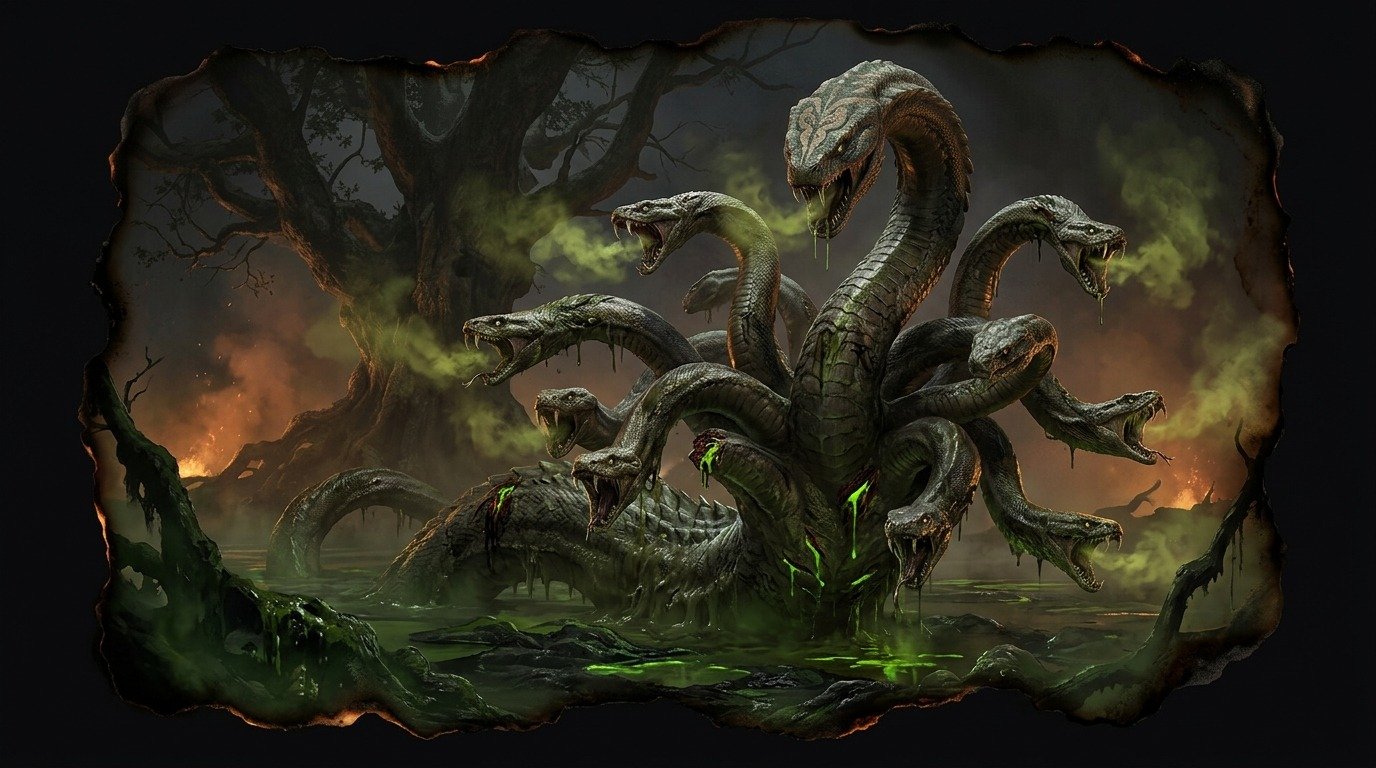
The Lernaean Hydra: The Multifaceted Horror of the Argolid Swamps
Chthonic Origin and Nature
The Lernaean Hydra is one of the most terrifying offspring of Typhon, the fire storm, and Echidna, the primordial viper. Raised by Hera herself under the shadow of a sacred plane tree, the beast was established in the limestone swamps of Lerna, a marshy territory of the Argolid that, according to Orphic traditions, constituted one of the direct entrances to the Underworld. The geography of the myth is not accidental: Lerna was famous for its mysterious bottomless lakes and its sacred springs, such as that of Amymone, which concealed unfathomable abysses. In the oldest texts, such as Hesiod's *Theogony* (8th century BC), the Hydra is described simply as a creature of countless heads whose breath and blood possessed a toxicity of cosmic proportions. It was not a simple large reptile, but an emanation of the chthonic and chaotic forces that the Olympian order sought to subdue. Its very existence was an affront to the sun, a condensation of primordial slime that breathed lethal vapors capable of killing any man who dared to cross its marshes, even while the beast slept.
Anatomy, Alchemy, and Multiplication
The morphology of the Hydra varies according to the chronicler. While the poet Alcaeus attributes nine heads to it, Simonides of Ceos raises the number to fifty, and later authors such as Virgil and Seneca speak of a hundred heads or an indeterminate number that defied visual perception. However, the mythological tradition consolidated by the *Bibliotheca* of Pseudo-Apollodorus establishes a canonical anatomy: a serpentine or draconian body from which sprouted multiple necks crowned by heads of variable bicephaly, of which the central one was strictly immortal. The most terrifying property of the Hydra was its capacity for compensatory regeneration. For every severed head, two new ones sprouted from the open wound, nourished by a black and corrosive sap that flowed through its veins instead of common blood. This blood was a dense, phosphorescent green, carrying a venom so active that even after the beast's death, the slightest drop exposed to the air corrupted the earth and made wounds inflicted with it eternally incurable, as the centaur Chiron well experienced. From a microcosmic perspective, the body of the Hydra functioned as an alchemical reactor of dissolution (*solutio*), where every solid or vital element was disintegrated and reduced to its lowest state of acid decomposition.
Esoteric Symbolism and the Psychological Shadow
On the plane of Hermetic philosophy and depth psychology, the Lernaean Hydra represents the multiplicity of unbridled desire and the ramifications of the unregenerated ego. It is the archetype of the collective shadow that dwells in the depths of the unconscious psyche (the swamp). Cutting off a head of the Hydra by brute force is equivalent to repressing a vice or a superficial trauma: purely mechanical amputation without internal transmutation only causes the symptom to double and return with greater virulence. The immortal head of the creature, which Heracles had to bury under a heavy rock on the road between Lerna and Elaeus, symbolizes the very root of egoic individuality, the spark of pride or the pathological self-preservation instinct that cannot be destroyed, but only subdued, buried, and transmuted under the weight of spiritual self-discipline (the great rock of the Temple). In Hermetic alchemy, the Hydra represents the prima materia in its most hostile state of *nigredo*: a shapeless, damp, poisonous, and devouring mass that must be purified through fire to prevent its emanations from suffocating the operator.
Remedies, Mitigation, and the Fire of Iolaus
The defeat of the Hydra is the second of the Labors of Heracles, and its resolution offers the classic protocol for the treatment of these proliferating energies. The hero understood that physical strength was useless without a principle of fixation. Here enters Iolaus, his charioteer and nephew, who provided the torches with which the technique of cauterizing the bleeding stumps was applied. The esoteric and physical protocol is clear: 1. **Isolation**: Forcing the beast out of its lair using flaming arrows, exposing the hidden horror to the light of consciousness. 2. **Fixation by Fire (*Calcinatio*)**: Immediately after the iron sword or the club cuts the head, apply extreme fire to the open flesh. The heat coagulates the acidic blood, seals the spiritual lymphatic vessels, and destroys the regenerative capacity of the chthonic cells, preventing multiplication. 3. **Neutralization of the Core**: Severing the immortal head with a consecrated or bronze weapon, and burying it deeply under a stone of high mineral density to sever its connection with the telluric currents of the swamp. 4. **Appropriation of the Essence**: Dipping weapons in the gall of the Hydra. This act represents the assimilation of the enemy's power; the initiate does not destroy the destructive force, but integrates it into their arsenal for future combats against the forces of chaos.
Comments
Share information, an experience, or a source to help enrich this entry. They are automatically reviewed before being published.
Loading comments...