Piasa
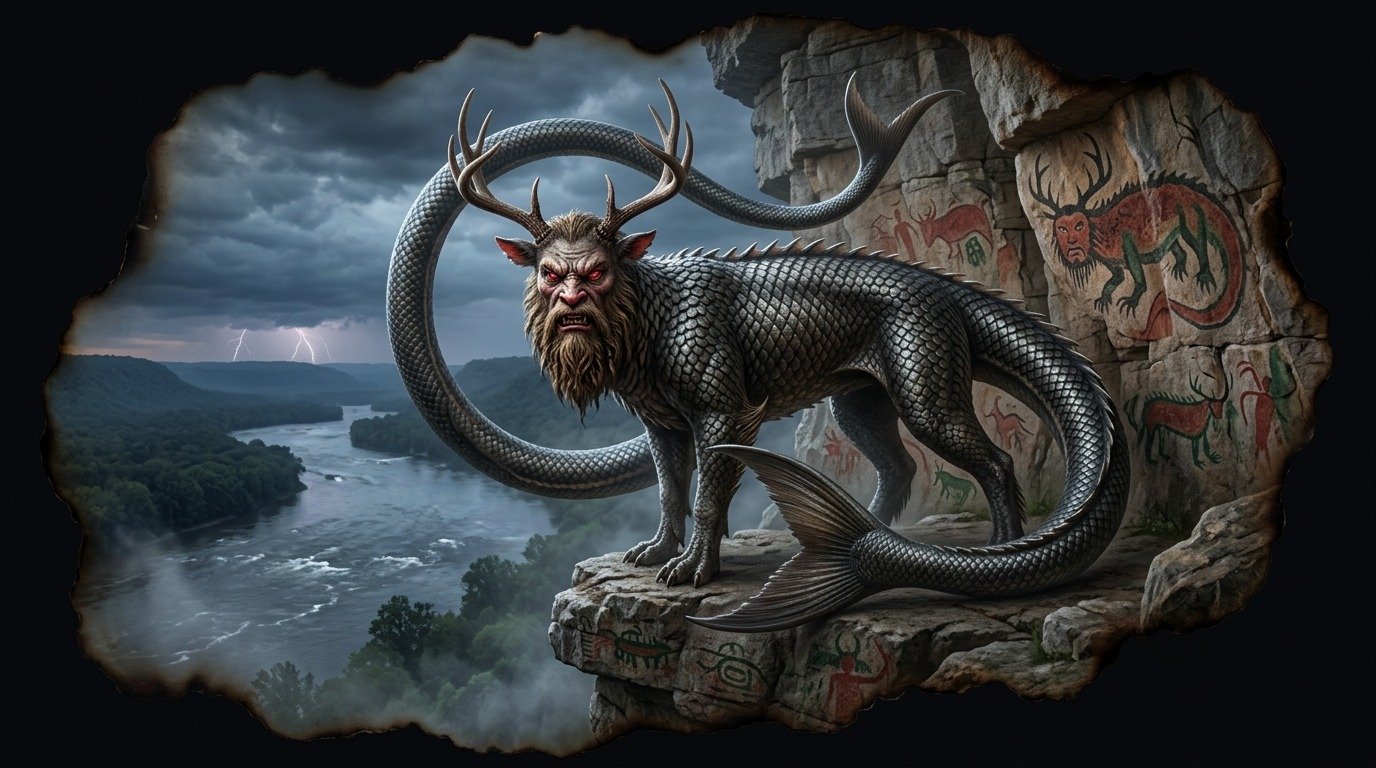
Piasa: The Devourer of the Mississippi Cliffs
Father Marquette's Testimony and the Rock Altar
In the year 1673, the French Jesuit missionary Jacques Marquette and the explorer Louis Joliet were navigating the upper Mississippi River when, on the limestone cliffs of what is now Alton, Illinois, they beheld a series of colossal rock paintings that filled them with awe and dread. In his journals, Father Marquette left the first written record of the creature known by the tribes of the Illiniwek Confederacy as the *Piasa* (or *Piasau*), which is usually translated in Algonquian dialects as "the bird that devours men" or "the deity of the destroying current". The original description penned by the Jesuit details an entity whose physiognomy defied the limits of natural taxonomy: > "It is as large as a calf, with horns on its head like a deer, a red and frightful gaze, a tiger's beard, and a face resembling a man's. Its body is covered with scales like a fish; its tail is so long that it wraps all the way around its body, passing over its head and returning between its legs, ending in a fish's tail." The original paintings, located high up on the rocky cliff, were painted with red, black, and green pigments obtained from iron oxides and local clays, and served as a sacred and feared landmark for all travelers of the river basin.
The Russell Hoax and the Metamorphosis of the Myth
In the mid-19th century, the story of the Piasa underwent a radical transformation that blurred its original indigenous roots. In 1836, a local Illinois writer and historian named John Russell published a highly dramatized and fictionalized account of the legend. In his version, Russell presented the Piasa not as a spiritual entity of the water currents, but as a giant bird of prey, endowed with immense wings and iron claws, which nested in the cliffside caverns and ravaged native villages, hunting hundreds of warriors before being slain by Chief Ouatoga through a stratagem involving poisoned arrows and human sacrifice. Although contemporary anthropologists and historians have shown that Russell's narrative was a romantic 19th-century invention to attract tourist interest to the region, this version of the "Piasa Bird" ultimately supplanted the original conception in modern American folklore. The cliffside monster of the Mississippi went from being an aquatic and subterranean deity to a flying monster of cryptozoology, similar to the *Thunderbird*, but endowed with malevolent and anthropophagous intentions.
Algonquian Cosmology: Between Water and Thunder
For the Native peoples of the Great Lakes and the Mississippi Valley, the true figure represented on the Alton cliffs possessed an immensely deeper theological weight. The original Piasa was not a bird, but a manifestation of the *Mishepishu* (the Underwater Panther), a primordial chthonic deity that ruled the underworld, deep lakes, and the whirlpools of rushing rivers. In Algonquian cosmology, the universe is in a state of eternal tension between two opposing forces: - **The celestial plane,** ruled by the thunderbirds (*Animikiig*), lords of lightning, wind, and celestial fire. - **The subterranean and aquatic plane,** ruled by the Underwater Panther and the Great Horned Serpents, lords of deep waters, precious metals (particularly native copper), and occult medicine. The Piasa of the cliffs, by combining deer horns (a symbol of spiritual status and sovereignty over the land), a human face with a feline beard, and a scaly body with a fish's tail, represents the perfect synthesis of the forces of the underworld. The paintings were not simple artistic representations, but warnings that one was entering a liminal portal where water currents could drag navigators into the abyss of the earth. Indian travelers did not shoot arrows at the rocks out of hatred, but rather deposited sacred tobacco and other offerings in the river to appease the deity's wrath and ensure safe passage.
Vestiges and Offerings of Passage
Although the original paintings on the Alton cliffs were destroyed in the mid-19th century due to limestone quarrying and industrial settlements, modern replicas have been painted near the original site, perpetuating the reverent respect that the region inspires. Those who study earth magic and local spirits consider that the area of the Mississippi where the Illinois River converges with the great river continues to contain the energetic signature of this deity: - **The offering of tobacco and corn:** To appease emotional turbulence or currents of chaotic energy in the seeker's life, one resorts to the ancient practice of casting natural tobacco and yellow corn kernels into the waters of fast-flowing streams, recognizing the dominion of the lord of the scaly depths. - **Avoiding the navigator's pride:** The myth of Chief Ouatoga, even though a nineteenth-century fiction, resonates with the esoteric truth that the forces of nature (the Piasa) can only be confronted through personal sacrifice and alignment with the forces of heaven (the bow and arrow, symbols of celestial lightning).
Comments
Share information, an experience, or a source to help enrich this entry. They are automatically reviewed before being published.
Loading comments...