Western Dragon
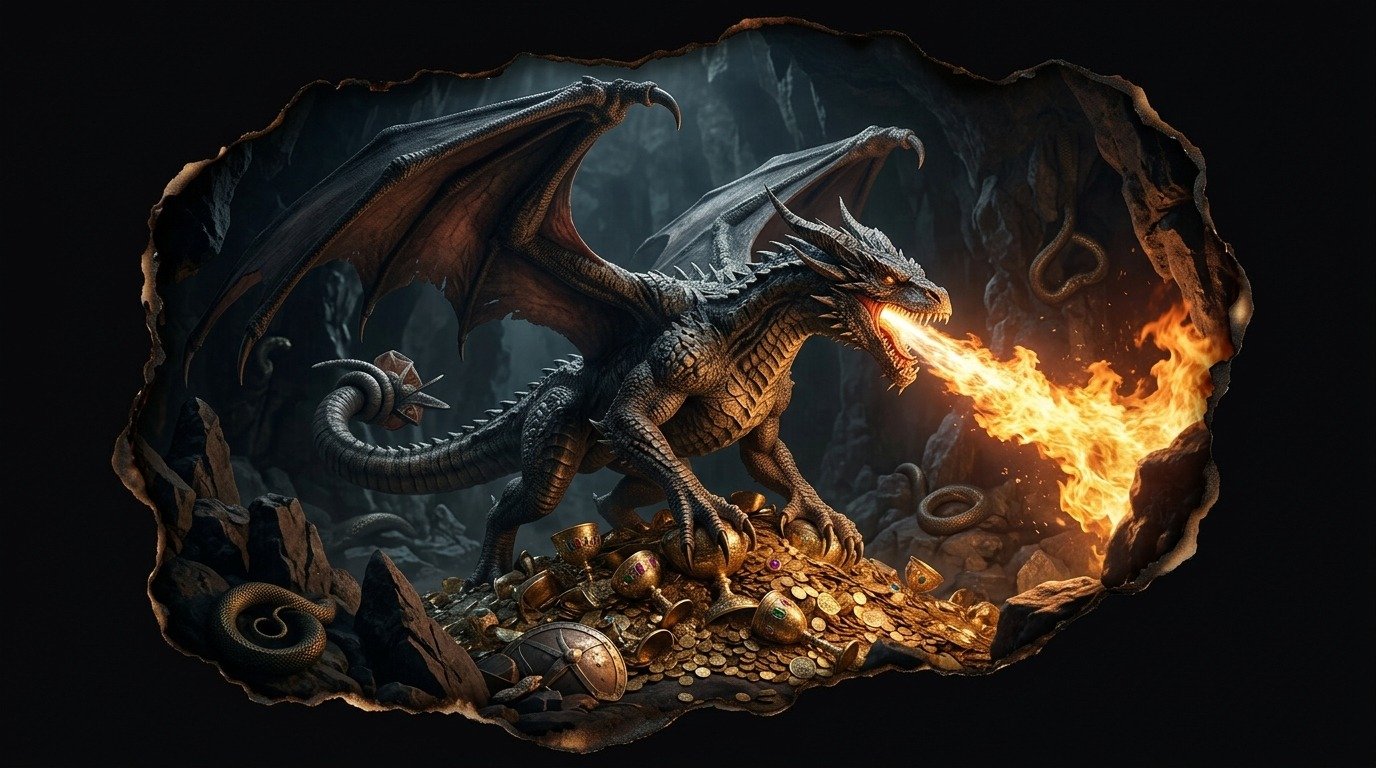
Western Dragon: The Guardian of the Treasure and the Shadow of the Beast
Origin and Ancient Morphology
The dragon of the Western hemisphere is not a mere reptile of herculean proportions, but the anthropogenic crystallization of the fear of chaos, the ultimate predator, and the untamed land. Its roots sink deep into the Indo-European concept of *Chaoskampf*—the primordial battle between a storm or order deity and a giant serpent that holds back the waters or the sun—as evidenced in the Sumerian myth of Kur, Zeus's struggle against Typhon, and Thor's combat with Jörmungandr. In the oldest texts of the Greco-Roman sphere, the *draco* (from the Greek *drakon*, "the one who stares") lacked wings and complex limbs; it was a serpent of colossal dimensions endowed with a hypnotic and venomous gaze. It is not until the Late Middle Ages, under the influence of Christian bestiaries such as the *Physiologus* and the Aberdeen Bestiary, that the creature acquires its canonical morphology: a scaly, tetrapod body, membranous bat-like wings (associated with the night and the underworld), talons of a bird of prey, and a fiery breath that emulates the fires of Gehenna.
Historical Evolution and Demonization
The conversion of the dragon from a guardian of sacred enclosures and oracles (such as the dragon of Colchis or Ladon in the Garden of the Hesperides) to the embodiment of absolute evil was consolidated with Christian patristics and the Vulgate. The *Apocalypse* of John explicitly identified the "ancient serpent" with Satan. From then on, the medieval bestiary stripped it of all mythical dignity to turn it into a symbol of the devil. It was claimed that its strength did not lie in its teeth, but in its tail, with which it constricted and suffocated, a metaphor for how sin envelops and destroys the unwary. In northern Europe, however, the Germanic and Scandinavian tradition preserved a more complex and tragic vision. Fafnir, in the *Volsunga Saga*, is not born a dragon, but rather transmutes into one due to his excessive greed for Andvari's cursed gold. Here, the dragon represents the entropy of the human mind: absolute isolation, the paranoia of the hoarder, and the petrification of vitality around the material. The hero who defeats him (Sigurd) not only performs a physical feat, but an esoteric initiation by consuming the beast's heart, which grants him knowledge of the language of birds and prescience.
Esoteric and Alchemical Meaning
In the alchemical opus, the Western dragon possesses a fundamental operative duality. It is, simultaneously, the chaotic and unstable *materia prima* (the green dragon devouring the sun) and the fiery force of philosophical sulfur. When depicted biting its tail (*Ouroboros*), it symbolizes the unity of matter, the eternal cycle of dissolution and coagulation (*solve et coagula*), and eternity devouring and regenerating itself. Under the lens of Carl Jung's depth psychology, the dragon is the archetype of the Shadow and the guardian of the threshold. The treasure it guards deep within its cave represents the *Self* (the latent potential of the individual), which cannot be reached without first descending into the unconscious and confronting/destroying the devouring aspect of the infantilized ego and the fear of death. The dragon's fire is the blind passion that consumes, but which, once mastered, is transformed into the light of consciousness.
Manifestation and Confrontation Protocols
On the plane of mystical and initiatory experience, the "dragon's strength" manifests as the unleashed chthonic energy of the earth and the operator's lowest instincts. Western magical traditions warn that one must not attempt to "destroy" this energy, but rather to subdue and channel it. The classic protocol of protection and mastery requires: 1. **The Sword of Will (Iron and Steel):** The mage must maintain an analytical and unwavering mind; any emotional weakness feeds the beast's fire. 2. **The Shield of Truth (Mirror of Self-Awareness):** The operator must recognize their own shadow in the creature to avoid being possessed by ego inflation. 3. **The Name of Power:** Just like Saint Michael the Archangel or Saint George, the operator invokes the ordering force of the Logos (the Air/Intellect element) to subdue the reptilian nature (Earth/Fire) and transmute it into a driving force for spiritual ascension.
Comments
Share information, an experience, or a source to help enrich this entry. They are automatically reviewed before being published.
Loading comments...