Basilisk
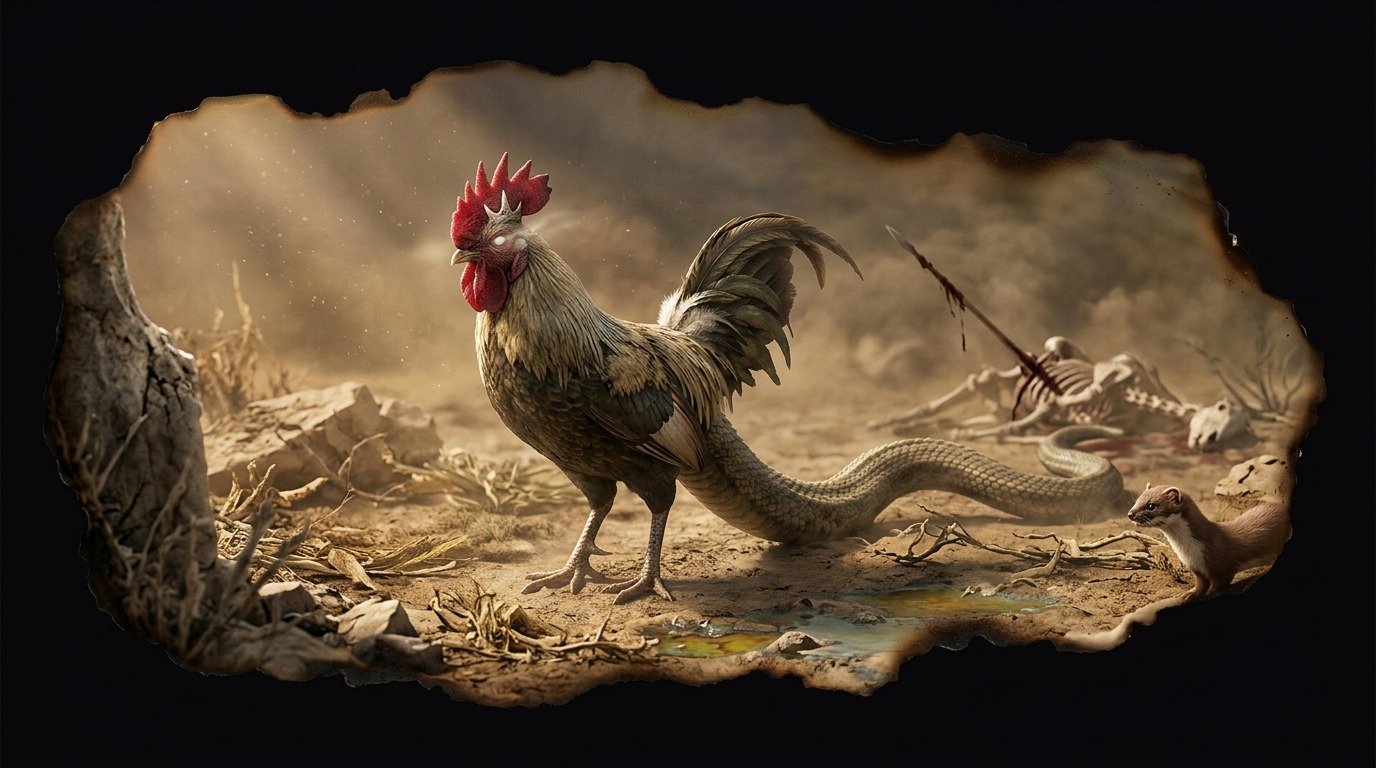
Basilisk: The Crowned King of Silent Death
Origin and Morphology in the Ancient World
The basilisk (from the Greek *basiliskos*, "little king") is the culmination of terrestrial venom and the terror of the sovereign gaze. The oldest and most influential mentions come from the *Natural History* of Pliny the Elder (1st century AD), who describes it not as a cyclopean monster, but as a small snake—no more than twelve fingers (9 inches / 23 cm) in length—native to the province of Cyrene (North Africa). Its royalty does not reside in its size, but in a whitish mark on its head that resembles a diadem or royal crown, and in its upright posture, for unlike other ophidians, it moves forward with the front half of its body raised off the ground. La toxicity of the original basilisk defies the ordinary laws of nature: its presence withers vegetation not only through contact, but by its mere breath; it cracks the stones of desert plains and poisons water sources at colossal distances. Pliny documents that if a rider pierces a basilisk with a spear from his horse, the poison flows up the wooden shaft, killing not only the rider but also the mount. Its mere existence turns fertile land into the wasteland of the Libyan desert.
Medieval Evolution: The Birth of the Cockatrice
During the process of Christianization and cultural hybridization of the Middle Ages, the morphology of the basilisk merged with the myth of the *Cockatrice*. The *Physiologus* and the treatises of Albertus Magnus reformulated its origin with a nuance of unnatural aberration. It was ruled that the basilisk is born from a deformed, spherical egg without a hard shell (a yolkless or wind egg), laid by an old rooster of seven to nine years of age during the dog days of summer. This egg must be incubated in a dung heap by a toad or a venomous serpent. From this nefarious incubation emerges a chimeric creature: it retains the head, legs, and wings of a spurred rooster, but its body ends in a scaly dragon or serpent tail. Its crown becomes a fleshy, bifid crest of blood-red color. The lethal power of the creature is now concentrated exclusively in its eyes: the *catoblepas* and the basilisk share the ultimate "evil eye"; whoever stares into the eyes of the basilisk dies instantly from the petrification of their blood or the sudden stopping of their vital pulse.
Esoteric and Alchemical Meaning
In the realm of hermetic alchemy, the basilisk possesses a highly reserved dual status. On one hand, it represents the dissolving and destructive force of unrectified "Secret Fire"; the rapid corruption of matter that has not been properly purified by the operator. It is the "poison of the great work," the danger of total decomposition before reaching the *Rubedo* stage. On the other hand, some late alchemical treatises identify the ashes of a burned basilisk as an indispensable secret ingredient for the transmutation of copper into high-grade gold. In this sense, the basilisk represents the extreme fixation of sulfur: a force so concentrated and lethal that it must be "killed" and reduced to powder to release its incorruptible core of transmuting power. On a symbolic-psychological level, it represents the destructive projection of envy and pure hatred. The gaze of the basilisk is the condemning judgment of the ego that refuses to see its own baseness and, by projecting it outward, destroys and petrifies everything living and creative around it.
Vulnerabilities and Defense Protocols
Folklore tradition and the records of medieval monster hunters agree that nature balanced the power of the basilisk by gifting it with specific weaknesses that the operator can and must exploit: 1. **The Weasel (Mustela):** It is the only animal immune to the gaze of the basilisk and capable of killing it in its own lair. If the weasel is wounded by the reptile's venom, it seeks out and bites leaves of rue (the prophylactic plant par excellence) to heal itself instantly before returning to combat. Esoterically, the weasel represents mental agility and instinctive purity that refuses to be paralyzed by fear. 2. **The Rooster's Crow:** The crow of the rooster announces the triumph of solar light over the darkness of night. Upon hearing this sound, the basilisk suffers violent convulsions that cause its death by nervous collapse. Desert travelers used to carry roosters in their cages as a measure of absolute protection. 3. **The Crystal Mirror:** The definitive method of active defense consists of carrying a mirror of pure crystal in front of one's face. If the basilisk attempts to direct its deathly gaze toward the operator, the gaze strikes the reflective surface and returns to the creature, causing its instant death by its own reflection. This teaches that absolute evil destroys itself when forced to contemplate its own nature without masks.
Comments
Share information, an experience, or a source to help enrich this entry. They are automatically reviewed before being published.
Loading comments...