Wyvern
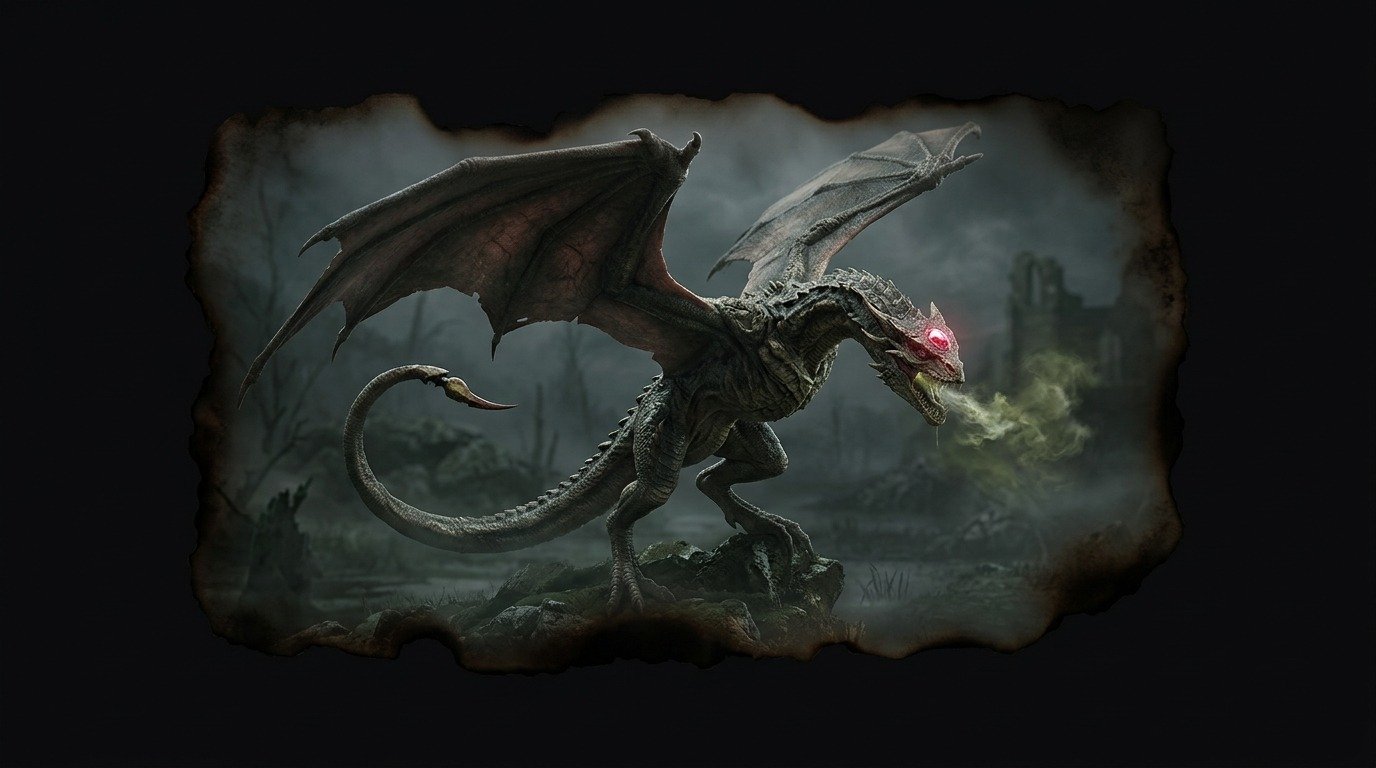
Wyvern: The Two-Clawed Scourge and the Heraldry of Poison
Etymological Roots and Medieval Folklore
The term *wyvern* (or wivern) traces its philological roots back to the Latin *vipera* (viper), a word that mutated through Old French into *wivre* and *vouivre* before settling in Middle English as *wyver*. Unlike the classic dragon of Eurasian tradition—commonly depicted as a winged quadruped—the wyvern is strictly defined by its morphology of only two hind legs, a pair of membranous wings that extend from its forelimbs (in the style of bats), and an elongated tail that usually culminates in a venomous dardo or barb.
In the folklore of northwestern Europe, particularly in the British Isles and Gaulish regions, the wyvern was not considered a creature of celestial fire or cosmic wisdom, but rather a monstrosity closely linked to damp earth, swamps, stagnant water sources, and pestilence. While the traditional dragon breathes purifying or destructive flames, medieval treatises attribute a pestilential and poisonous breath to the wyvern, capable of corrupting crops and poisoning local water wells. This liminal nature, halfway between a terrestrial serpent and a bird of prey, made it one of the most feared manifestations of medieval fabulous fauna.
The Heraldic Flight and the Gallic Vouivre
From the 12th century onward, with the systematization of European heraldry, the wyvern acquired a symbolic dimension of the highest order, sharply distinguishing itself from the dragon. In the British system of coats of arms, the *wyvern* personified hostile vigilance, armed brute force, and relentless protection. It was the emblem of the kings of Wessex and became a symbol of military status, representing a fearsome enemy that, when subdued, bestowed unparalleled prestige upon the knight who carried it on his clipeum / the shield.
In France, the regional variant known as *la Vouivre* presents more complex mythological nuances. The folklore of Franche-Comté and Burgundy describes the Vouivre as a gigantic winged serpent that wears a carbuncle on its forehead—a ruby or gem of blinding brilliance—which serves as its single eye. According to local legends, when the creature descends to bathe in local rivers, it deposits its gem on the shore. Any mortal who managed to steal the carbuncle without being devoured would obtain incalculable wealth and an understanding of the secrets of the earth; however, almost all tales conclude with the daring thief drowned or torn to pieces by the beast, which recovers its guiding eye through olfactory tracking.
Esoteric and Alchemical Meaning
In the realm of hermetic philosophy and Late Medieval alchemy, the wyvern occupies a prominent place as a representation of the prima materia in its wildest and most untamed state. Possessing only two legs, it symbolizes a creature that is neither fully connected to the terrestrial realm (to which quadrupedal beasts belong) nor entirely free in the celestial realm (reserved for pure birds). It is the symbol of the unfixed volatile.
In certain alchemical manuscripts, the wyvern biting its own tail or fighting a terrestrial dragon represents the combat between sulfur and mercury. The poison of its tail is interpreted as the dissolving agent or the *corrosive ingredient* indispensable for the great work (the *solutio*). The French Vouivre, for its part, with its removable gem, is a perfect metaphor for the quest for the Philosopher's Stone hidden within the physical body of the terrestrial monster: the spiritual light enclosed within the density of organic matter.
Manifestation, Testimonies, and Protection Warnings
Unlike modern cryptid sightings, historical records of wyverns are recorded in ecclesiastical chronicles as presences of negative telluric energy. They were said to inhabit the ruins of Saxon churches or prehistoric barrows, attracted by underground water currents.
Traditional protection protocols against these entities differed from those used against common dragons:
- **The neutralization of the poison:** Since its primary weapon is not fire but consumption and pestilence, exorcism manuals of the era recommended the use of sacred woods such as ash and elderberry to purify the surrounding air. - **The mirror trap:** Like the basilisk, the wyvern was believed to possess a gaze charged with evil intent; placing polished surfaces near their theoretical nests forced them to confront their own spiritual ugliness, driving them away. - **The cold iron of the swamps:** Weapons intended to fight the wyvern had to be submerged in peat bog mud to counteract the biological acidity of the poison in its tail.
Comments
Share information, an experience, or a source to help enrich this entry. They are automatically reviewed before being published.
Loading comments...