Amphisbaena
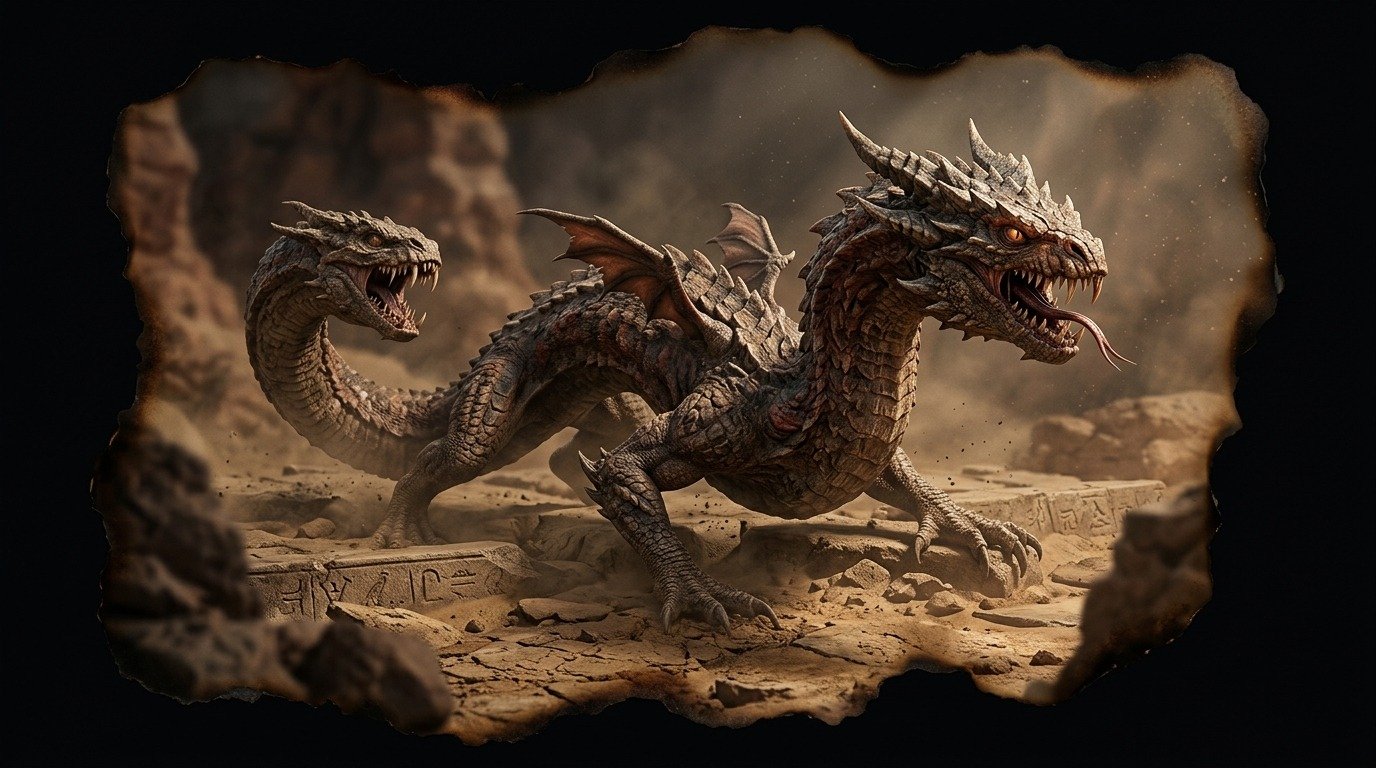
Amphisbaena: The Two-Headed Serpent of the Wounded Deserts
The Birth of Gorgonian Blood
The amphisbaena (from the Greek *amphis*, 'both ways', and *bainein*, 'to go' or 'to walk') is a creature whose first documented mention dates back to classical antiquity. The Latin poet Lucan, in his epic work *Pharsalia* (1st century AD), describes in detail the horrors that the army of Cato the Younger encountered while crossing the deserts of Libya. According to the Greco-Roman founding myth, when the hero Perseus flew over North Africa carrying the decapitated head of the Gorgon Medusa, the drops of blood that fell onto the barren sand spawned various species of monstrous serpents, the most fearsome being the amphisbaena.
The defining anatomical feature of the amphisbaena is the possession of a second operational head at the opposite end of its body, where the tail would normally be located. Pliny the Elder, in his monumental *Naturalis Historia*, validates this description by pragmatically arguing that a single head would not be enough to discharge such a large amount of venom. This physiognomy grants it a unique motor capability: it can move with equal speed in both directions and, to advance more rapidly, it can bite one of its heads with the other, forming a rigid hoop and rolling down slopes as if it were an organic wheel.
Metamorphosis in the Medieval Bestiary
As the creature transitioned from pagan antiquity to medieval scholasticism, its morphology underwent significant visual adaptations. In the illuminated bestiaries of the 12th and 13th centuries, the amphisbaena was frequently depicted not as a simple serpent with two cephalic ends, but as a hybrid creature equipped with scaly legs resembling those of a rooster or a lizard, atrophied membranous wings, and, on occasion, horns on its main head.
This process of visual deformation coincided with the Christianization of symbolic fauna. The amphisbaena came to embody supreme deceit, falsehood, and moral duplicity. By looking simultaneously in opposite directions, it was directly linked to the gospel passage warning about the impossibility of serving two masters. It became the symbol of hypocrisy and of the soul divided between virtue and worldly sin. Nevertheless, in some rural traditions of Spain and Southern Europe, a more pagan view was maintained, which considered it the guardian of underground treasures, capable of remaining awake eternally because, while one head slept, the other watched the surroundings.
Esoteric Hermeneutics: The Tension of Opposites
In the realm of Kabbalistic esotericism and Jungian depth psychology, the amphisbaena represents the paralysis of the will caused by internal conflict. It is the archetype of absolute contradiction: two forces identical in power and venom pulling in opposite directions, preventing any real spiritual progress. It represents the individual trapped in their own polarities (light and shadow, intellect and instinct) before achieving the process of individuation or integration of opposites.
On the plane of sympathetic magic and hermetic medicine, on the contrary, the amphisbaena enjoyed an astonishingly positive reputation. Ancient medical texts—such as those attributed to Dioscorides—claim that the skin of a dead amphisbaena possesses unparalleled prophylactic properties:
- **Protection against extreme cold:** The body of the amphisbaena was considered "doubly warm" due to its two heads; therefore, wrapping oneself in its skin or carrying a fragment ensured body warmth in the worst blizzards. - **Talisman of fertility and gestation:** Pregnant women used small representations of the two-headed serpent to ensure that the fetus would not suffer from malformations of duplicity. - **Healing of joint ailments:** It was believed that the circular movement of the creature helped to make limbs numbed by rheumatism more flexible.
Practice and Warnings in the Grimoire
For the practitioner working with the energies of the astral plane, the invocation or symbolic use of the amphisbaena requires extreme caution. It is not a devotional spirit, but rather an energetic current of destructive stagnation.
If it is suspected that a home or temple is under the influence of this two-headed vibration—characterized by constant arguments where the parties repeat themselves without reaching agreements, or by a sudden collective inability to make essential decisions—the following traditional remedies must be applied:
1. **The breaking of the circle:** Since the amphisbaena seeks to join itself by biting its tail to roll, a dividing line of exorcised salt enriched with sulfur must be drawn along the central axis of the affected space. This fragments the entity's illusion of continuity. 2. **Use of grapevine wood:** Grapevine wood, consecrated to purifying fire, was used in the desert to ward off these reptiles, as its dense smoke disrupts the olfactory orientation of both heads simultaneously.
Comments
Share information, an experience, or a source to help enrich this entry. They are automatically reviewed before being published.
Loading comments...