Undine
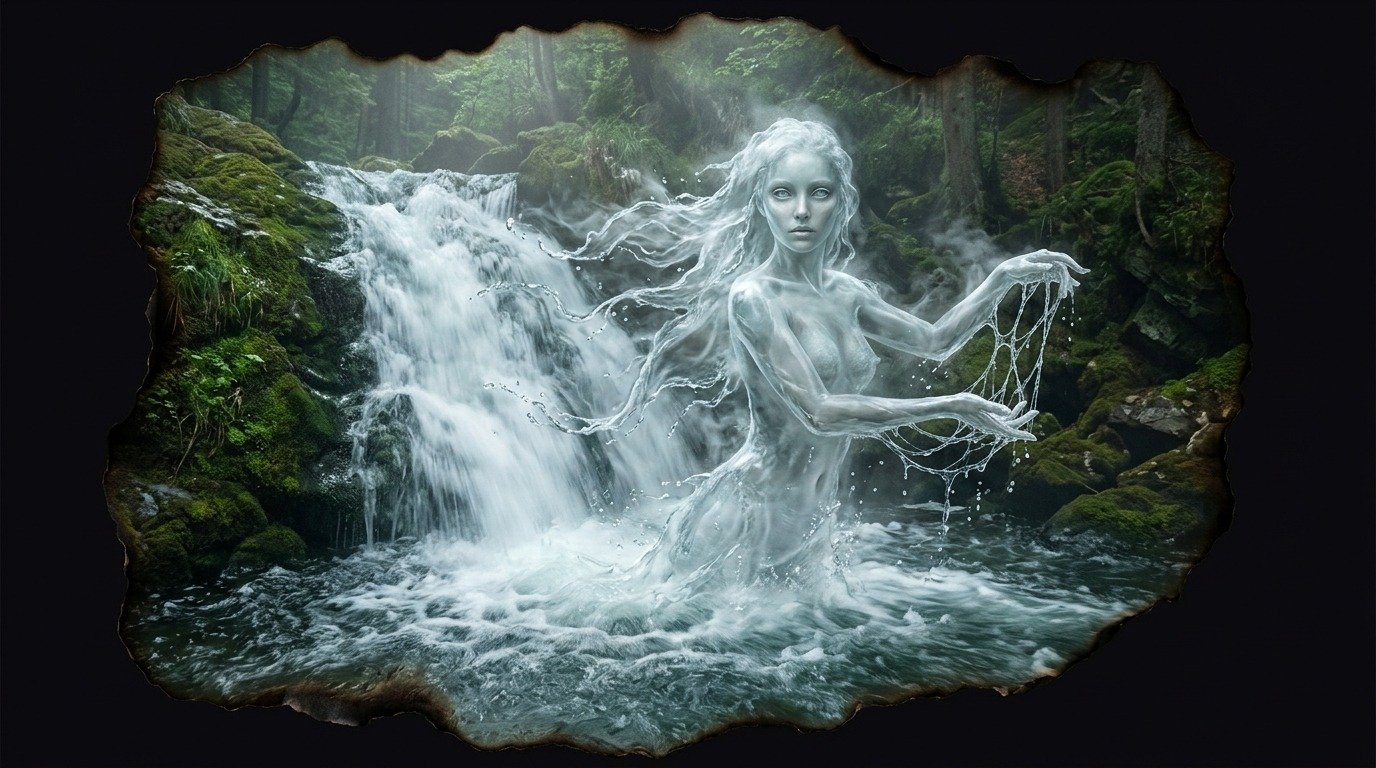
Undines: the weavers of water and the elusive soul
The mirrorless reflection
In the treatises of the ancient sages of transmutation and the secrets of matter, it is said that the universe is guarded by four families of pure spirits. Of all of them, the one that inhabits the liquid element is the closest to human physiognomy and, at the same time, the most tragically distant. Undines are not simple creatures that swim in rivers; they are water itself endowed with will, a current that has taken the form of a woman to be able to contemplate the dry world. Unlike men, made of clay blown by divine breath, undines were modeled with the changing and fluid substance of springs. This elemental purity condemns them: they lack an immortal soul. They live for centuries, gliding beneath the ice of winter lakes or dancing in the foam of waterfalls, but when they die, there is no heaven or hell for them; they simply dissolve into the moisture of the air or merge with the common current, losing all self-awareness. From this is born their innate melancholy and their dangerous fascination with mortals.
The pact of fluidity
For an undine, human love is not a romantic whim, but an ontological search for salvation. The physician and alchemist Paracelsus described this mystery with precision: by uniting in marriage with a man and conceiving a child, the undine receives the gift of a soul. In that instant of sacred communion, her gaze, previously cold and clear like meltwater, acquires the dark depth and weight of the human spirit. She becomes mortal, experiencing the pain of aging and the promise of eternity. However, this surrender carries absolute risk. The man who takes a creature of the rivers as his wife must remember that water does not tolerate offenses. If the husband is unfaithful to her or mistreats her, especially near a stream of water, the undine will be magnetically dragged back to her element of origin, losing her human home but retaining her newly acquired soul, now heavy with pain. Even worse is the fate of the traitor: elemental law demands that the undine take his life. Not out of worldly revenge, but out of a need for cosmic balance. The unfaithful man will drown in his own bed or be dragged to the bottom of a pool that seemed harmless, where his last breath will be devoured by the water he once claimed to love.
Water between the hands
In the great machinery of hermetic philosophy, undines occupy an intermediate place of temperance. While the gnomes of the earth are dense and coarse, and the salamanders of fire consume everything they touch with a purifying violence, undines share with the sylphs of the air the subtle lightness of constant movement. Their presence is perceived in the atmosphere just before a storm, when the air becomes heavy and humid, or in the strange stillness of mountain lakes, where the reflection of the shore seems more real than the shore itself. Those who have locked eyes with one of them at the edge of a damp forest describe a beauty that disquiets more than it attracts. Her skin is so pale it seems translucent, her eyes do not blink at the rhythm of ours, and her voice has the lulling tone of pebbles dragged by a gentle tide. They are the personification of fluidity: impossible to retain by force, destructive when one attempts to dam them, and givers of life when allowed to run free.
The treatise of Paracelsus
The *Undines* (from the Latin *unda*, "wave") represent the esoteric formalization of the elemental spirits of water in the hermetic tradition and the natural philosophy of Renaissance Europe. Although their roots lie in the nymphs of classical antiquity and Greco-Roman naiads, their definitive conceptualization was structured by the Swiss physician, alchemist, and astrologer Paracelsus (Theophrastus von Hohenheim) in his treatise *Liber de Nymphis, Sylphis, Pygmaeis et Salamandris* (1566). For Paracelsus, the cosmos is inhabited by beings that occupy an intermediate space between the physical and the purely spiritual. Undines are the legitimate rulers and inhabitants of the liquid element (rivers, lakes, springs, and seas). They possess subtle bodies of ethereal matter, are capable of experiencing human passions, falling ill, and dying, but they lack a fundamental ontological property: an immortal soul.
The punishment of the traitor
The Undine demands absolute fidelity and perpetual reverence toward the water element. If the husband offends her near any watercourse, or if he is unfaithful to her on land, the Undine will instantly return to her elemental realm. Nevertheless, the offense does not go unpunished: occult law forces the Undine to execute the traitor, usually by causing his suffocation or drawing away his life through a wasting disease that dries up his bodily fluids.
Esoteric and alchemical significance
In the *Great Work* of Alchemy, Undines personify the processes of dissolution, purification, and fixation of philosophical mercury (*solve et coagula*). They represent the feminine, passive, moist, and intuitive aspect of the prima materia. Contact with the Undine is the descent into the waters of transmutation; for the alchemist to achieve mental transmutation, they must learn to govern the emotional and intuitive forces that these entities embody, avoiding being drowned by them. From the standpoint of cabalistic esotericism, Undines are under the regency of the archangel Gabriel, the ruler of the North, and answer to the name of the elemental king *Niksa*. Their season is autumn, their direction the west, and their microcosmic manifestation in the human body governs lymphatic fluids, blood, and the processes of secretion and psychic gestation.
Invocation, respect, and hermetic warnings
Texts of high magic and theurgy establish strict guidelines for those seeking to commune with the elemental spirits of water: 1. **Purification by Water:** To approach the vibration of the Undines, the operator must undergo rigorous fasting and ritual washings with consecrated spring water, banishing from their mind all thoughts of worldly lust or greed. Undines flee from coarse and violent spirits, but are drawn to beauty, poetry, and mystical devotion. 2. **The Prayer of the Elementals:** The mage uses the famous *Prayer of the Undines* (preserved by Eliphas Lévi in *Dogme et Rituel de la Haute Magie*), invoking the "Terrible King of the Sea" to balance the internal currents of the operator. 3. **The Danger of Obsession:** The greatest risk in theurgical work with Undines is *astral fixation*. A mage who allows themselves to be seduced by the ethereal beauty of a water elemental will gradually lose their physical vitality and their interest in the material world, falling into a lethargic apathy (damp melancholy) that consumes their inner fire, becoming an empty shell dominated by astral fantasies.
Comments
Share information, an experience, or a source to help enrich this entry. They are automatically reviewed before being published.
Loading comments...