Sylph
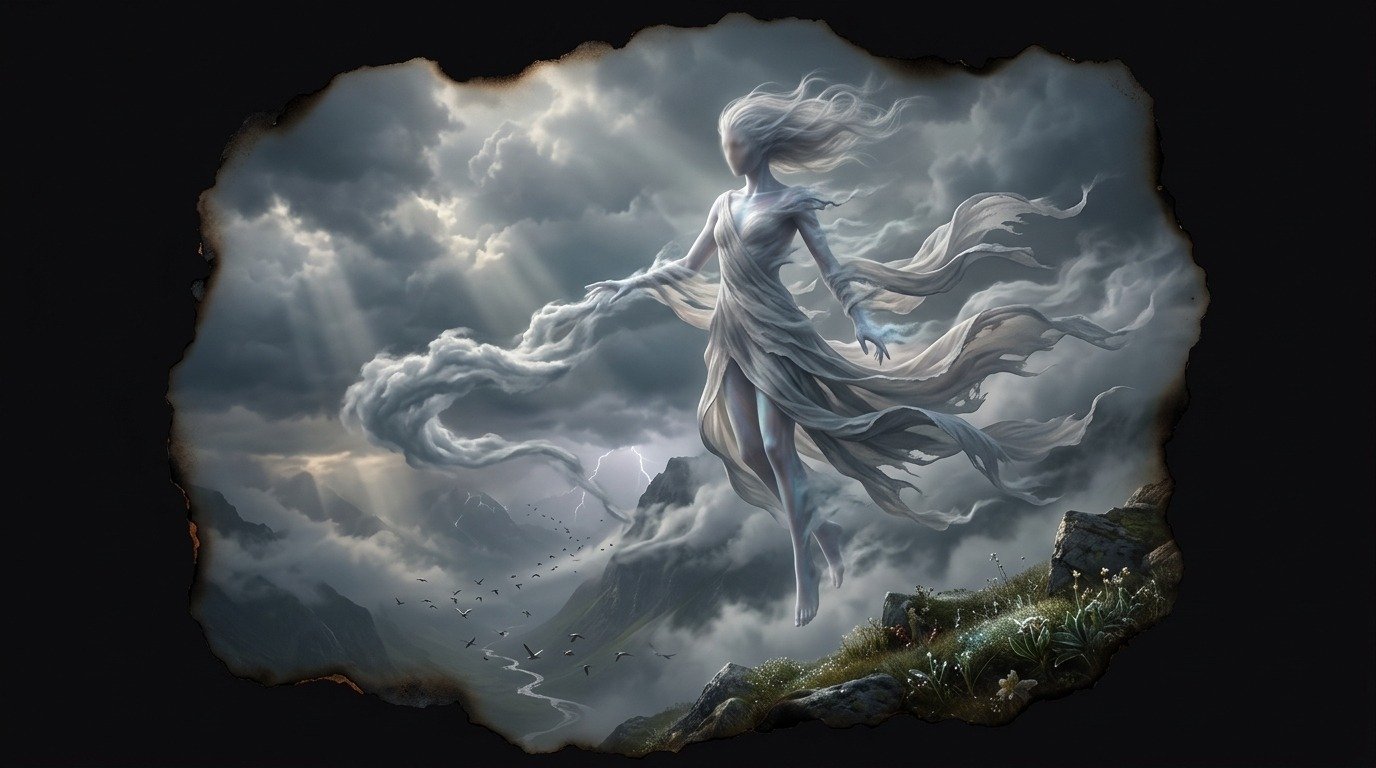
Sylph: The Breath of Invisible Transmutation
The Riders of Subtle Chaos
Above the heaviness of earth and water stretches the vast empire of the air, a space that ancient sages and nineteenth-century theosophists called "Chaos." This is the domain of the sylphs, the elementals of air, creatures whose physical subtlety places them on the very boundary between the material and the purely spiritual. Paracelsus described them as taller and more slender than humans, of an ethereal and androgynous beauty, whose forms constantly change contour, mimicking the flow of clouds and the volatility of the wind.
Sylphs do not walk on the ground; they float and glide through atmospheric currents. Their consistency is so light that they can occupy the same space as a solid body without being perceived, and their presence is only betrayed by a sudden change in air temperature, an aroma of ozone after a storm, or the sudden movement of a curtain in a closed room. While gnomes represent fixity and contraction, sylphs are the personification of expansion, continuous movement, and the lightness of thought.
The Weavers of Weather and Human Inspiration
The function of the sylphs is the regulation of the invisible currents that envelop the globe. They direct the course of clouds, guide the migrations of birds, and balance the tensions of the atmosphere to prevent the sky from collapsing onto the earth in an eternal tempest. They are also the bringers of morning dew and those who cleanse the air of poisonous vapors rising from swamps and the industries of men.
On the mental plane, esoteric tradition attributes to sylphs a direct influence on human imagination and intellect. By inhabiting the element that serves as a vehicle for sound and the spoken word, sylphs communicate with the brains of poets, inventors, and philosophers through breaths of intuition. A sylph can deposit a brilliant idea in a man's mind while he contemplates the evening sky, or flutter its wings to disperse the mists of melancholy that cloud his reason. However, this very nature makes them fickle and inconstant. They lack the constancy of gnomes; their emotions are as swift as gusts of wind, passing from the most radiant joy to the destructive fury of a hurricane in a matter of moments.
The Search for the Divine Spark
Like their brothers of the earth, sylphs are devoid of an immortal soul. This lack fills them with a secret melancholy manifested in their sad songs, which men sometimes mistake for the whistling of the wind in window cracks or in the tops of pine trees. The sylph yearns for human immortality with a desperate intensity.
To obtain a soul, a sylph must find a human being whose mind is as pure and elevated as the air itself. Through a mystical union—which is not based on physical contact, but on the perfect attunement of thoughts and spiritual aspirations—the sylph amalgamates with the mortal's soul. This type of union elevates the human to never-before-seen heights of artistic or scientific genius, but also condemns them to a hypersensitivity that often distances them from the society of their peers. When the human dies, the sylph, now endowed with an eternal divine spark, accompanies them in their transition to the celestial spheres, leaving behind the air of the earth that for millennia was its home and its prison.
Comments
Share information, an experience, or a source to help enrich this entry. They are automatically reviewed before being published.
Loading comments...