The King and Queen of the Fairies
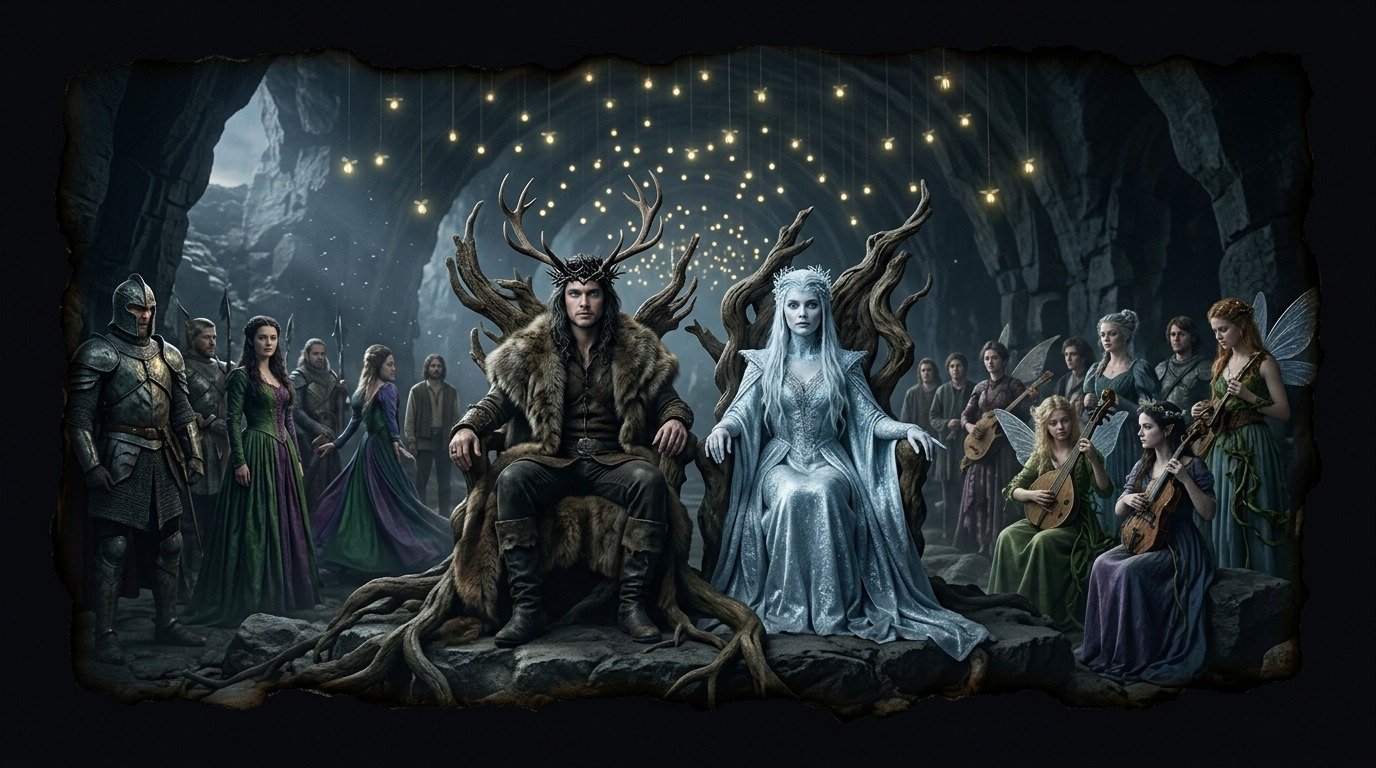
The King and Queen of the Fairies: The Sovereigns of Twilight
The Crowns of Frost and Thorns
In the heart of the densest forest, there where the sunlight breaks into motes of golden dust and time seems to stand still in an eternal sunset, rises the court of the invisible sovereigns. The King and Queen of the Fairies are not mere rulers by right of lineage; they are the very embodiment of nature in its purest, most majestic, and terrible state. Their names change depending on the hill they inhabit or the wind that carries their whispers—he may be the untamed Gwynn ap Nudd, the cunning Finvarra, or the crowned Oberon; she, the icy Queen Mab, the radiant Oona, or the unfathomable Titania—but their essence is immutable. They are the embodiment of the desire and rigor of winter, the blossoming of spring, and the decay of autumn.
Physically, their beauty is not that of mortals; it is a cold symmetry, sharp as cut glass. The King usually presents himself with eyes the color of frozen lakes and hair that carries the scent of fallen leaves and damp earth; his crown is made of stag antlers and blackthorn thorns. The Queen, for her part, wears a gown woven from the glow of the moon and the silk of heath spiders; her fingers are long and pale, capable of caressing with the softness of a May breeze or freezing the blood with a single touch of her mother-of-pearl fingernail. Together they rule from thrones carved from the roots of ancient oak, surrounded by a court of knights in beetle armor and ladies whose dresses change color according to the mood of their lords.
The Palace Under the Hill
The kingdom over which they hold sovereignty knows no maps. Their palaces are found beneath prehistoric barrows, the green hills that men avoid treading upon after sunset. Whoever is invited into their halls through a crack in the rock does not find the darkness of a cavern, but infinite vaults supported by basalt columns and ceilings from which thousands of motionless fireflies hang. There, the monarchs preside over eternal banquets where blackberry wine that makes one forget the past is served, along with pollen cakes that drive anyone who tastes them mad with longing.
Music in their presence is a deadly danger. Under the gaze of the monarchs, the fairy orchestra plays melodies that alter the course of time: a single dance in their hall, which to the mortal seems to last barely a few minutes, is equivalent to a hundred years in the outside world. The monarchs observe this passage with a sovereign indifference. They do not hate humans, any more than the wind hates the dry leaves it sweeps away; they simply consider them fleeting creatures, curious toys to add to their collection of oddities, or temporary servants for their fields of asphodels.
The Whims of the Invisible Royalty
The relationship between the royal couple is as tempestuous as the weather of the northern islands. Their disputes are not resolved with words, but with the changing of the seasons and the fortune of human harvests. If the King and Queen argue, crops rot in the fields under unseasonal torrential rains, or winter prolongs itself until it devours spring. When they reconcile, the earth blossoms in a single night and the beasts of the forest give birth with astonishing fertility.
Sometimes, the entire court goes out in procession during nights of the full moon: it is the so-called Fairy Cavalcade. Mounted on white steeds whose hooves leave no print on the grass and whose silver bridles chime with the sound of a thousand bells, the King and Queen lead a procession that crosses the moors. Any mortal who crosses their path must prostrate themselves on the ground and cover their eyes; to see the Queen's face in her nocturnal splendor condemns a man to incurable blindness, and to lock eyes with the King instills a melancholy that can only be cured by death. They are the lords of the border between what is and what is dreamed, and their laws admit no appeal.
Comments
Share information, an experience, or a source to help enrich this entry. They are automatically reviewed before being published.
Loading comments...