Cyclops
Cyclops: The Forgers of Lightning and the Builders of the Colossal
The Three Lineages: Divine, Shepherds, and Builders
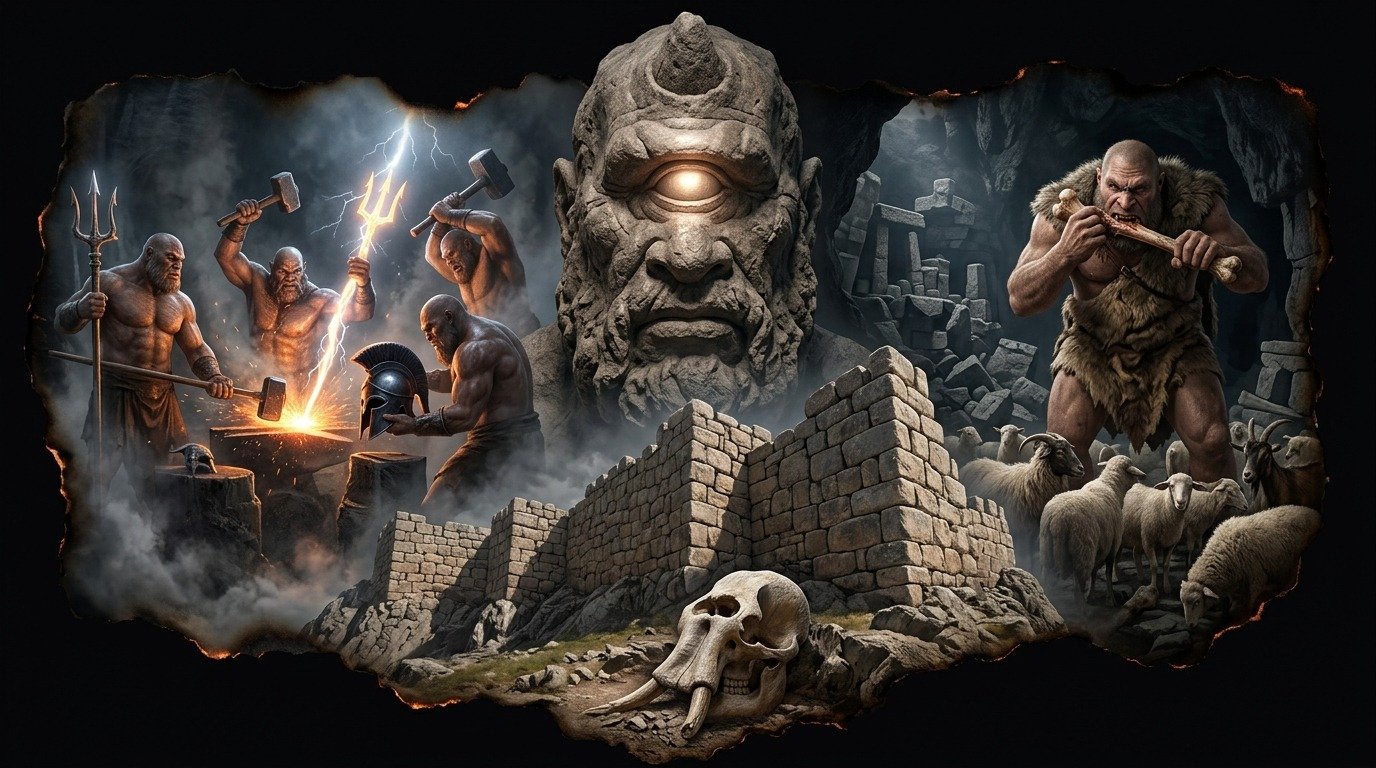
The figure of the Cyclops (from the Greek *Kýklōps*, "round eye") is one of the most complex mystical structures of classical antiquity, often distorted by literary simplification. Hellenic tradition, from Hesiod to Strabo, clearly distinguishes three lineages or races of cyclopes, completely differentiated by their origin, function, and metaphysical nature. The first lineage is that of the **Uranian or Divine Cyclopes** (Brontes, Steropes, and Arges: Thunder, Lightning, and the Bright Thunderbolt). Children of Uranus (the Sky) and Gaia (the Earth), they represent primordial cosmic forces. Imprisoned by their father in Tartarus due to their fearsome power, they were freed by Zeus during the Titanomachy. In gratitude, they forged for him the thunderbolt and lightning, the ultimate weapons that granted sovereignty to Olympus; likewise, they forged Poseidon's trident and Hades's helmet of invisibility (Kynée). They are divinities of celestial metallurgy, masters of the forge who dwell in the depths of volcanoes, especially beneath Mount Etna, collaborating with Hephaestus. The second lineage is that of the **Homeric or Shepherd Cyclopes**, immortalized in the *Odyssey* through the figure of Polyphemus. These are neither gods nor divine artisans, but wild, brutal, and unsocial giants who inhabit the island of Sicily (or the island of Trinacria). They know no laws, do not practice agriculture, lack political assemblies, and live in isolated caves devouring human flesh. They are sons of Poseidon and represent the wildest and most chaotic aspect of maritime and terrestrial nature, completely alien to the order of the Greek *polis*. The third lineage is that of the **Builder or Argive Cyclopes**, originating from Lycia according to Strabo. To them is attributed the construction of the Mycenaean walls of Tiryns, Mycenae, and Argos. These structures, made of colossal stone blocks laid without mortar, were considered impossible to build by human hands, giving rise to the technical term "cyclopean architecture".
From Cosmic Fire to Barbarism
The evolution of the myth of the Cyclops moves from high spiritual theogony to rationalist and paleontological explanation. In the 20th century, paleontologists like Othenio Abel proposed a materialistic explanation for the physical origin of the myth: the discovery by ancient Greek sailors of fossilized skulls of dwarf elephants (*Palaeoloxodon falconeri*) in the coastal caves of Sicily and Cyprus. These skulls feature a large central nasal cavity which, to eyes unfamiliar with proboscidean anatomy, perfectly resembles the socket of a single, colossal central eye. Historically, the Cyclops went from being the sustainer of Zeus's power to becoming a symbol of barbarism that must be overcome by human intelligence, as dramatized in the confrontation between Odysseus (wit, *Nobody*) and Polyphemus (monocular brute force). In the Hellenistic and Roman eras, poets like Virgil portrayed them purely as industrial laborers of the volcanic forge, losing their character as primordial deities to become the muscular machinery of the Empire.
The Single Eye: Initiatic and Alchemical Symbolism
The symbolism of the single eye in the forehead of the Cyclops is of a profound hermetic richness. It represents monocular vision, that is, perception without duality, but in two opposite senses depending on the lineage analyzed. For the Uranian Cyclopes, the single eye is the **Eye of Providence** or the Third Eye (the active pineal gland). It is pure spiritual vision, the direct perception of the laws of the cosmos before reality fragments into the binomial of good and evil (the two eyes of ordinary human perception). Its location on the forehead indicates the concentration of will and mental power. Forging Zeus's thunderbolt means channeling diffuse spiritual energy and concentrating it into a point of absolute and destructive power. For the Homeric Cyclopes like Polyphemus, the single eye represents spiritual blindness and obsessive fixation. It is the hypertrophied consciousness of the ego that can only look forward, unable to possess peripheral vision or dialectical perspective. Lacking two eyes, they have no perception of depth or empathy; they see the world in a flat and utilitarian way: food, shelter, and livestock. Blinding Polyphemus, therefore, is equivalent to destroying the illusion of the tyrannical ego through the use of the subtle intellect.
Manifestation and Historical Record
The imprint of the cyclopes remains engraved in the stone of the Mediterranean. The cyclopean walls of Mycenae and Tiryns still stand as physical testimony to human fascination with the colossal. In the manuals of theurgy and magic of the Olympic current, contact with the energy of the Uranian Cyclopes (especially through invocatory formulas addressed to Brontes or Steropes) was used for: * **The Consecration of Tools of Power:** Charging metal ritual instruments with martial or operative energy through the visualization of the volcanic forge of Etna. * **The Opening of the Mental Focus:** Rituals aimed at destroying mental dispersion and focusing the entirety of the operator's willpower on a single precise objective (the lightning bolt). * **Protection against Chaotic Entities:** Invoking the strength of the forgers of the Olympic order to dissipate astral parasites through the glare of the primordial lightning's light.
Comments
Share information, an experience, or a source to help enrich this entry. They are automatically reviewed before being published.
Loading comments...