Ojáncanu
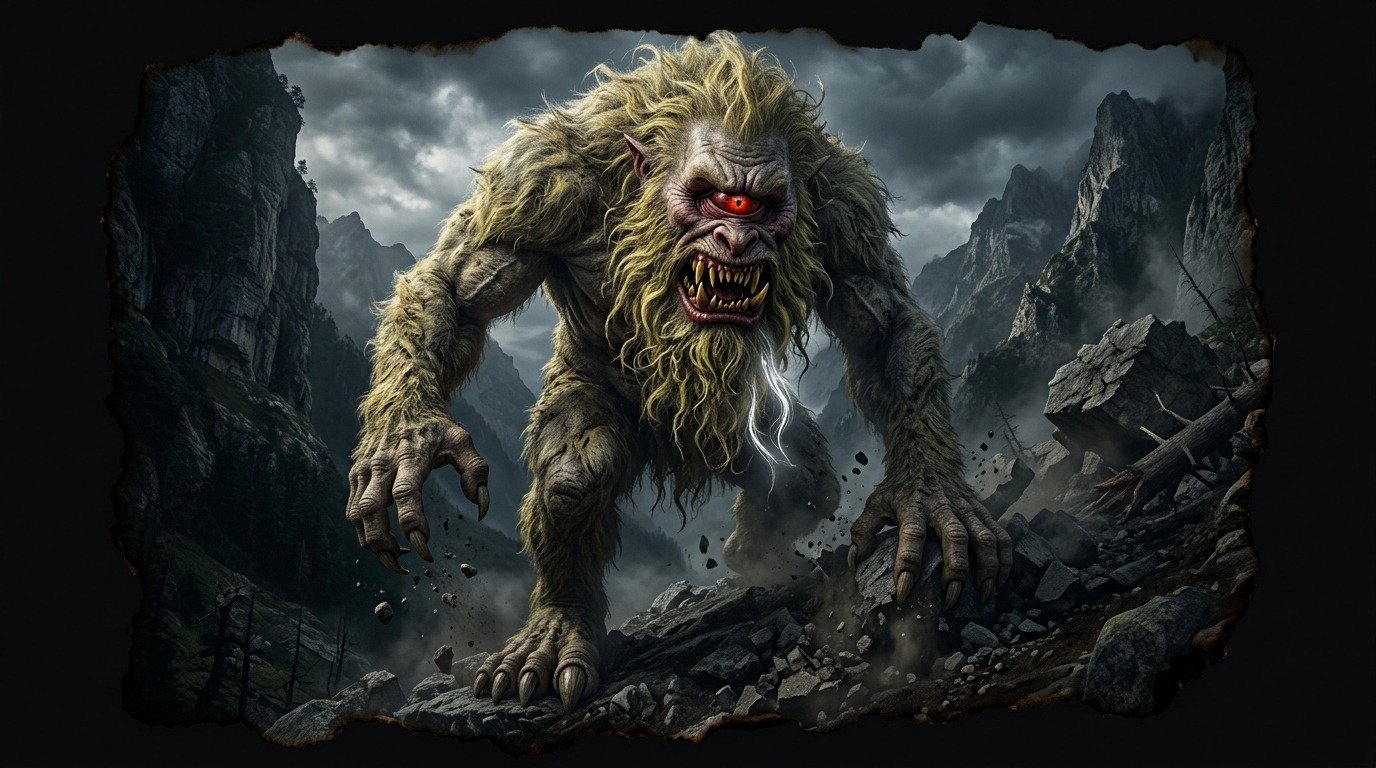
Ojáncanu: The Telluric Wrath of the Cantabrian Mountain
The Shadow Over the Cantabrian Cornice
In the depths of the valleys and the most inaccessible caves of Cantabria, in the north of the Iberian Peninsula, dwells the Ojáncanu. This being is the embodiment of absolute evil, destructive chaos, and the unleashed telluric forces in Cantabrian folklore. Unlike other European giants who show moments of comical clumsiness or neutrality, the Ojáncanu is an active force of pure malevolence, a constant scourge to the balance of mountain life.
Physically, it is a colossal creature, anthropomorphic yet deformed in appearance. It possesses a single eye in the middle of its forehead, which glows with a bloody red color, directly linking it to the cyclopean traditions of the Mediterranean and the Atlantic. Its body is covered in a coarse, thick coat of yellowish or grayish fur, similar to that of a mangy wolf or an old wild boar. Its mouth is an abyss equipped with two rows of sharp, yellow teeth, from which sprouts a long, tangled beard of the same color as its fur. It has ten toes on each foot and ten fingers on each hand, tipped with nails as hard as flint, which it uses to dig into the earth and tear through rock.
Life Cycle and the Tragedy of the White Hair
The Ojáncanu is not born through common natural means. Its reproduction is linked to a cycle of monstrous death and regeneration: when an Ojáncanu grows old and senses its death, its peers slit it open and bury it under an oak tree or in the depths of a chasm; from its decomposed flesh, large yellow worms are born, which, after a period of underground gestation lasting several years, emerge transformed into young and hungry Ojáncanus. There also exists the Ojáncana or Juáncana, its female equivalent, who is even more ruthless; she lacks fangs but possesses enormous sagging breasts that she must fling over her shoulder in order to run, and she feeds her offspring with human blood.
The only vulnerability of the Ojáncanu lies in its own beard. Hidden among the dense yellowish hair, a single, long **white hair** grows. This filament is the receptacle of its vital force and its magical power. If an extraordinarily brave man manages to approach the giant while it sleeps and pulls out this white hair, the Ojáncanu instantly loses all its strength, goes blind in its single eye, and dies amidst horrific screams that make the mountain peaks tremble. However, if the attempt fails and the Ojáncanu wakes up before losing the hair, the intruder's death is guaranteed in the most atrocious way imaginable.
Esoteric and Telluric Interpretation
The Ojáncanu represents the destructive forces of the geology and climate of the Cantabrian Mountains. It is the rockslide that buries shepherds' huts, the lightning bolt that strikes down sacred oaks, the flash flood that destroys crops, and the sudden fog that drives livestock over cliffs. Within the framework of comparative mythology, it shares space with the Irish Balor or the Basque Tártalo, personifying the sterile winter and the summer sun that parches the fields.
Esoterically, it represents unrefined raw material, the lead of the alchemists in its densest and most destructive state. It is the inflated and blind ego (a single eye) that devours everything around it due to an inability to see beyond its own immediate appetites. The struggle to pluck the white hair is the process of the *Great Work*: extracting the subtle thread of spiritual purity (the white hair of wisdom) from the depths of corrupt and monstrous matter (the body of the giant).
Traditional Defenses and Folkloric Record
The inhabitants of the Cantabrian mountains relied on cunning and the intercession of beneficent forces to survive living in the vicinity of the Ojáncanu:
* **The Intercession of the Anjanas:** The Anjanas, good fairies of Cantabrian mythology, are the natural enemies of the Ojáncanu. When the giant is about to commit an atrocity, the Anjanas usually intervene by temporarily blinding him with stardust or turning his club blows into caresses of wind. * **The Flight of Bats and Owls:** It is said that the Ojáncanu deeply fears bats and owls. If a traveler is pursued by the giant at night, they must imitate the sound of the owl or throw wing-shaped stones to make him believe these creatures are nearby, which will force him to retreat to his cave. * **The Sign of the Ash Cross:** Placing crossed branches of ash—a sacred protective tree—over the doors of huts prevents the Ojáncanu from tearing down the walls, forcing him to pass by.
---
Comments
Share information, an experience, or a source to help enrich this entry. They are automatically reviewed before being published.
Loading comments...