Nahual
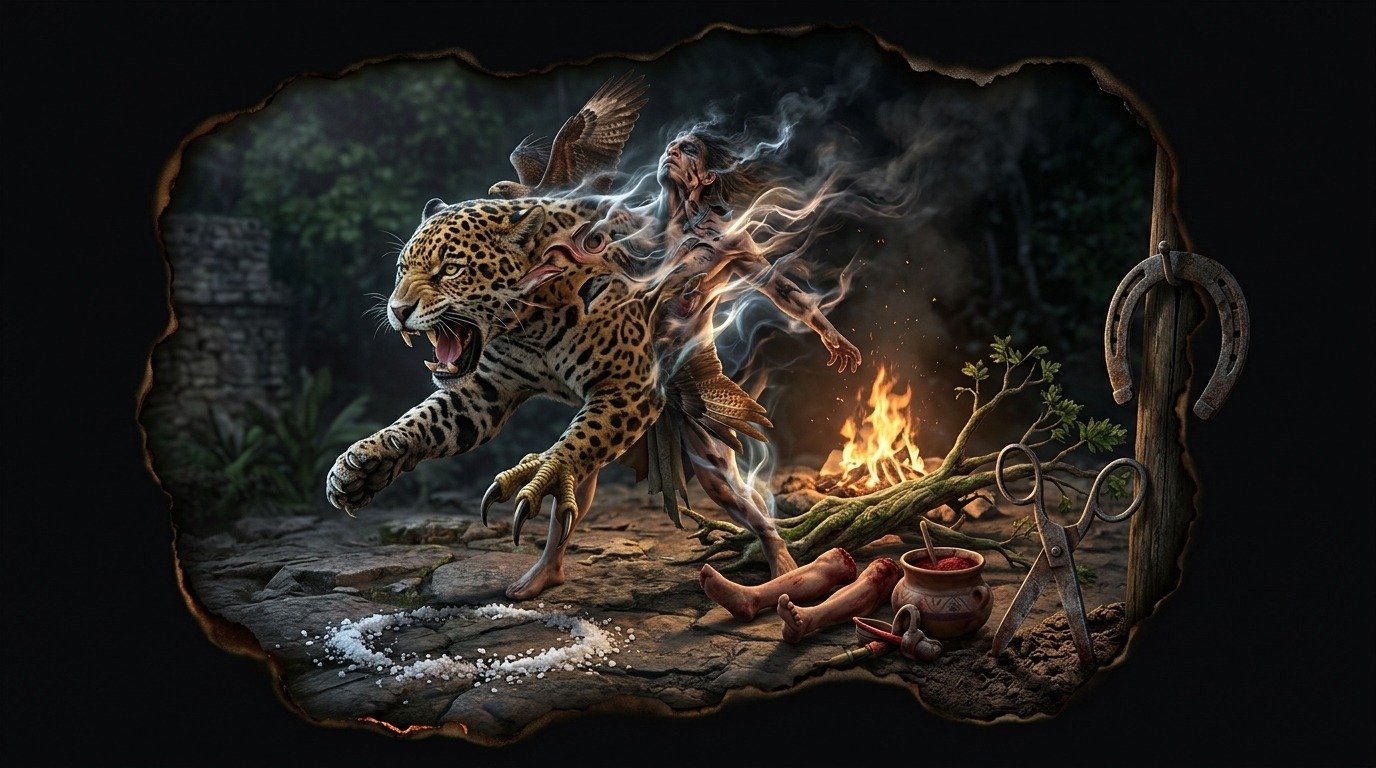
Nahual: the zoomorphic alter ego and the lord of transmutation
Ontological Origin and Identity
The figure of the nahual (from the Nahuatl *nahualli*, whose meaning fluctuates between "double", "disguise" or "the hidden") sinks its roots into the pre-Hispanic Mesoamerican worldview. It is not a mere lycanthropic creature in the European folkloric sense, but rather a complex ontological concept based on the dualism of the soul. In Toltec, Mexica, and Maya thought (where it is known as *way* or *wayob*), every human being is born in intimate spiritual communion with an animal or a natural phenomenon. This connection is divided into two aspects: the *tonal* (the diurnal life force, the destiny linked to the sacred calendar) and the *nahual* (the nocturnal counterpart, the capacity for spiritual projection outside the body). The *nahualli*, in its strictest sense, is the ritual specialist—shaman, priest, or sorcerer—who possesses the knowledge and spiritual strength necessary to shed their human envelope and manifest their consciousness in the bodily vehicle of their animal counterpart.
Historical Evolution and Demonization
During the pre-Hispanic period, nahualism was a sacred institution. Rulers and high-ranking priests possessed nahuales of great power, such as the jaguar (*ocelotl*) or the eagle (*cuauhtli*), considered extensions of their sovereignty and their capacity for intermediation with the underworld (*Mictlán*). However, with the arrival of the Spanish colonizers and the subsequent imposition of the tribunal of the Holy Office, this practice was immediately assimilated into European witchcraft and the demonic pact. Catholic theology transformed the wise transmuter into a servant of the devil who traded his soul to transform into a beast. In the contemporary folklore of central and southern Mexico, as well as in Guatemala, the nahual survives under two contradictory facets: on one hand, the community protector who watches over the crops in the form of a white dog or coyote; on the other, the nocturnal thief and parasitic entity that adopts grotesque forms—huge pigs, headless donkeys, or birds of ill omen—to plague the villages.
Esoteric and Archetypal Significance
From a hermetic and psychological perspective, the nahual represents the integration of the shadow and mastery over the astral body. Transmutation is not physical in the plane of dense matter, but rather a mental and energetic projection of such intensity that it alters the sensory perception of those who witness it (a phenomenon of collective hypnosis or dimensional transposition). It represents the voluntary regression to the primordial state, shedding the mask of civilization to access the instincts and the telluric power of the animal kingdom. It is the guardian of the threshold between the conscious world and the collective unconscious; a master of the plasticity of matter who demonstrates that the human body is only one of the multiple garments that the spirit can adopt.
Manifestation and Defense Protocols
Esoteric tradition and rural folklore record that the process of transmutation requires a physical detachment. The operator must perform a ritual of disarticulation (frequently described as "detaching the legs" or performing ritual jumps over a bonfire) and leave their original body hidden in a safe place, usually under the protection of a sacred tree like the ahuehuete or the ceiba. If this empty body is moved, anointed with salt, or altered from its original position, the nahual will not be able to return to its human form, remaining trapped in the beast or perishing at dawn. To repel or subdue a nahual of hostile intentions, popular witchcraft treatises prescribe: * **Metal and inversion:** Placing open scissors in a cross under the pillow or hanging blessed horseshoes on the doors of homes. * **Live salt:** Drawing circles of coarse salt around the perimeter one wishes to protect; the salt acts as a solvent for the projected astral energy. * **The obsidian mirror:** Showing the nahual its own reflection under the moonlight destabilizes its projection, forcing it to confront the division of its own soul and forcing its immediate flight.
Tonalism and nahualism
Nahualism is an initiatory practice of high spiritual specialization, linked to the political, military, and sacred power of ancient Mexico, present in the Nahua, Maya, Zapotec, and Mixtec world. It must not be confused with European lycanthropy, which is essentially a pathology or a demonic curse. In the Mesoamerican worldview, human existence is intrinsically linked to the universe through two fundamental concepts: - **Tonalism:** The mystical and astrological connection of each individual, from birth, with a protective animal or natural phenomenon (the *tonal*), determined by the ritual calendar (*Tonalpohualli*). The destiny of the man and that of his animal run in parallel; if the animal falls ill or dies, the man suffers an identical end. - **Nahualism:** The active and conscious capacity of certain priests, shamans, or high-ranking warriors (the *nahuallis*) to project their life force (*teyolía* or *ch'ulel*) outside the human body and embody the form of their complementary animal, or else transmute their own physical body into a zoomorphic manifestation (jaguar, eagle, serpent, coyote) or into a meteorological phenomenon (lightning, a fireball).
The office of the nahualli
Following the Spanish conquest, chroniclers and inquisitors (such as Fray Bernardino de Sahagún in his *General History of the Things of New Spain* or Hernando Ruiz de Alarcón in his *Treatise on the Heathen Superstitions and Customs*) classified the *nahualli* as an agent of the devil, reducing their practice to malevolent witchcraft and pacts with the devil.
However, for the native communities, the *nahualli* fulfilled an ambiguous but necessary social role: - They were the guardians of the spiritual borders of the community. - They acted as healers capable of traveling to the underworld (*Mictlán*) to rescue the lost souls of the sick. - They served as warriors capable of spying on enemies under the form of birds or fast felines.
The transformation of the nahual did not depend on animal fat ointments, but on a deep ascetic training that included prolonged fasting, sleep deprivation, ritual consumption of sacred plants (such as *teonanácatl*, *oloiliuhqui*, or *peyote*), and the ability to split consciousness through the voluntary shedding of human skin, which remained protected in the sorcerer's home while their essence inhabited the body of the beast.
The jaguar and the mountain paths
In Nahua esotericism, the universe is a fluid network of energies where the border between the human, the animal, and the divine is not rigid, but permeable. By assuming the form of their nahual (for example, the jaguar, associated with the god Tezcatlipoca, the smoking mirror), the shaman accesses the atavistic memory of the species, the night vision of the predator, and the terrestrial strength of nature.
Nahualism survives today in the indigenous communities of central and southern Mexico and Guatemala, where sightings are reported of "giant black dogs without ears or tails," or "birds of monstrous wingspan" that watch over the mountain paths.
Hurting the animal is hurting the sorcerer
Hunting a nahual requires a metaphysical rather than a physical understanding, since hurting the animal implies directly hurting the shaman in their bed miles away: - **The trap of the mirror and the water:** To discover the true identity of a nahual prowling a dwelling, one must place a jícara with clean water and a crossed iron knife at the bottom, under the moonlight. The nahual cannot bear to contemplate the reflection of its soul exposed by the metal and the water, and will avoid the place. - **Tejocote thorns and the ixtle cord:** Thorns from sacred trees or the use of ropes woven with blessed maguey fibers are the only elements capable of physically binding the beast without it being able to dissolve into smoke or wind.
Comments
Share information, an experience, or a source to help enrich this entry. They are automatically reviewed before being published.
Loading comments...