La Tunda
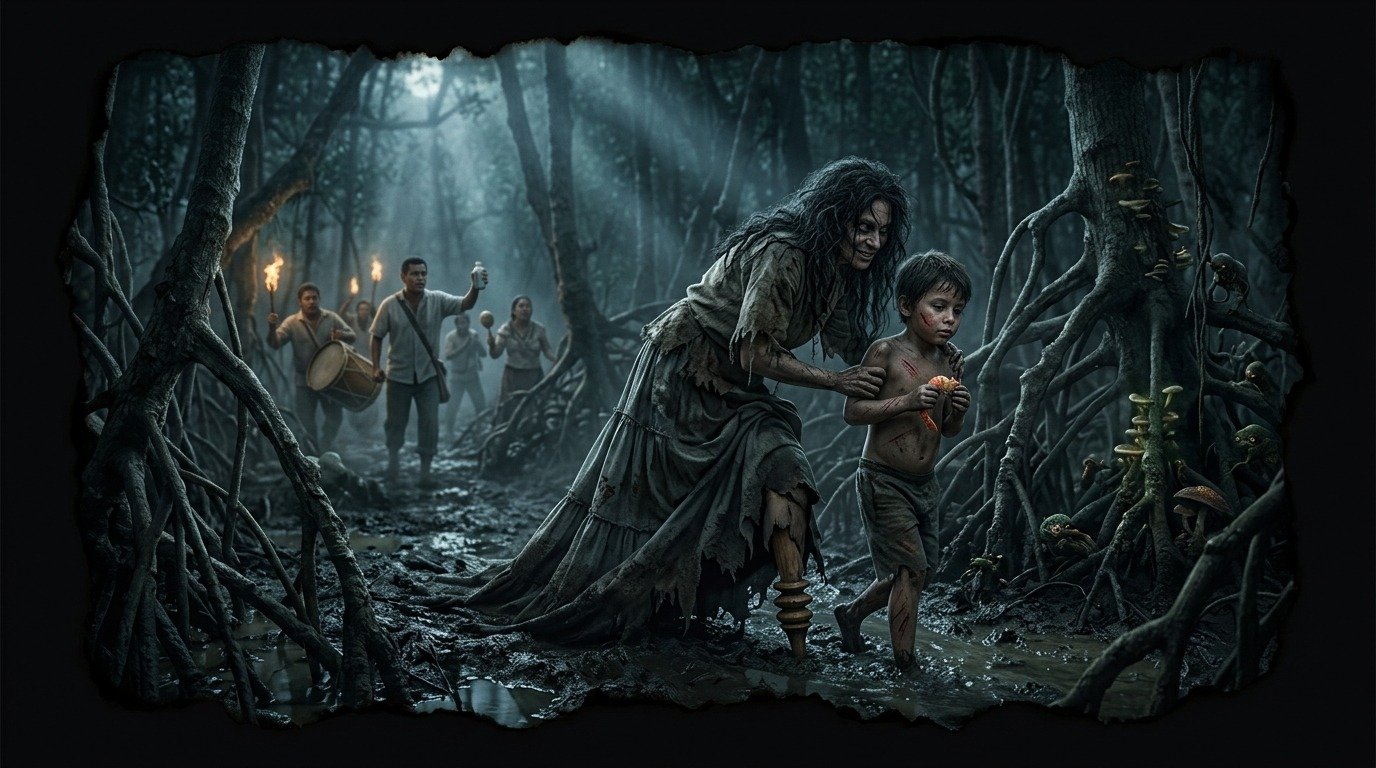
La Tunda: The Aberration of the Mangrove and the Abduction
Afro-Pacific Origin and Cosmogony
In the dense and labyrinthine wetlands of the Colombian-Ecuadorian Pacific, where the rainforest drowns in the ocean, dwells La Tunda. This being cannot be understood without the historical trauma of the African diaspora and syncretism with indigenous cosmogonies (mainly Emberá and Awá). Arising from the collective memory of the enslaved people who escaped to colonial *palenques* (maroon communities), La Tunda personifies the dangers of unknown territory, but also the forces of nature's resistance against human domestication. The roots of this being sink into the forest deities of West Africa (such as the *Sasabonsam* spirits of Ashanti mythology, tree-dwelling monsters with deformed legs). In the humid Americas, this entity mutated to become a woman of shifting physiognomy, whose primary mark of otherness and physical defect is one normal human leg and another that ends in a *molinillo* (the ribbed wooden utensil used to whisk cocoa) or a goat's hoof, which she cunningly hides under her wide skirts or by walking backward.
The Phenomenon of Entundamiento
La Tunda does not kill immediately; her method is psychological abduction, a state of mental suspension known regionally as *entundamiento*. The entity selects her victims based on two specific profiles: disobedient or unbaptized children, and unfaithful men or late-night wanderers. To lure them, La Tunda operates through perfect mimicry. She adopts the appearance of a loved one (the mother, the grandmother, or the desired woman). Once the victim yields to the deception and ventures into the heart of the mangrove, La Tunda feeds them shrimp and shellfish that she has previously seasoned with her own bodily gases or fluids charged with a hypnotic poison. This food plunges the person into a state of absolute lethargy, a catalepsy of the will where the individual perceives reality in a distorted way, losing track of time and forgetting their identity.
Social and Territorial Significance
From an anthropological perspective, La Tunda acts as a guardian of the social order and the ecological boundary. The mangrove is a space of survival, but also a threshold where the laws of the community cease to apply. The myth warns of the vulnerability of those who break community cords (filial disobedience, infidelity, defiance of baptismal rites). The *entundado* is he who has crossed the boundary of the human to be assimilated by the untamed jungle; he represents the loss of the soul at the hands of a nature that is not neutral, but actively hostile.
The Rite of Redemption and Protection
The only way to rescue an *entundado* is not through physical force, but through the restoration of the sacred order and community vibration. To break La Tunda's spell, family members must venture into the wilderness carrying specific elements: * **Sacred instruments of the Pacific:** The *bombo*, the *cununo*, and the *guasá*. * **Songs of resistance:** The *alabaos* (funeral and spiritual chants) and *arrullos* (devotional lullabies) directed to the saints or the Virgin. * **The presence of a priest or a godfather:** Who carries holy water. La Tunda, upon hearing the sacred percussion and collective songs, experiences intolerable pain due to her profane nature. She flees into the depths of the jungle, abandoning her prey, who is usually found in a semi-unconscious state, covered in mud and thorns, among the aerial roots of the mangroves. To complete the healing, the individual must be purged and spiritually baptized to cleanse the residues of the beast's poisonous food.
Comments
Share information, an experience, or a source to help enrich this entry. They are automatically reviewed before being published.
Loading comments...