Mapinguari
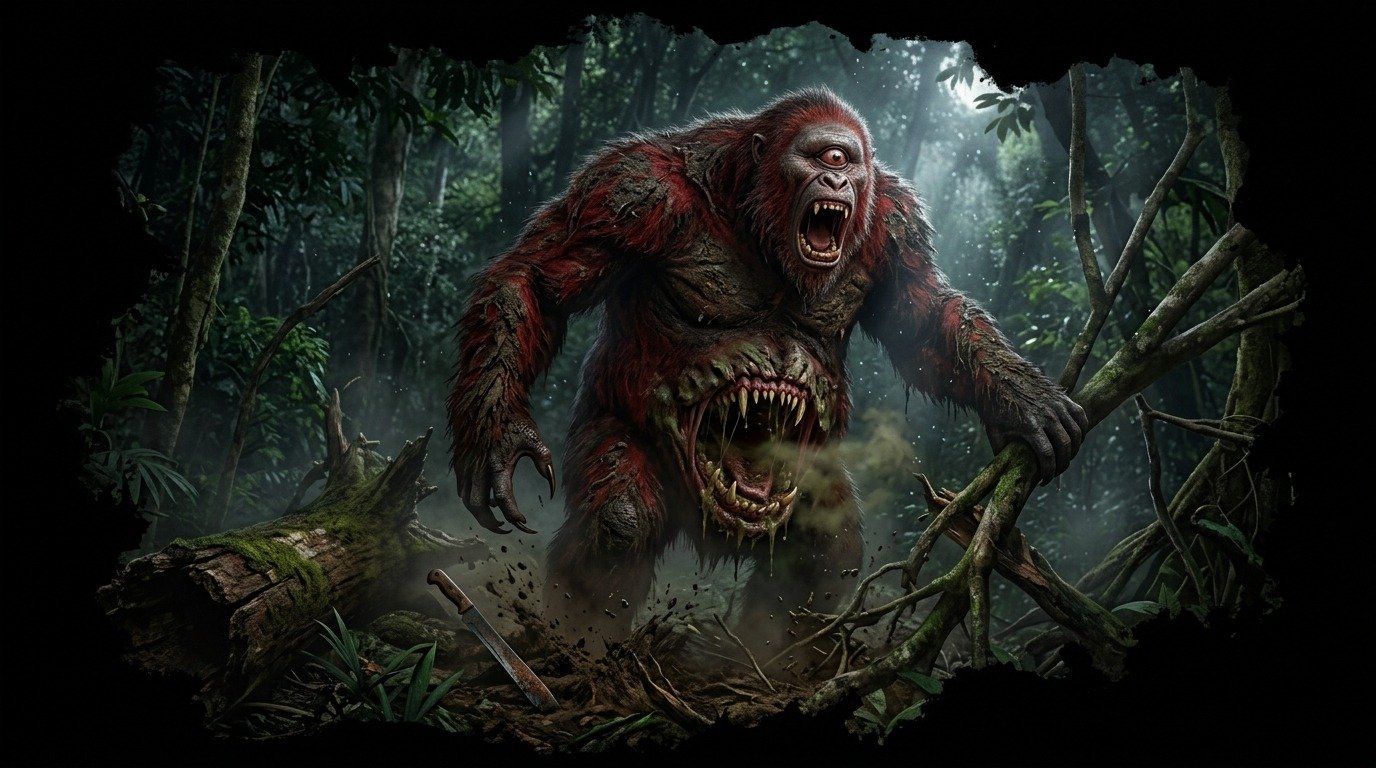
Mapinguari: The Roaring Beast of the Shield of Hair and the Ventral Mouth
Origin, Mythology, and Cryptozoological Perspective
In the unexplored depths of the Amazon rainforest, along the borders of Brazil, Bolivia, and Peru, dwells the Mapinguari (also called *Isnashi* by some native tribes). Folkloric descriptions and testimonies from caboclo and indigenous hunters describe a gigantic being, vaguely anthropomorphic in appearance but predominantly beastly, covered in thick, tangled reddish or blackish fur. Two monstrous characteristics define its physiognomy: it possesses a single eye in the middle of its forehead (a trait that links it to the cyclops archetype) and a huge, fetid secondary mouth located in its abdominal region, vertically aligned, which it uses to devour its prey whole.
From the perspective of cryptozoology and modern anthropology, researchers like biologist David Oren suggest that the myth of the Mapinguari could be the cultural memory passed down from generation to generation of real encounters with giant ground sloths (such as *Megatherium* or *Mylodon*), which survived in the Pleistocene refuges of the Amazon until a few thousand years ago. Its extremely thick skin, capable of deflecting arrows and bullets, matches the osteoderms (bony dermal plates) possessed by these extinct mammals.
Behavior and the Ecology of Putrefaction
The Mapinguari is a purely physical and territorial creature, unlike spiritual entities such as the Curupira or the Boitatá. It is described as a clumsy but unstoppable being, snapping branches and bending tree trunks in its path. Its most fearsome weapon, beyond its sharp claws, is its scent: it emits a nauseating gas, a mixture of sulfur and decaying organic matter, which incapacitates the nervous system of any animal or human within a wide radius, causing extreme disorientation, suffocation, and fainting, thus facilitating their capture. Its roars are described as human thunder, deafening screams that freeze the blood of those who hear them from kilometers (miles) away.
Symbology and the Mouth of the Stomach
On the archetypal plane, the Mapinguari represents the brute and irrational force of untamed nature. The mouth on the belly is a potent symbol of pure biological necessity and absolute voracity; it represents the devouring aspect of the rainforest, where life continuously consumes itself to regenerate. It is the antithesis of civilization and reason, a physical reminder that at the heart of the earth exist prehistoric forces that cannot be reasoned with or tamed, and that view human beings simply as consumable organic matter.
Evasion Tactics and Immunities
Hunting a Mapinguari is considered suicide by riverine communities. Its fur, hardened by mud, tree resin, and its own dermal plates, is impenetrable to conventional medium-caliber firearms and arrows poisoned with curare. However, ancient tales identify very specific weak points and escape protocols:
* **Cranial vulnerability:** The only point of physical weakness is found in its ocular area or in the ventral mouth when it opens to emit its pestilence. A precise shot or a hardwood spear driven into its single eye is the only known way to bring it down. * **The horror of water:** The Mapinguari avoids deep bodies of water due to its massive weight and hydrodynamic clumsiness. Crossing a wide river or submerging in a lagoon is the safest way to escape its pursuit. * **The sound of metal:** The violent clashing of pans, machetes, or metal objects produces an acoustic dissonance that disturbs the beast's sensitive auditory system, forcing it to temporarily retreat to protect its ears.
Comments
Share information, an experience, or a source to help enrich this entry. They are automatically reviewed before being published.
Loading comments...