The Creole Basilisk
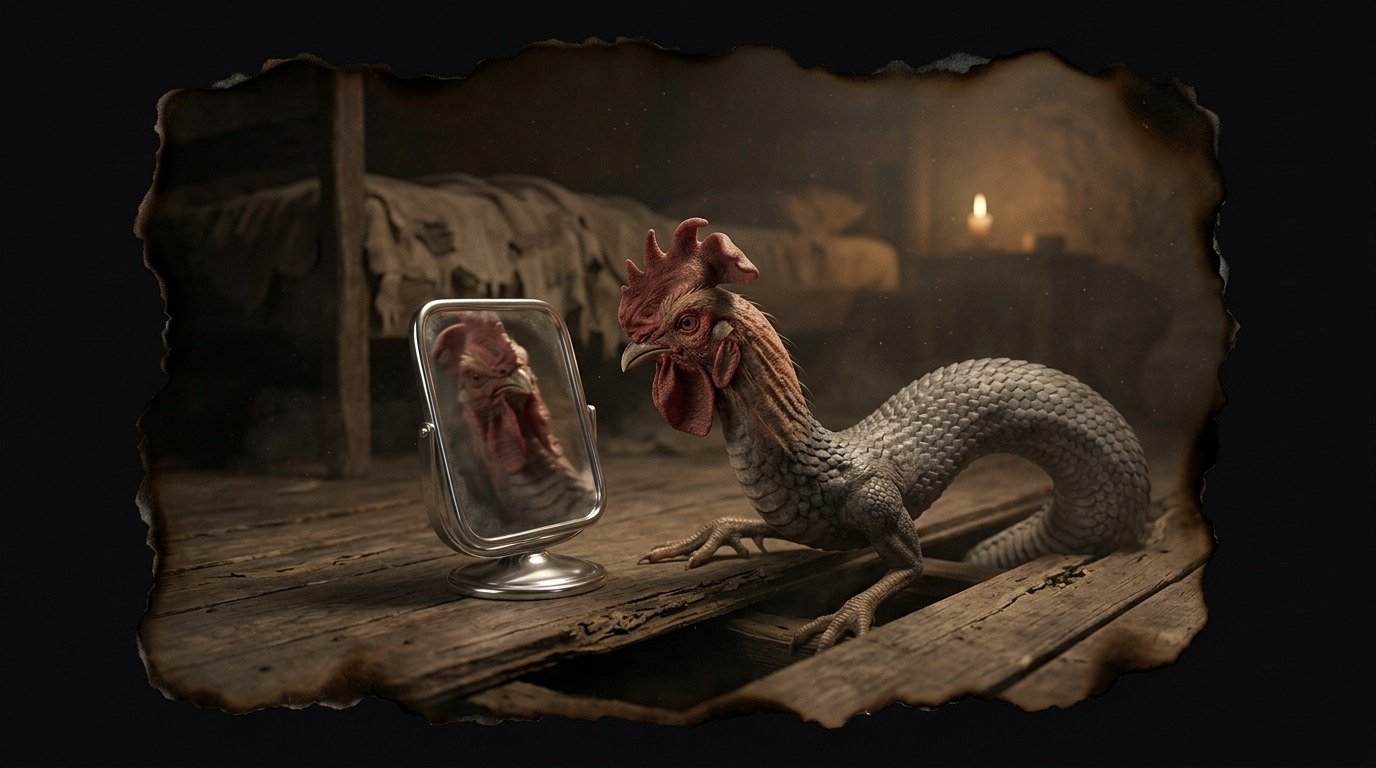
The Creole Basilisk: The Parasite of Domestic Shadows
The Birth of Corruption: The Huevo Lito
The Creole Basilisk is the American transposition of the mythical European basilisk, acclimated and reinterpreted in the rural territories of Chile, Argentina, and the Andean region of Colombia. While the Old World entity possessed regal proportions and was considered the king of serpents, the Creole variant adopts a markedly parasitic, domestic nature of subterranean vileness. Its origin is strictly zoological-mystical: it is born from a small, spherical egg with a rough shell and devoid of yolk, popularly known as the *huevo lito* or *rooster's egg*. Belief holds that this egg is laid by an old, sterile rooster (or a hermaphrodite hen) on a Friday during a waning moon. If this egg is not immediately destroyed by fire, it will be actively sought out by a snake or a toad, which will incubate it in the warmth of manure or under the floorboards of a dwelling for seven years, giving life to the monster.
Morphology and the Silent Consumption of Life
The Creole Basilisk manifests as a hybrid and unsettling creature: it possesses the head, neck, and legs of a deformed rooster, crowned by a limp red crest, but its body is elongated, covered in grayish scales and devoid of feathers, ending in a serpent's tail. Its primary habitat is the darkness of the human home, taking refuge under wooden floorboards, in attics, or behind the adobe of the walls. The Basilisk does not attack with claws or teeth; its method of depredation is subtle and nocturnal. While the inhabitants sleep, the creature emerges from its hiding place and glides to the bed. It inhales the breath of the victims or licks their saliva, thereby absorbing their vital force, their *anima*, and their biological moisture. With each night of being targeted, the victim languishes: they develop a dry, persistent cough, their body thins to the point of emaciation, and their skin acquires a sallow tone. This state of physical consumption, known in the countryside as "basilisk consumption," inevitably leads to death if the creature is not eliminated.
Prophylaxis, Destruction, and Esoteric Meaning
The traditional protocol for eradicating the Creole Basilisk requires extreme vigilance of the chicken coop to detect the *huevo lito*. If the creature has already been born and has settled in the home, conventional hunting methods are useless due to its speed and its ability to blend into the shadows. Tradition indicates that the Basilisk can be defeated by forcing it to look at its own reflection in a silver or polished metal mirror; the ugliness of its reflected essence projects back its own deadly energy, destroying its nervous system. However, the ultimate recourse is usually purification by fire: burning down the entire house with the creature inside. Esoterically, the Creole Basilisk represents the internal corruption of the home; the invisible parasite that feeds on complacency, secrecy, and the silent erosion of family relationships. It is the personification of degenerative and respiratory diseases (such as tuberculosis in colonial times) that decimated entire communities from within their own safe spaces.
Comments
Share information, an experience, or a source to help enrich this entry. They are automatically reviewed before being published.
Loading comments...