Leviathan
Leviathan: The Jailer of the Insatiable Jaws
The Inhabitant of the Lower Abyss
Much has been written about the great monster that stirs the primordial waters, the scaly beast that defies the harpoons of men and embodies the chaos of the ocean. However, in the darkest corners of the cosmology of the afterlife, another truth exists: Leviathan is not only a physical creature from the beginning of time, but also a celestial dignitary of dissolution, a guardian of death with the rank of an angel of the abyss. In this facet, his body is not made of flesh and scales, but of concentric shadows that form the walls of Sheol itself.
Under this role, Leviathan is in charge of holding the souls of those whose existence was marked by spiritual emptiness and constant rebellion. He is not an active torturer, but something far more fearsome: the absolute container, the stomach of the universe where souls that do not have enough weight to ascend to the Throne are digested by oblivion. His presence is the silence that precedes nonexistence, a void that sucks in all light and all memory.
The Breathing Gates
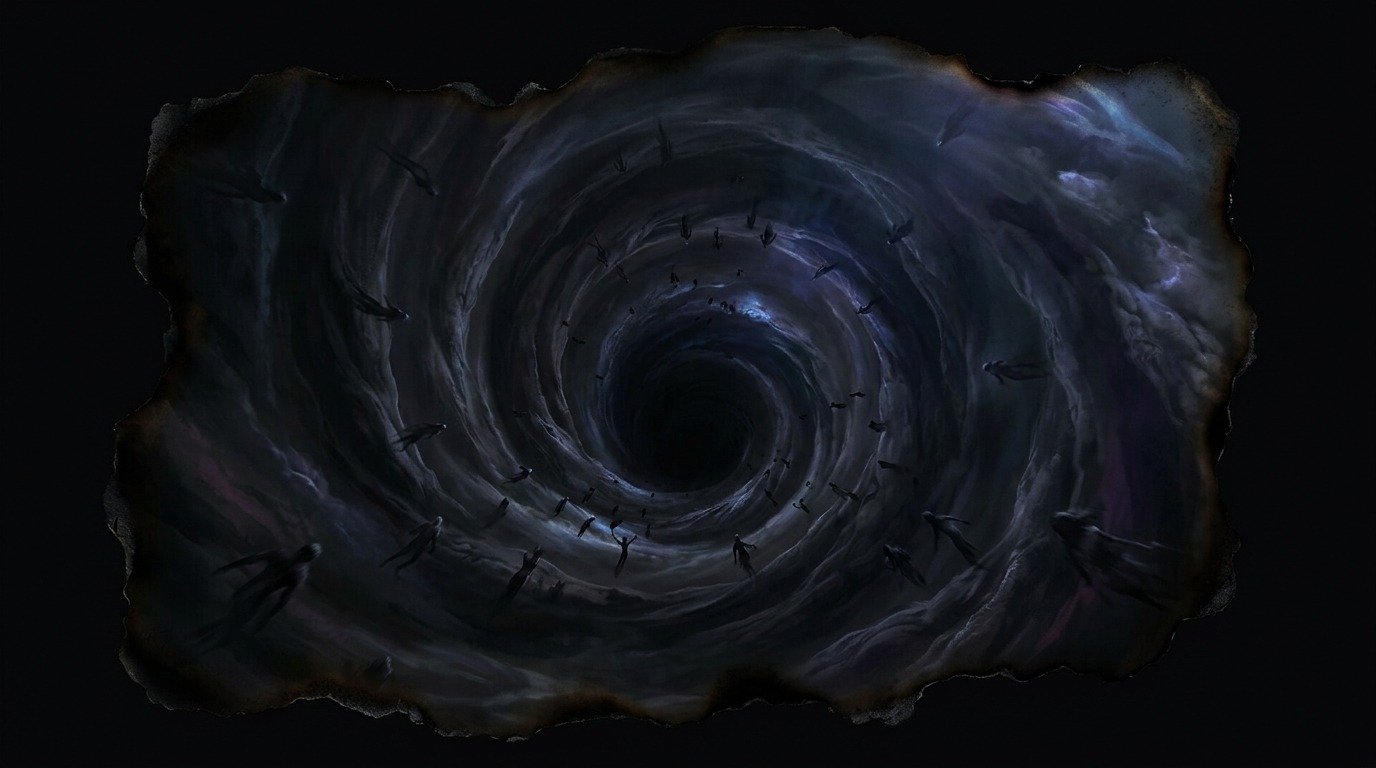
Whoever descends to the domains of death under the custody of Leviathan finds no paths or rivers to cross, but rather a massive throat that opens in the floor of the cosmos. This threshold, known in ancient visions as the "jaws of Leviathan," exhales an odor of sulfur and decomposed salt. It is said that the angel-monster remains motionless at the bottom of the pit, with his mouth wide open, allowing the gravity of sin to drag the dead into his interior.
The act of dying under his influence is experienced as an infinite fall into a pit without walls, where the whisper of the wind gradually transforms into the gnashing of titanic teeth. Leviathan does not need to use force; his mere nature is a magnet for the dense and the impure. Souls fall into him like raindrops into a dark ocean, losing their individuality to become part of the tide of shadows that sustains the foundations of creation.
The Limit of Oblivion
In the protection rituals and amulets of ancient mystics, the name of Leviathan was pronounced with dread and reverence, not to invoke him, but to plead that his blind eyes would not fixate on the deceased during their journey to the afterlife. For once the soul crosses the threshold of his jaws, it remains beyond the reach of the prayers of the living.
He represents the aspect of death that is definitive and irrevocable: the dissolution of the self into the primordial nothingness. While other angels of death lead to judgments or temporary purifications, Leviathan is the jailer of the final abyss, the reminder that there are depths in the fabric of reality from which not even the echo of a man's name can return.
Comments
Share information, an experience, or a source to help enrich this entry. They are automatically reviewed before being published.
Loading comments...