Marchosias
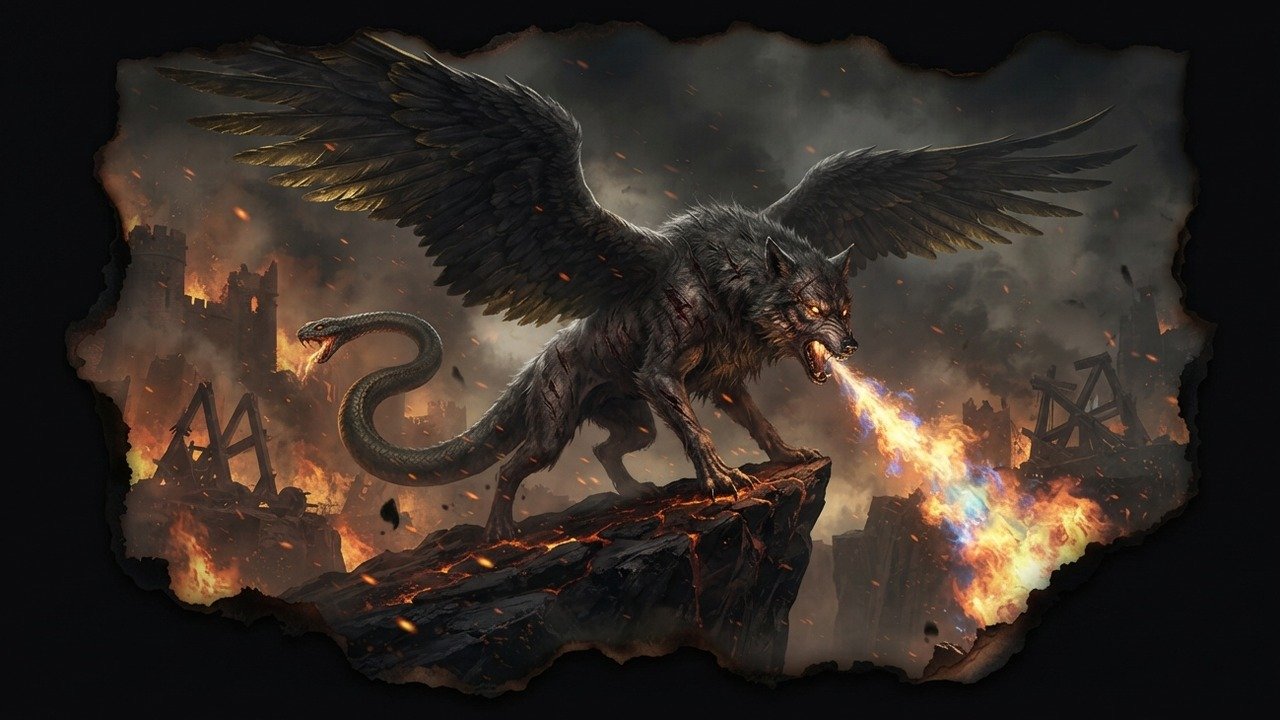
The Marquis of the Indomitable Flame and the Warrior Wind
Origin and Legend: The Legions of the Ancient Ether
To trace Marchosias outside the Goetic swarm of Renaissance Europe, one must go back to the archaic Levantine and Mesopotamian cosmogonies, where winged and chimeric beasts did not represent theological evil, but rather the guardians of elemental borders and desert winds. In pre-monotheistic myths, hybrid beings with canine or lupine morphology endowed with griffin wings protected the thresholds between the inhabited world and primeval chaos.
When the Judeo-Christian tradition absorbed these entities, Marchosias was reconfigured under inquisitorial taxonomy as a Great Marquis of Hell who commanded thirty legions of spirits after the fall. However, classic grimoires such as Johann Weyer's Pseudomonarchia Daemonum and the Lemegeton preserved a fundamental peculiarity: Marchosias originally belonged to the choir of Dominations (Dominions) and harbored for centuries the firm conviction of returning to the Seventh Heaven after one thousand two hundred years. This entity does not embody absolute hatred toward the cosmic order, but rather the tragedy of the warrior trapped in exile who refuses to pervert his inherent nobility.
Historical Evolution: From Wasp-like Beast to Symbol of Loyalty
Throughout the 14th to 17th centuries, demonological iconography portrayed Marchosias as a ferocious wolf with griffin wings and a serpent's tail, vomiting fire from its jaws. However, in conjuration manuals, when the operator exercised a command of firm authority, the entity would abandon its beastly chimera appearance to transmute into a noble man, with an impeccable military presence and an extremely dignified bearing.
During the Enlightenment and the subsequent codification of occultism in the 19th century by figures such as S.L. MacGregor Mathers, the interpretation of Marchosias shifted from folkloric horror toward the consideration of a genius of strategy and combative rhetoric. He went from being seen as a devouring beast to being recognized as the archetype of the unwavering guardian, a fighting force that retains military honor even within the abyss.
Esoteric Meaning: The Discipline of Martial Fire
In the Tree of Life and depth psychology, Marchosias represents purified martiality (the sphere of Geburah) operating at subconscious levels. It is not the destructive chaos of uncontrolled anger, but rather the force of containment, military strategy, and absolute rigor in the face of adversity.
Archetypally, he embodies the animal instinct refined by divine will. His wings represent the elevation of thought over the predatory nature of the wolf. In the Left-Hand Path traditions, he is considered the patron of warriors of the spirit: those who venture into internal battles to master their own passions without destroying their creative essence.
Practice and Manifestation: The Guardian in Personal Battle
The energy of Marchosias operates in material and psychic reality as a burst of focused fire and unwavering determination.
Manifestation: It is perceived in the individual as a sudden increase in willpower, the ability to maintain calm in the midst of extreme crises, and a tactical mental sharpness in the face of external or internal aggressions.
Approach and Protection: To work with this force or to shield oneself from its scorching aspect, the practitioner must maintain a posture of absolute sovereignty and unwavering discipline. Marchosias despises moral weakness, doubt, and servitude. Balance before his frequency is not obtained through submission or fear, but by aligning one's own will with personal justice and the honor of the sovereign.
Comments
Share information, an experience, or a source to help enrich this entry. They are automatically reviewed before being published.
Loading comments...