Marbas
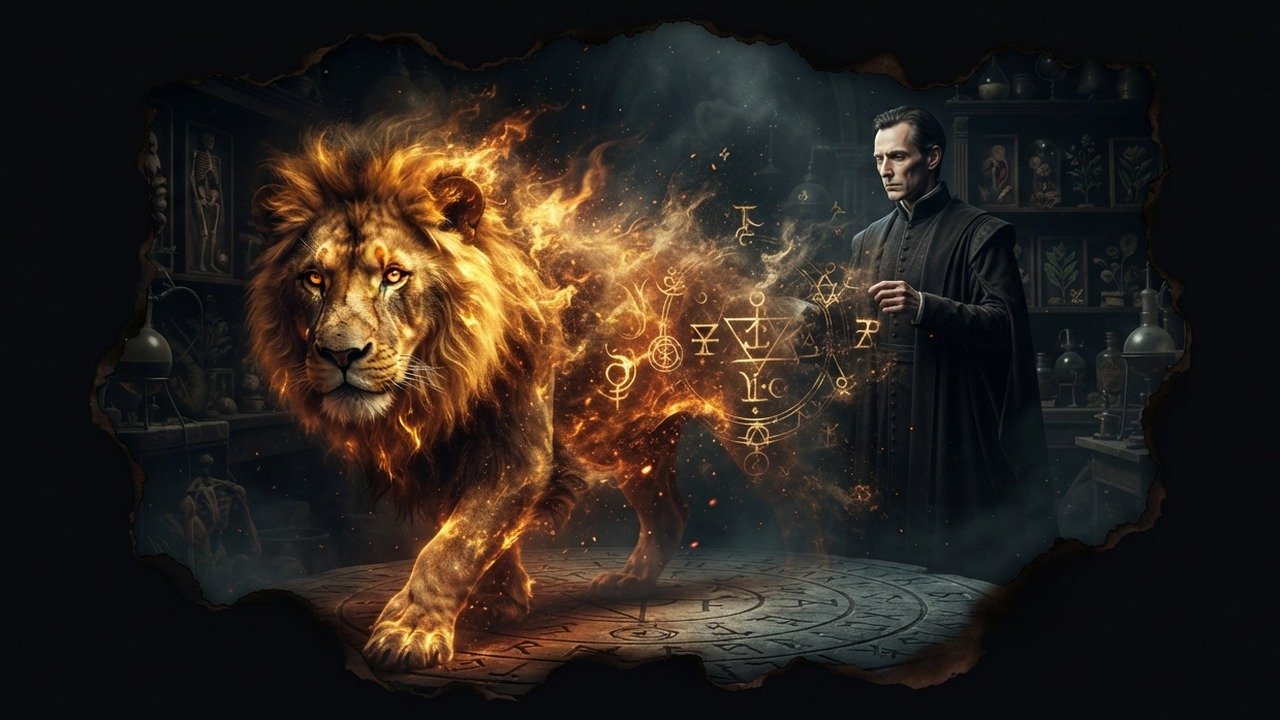
The Legacy of Marbas: The Great President of Knowledge, Pestilence, and Reconstruction
Origin and Legend: The Seed of the Lion and Pestilence
To find the root of Marbas—also recorded in ancient texts as Barbas—one must set aside Renaissance demonology texts and descend to the civilizations of the Fertile Crescent. In the pantheon of Mesopotamian dynasties and the Levant, there was no Manichaean division between celestial demons and subterranean hells; divinities embodied the totality of nature, being at once the hand that heals and the air that infects.
The essence of Marbas is intertwined with the worship of Mesopotamian gods of the Underworld and pestilence, such as Nergal or Resheph, divinities associated with the scorching heat of summer, the spread of fevers, and the subsequent healing when the cycle of disease ceased. In these lands, the lion was not a simple predator, but the herald of the solar power of the plague and the sovereignty of the desert. When the grimoire tradition of the Late Middle Ages and the Renaissance synthesized the catalogs of Hell, it took these ancient territorial powers and cataloged them under the hierarchy of the Goetia. Marbas was established in Johann Weyer's Pseudomonarchia Daemonum and in the Lesser Key of Solomon not as an entity of mere perdition, but as the Great President who rules over thirty-six legions of spirits, keeping his ancient ambivalence intact: the capacity to corrupt the flesh and the exact knowledge to restore it.
Historical Evolution: From the Idol of Pestilence to the Sefer of Secrets
Throughout the centuries, the perception of Marbas underwent a drastic transformation. During the witch hunts and the rise of ecclesiastical absolutism, inquisitors reduced him to an evil spirit who infected crops, rotted the wounds of soldiers, and deformed the faces of the condemned. He was feared as the lord of organic decay.
However, in the secret academies of sixteenth- and seventeenth-century alchemists, astrologers, and physicians, his figure acquired a deeply intellectual dimension. Occultists seeking a theoretical understanding of diseases—in an era when official medicine resorted to blind bloodletting—saw in the figure of Marbas the key to occult anatomy. He ceased to be perceived solely as the bringer of contagion and was recognized as the custodian of mechanical knowledge and the architecture of matter. He was credited with the faculty of answering with absolute truth about hidden or secret things, the teaching of mechanical arts, and the ability to transform the human form—the latter understood by alchemists not as physical lycanthropy, but as the alteration of the subtle structure of the vital body.
Esoteric Meaning: The Alchemy of Tissue and the Archetype of Metamorphosis
In the Dark Kabbalah and the structure of the Qliphoth, Marbas operates within the sphere of Thagirion (the shell of the dark Sun) or under the influence of the shadow of the higher Mercury, channeling the knowledge that decomposes and recomposes form.
La Dualidad Peste-Sanación: Marbas represents the cosmic principle that disease and cure are the same energy in different frequency vectors. One cannot heal a body or a mind without understanding the exact mechanics of its destruction. It is the alchemical force of the solvent that rots stale matter so that the Seed (Coagula) can germinate upon a clean foundation.
El Arquetipo del Anatómico Oscuro: In depth psychology, he represents the ruthless analytical function. He is the part of the psyche that breaks the illusions of external form to examine the organs, secret structures, and internal gears of the human being.
El Mechanikos Arcane: He rules over practical wisdom, the construction of artifacts, occult physics, and the transmutation of dense-biological matter. He is the principle that understands that matter is moldable if the original design of its matrix is known.
Practice and Manifestation: The Presence, the Bond, and Sovereignty
In the grimoire tradition, Marbas is not a volcanic or chaotic energy; his nature is cold, mathematical, incisive, and majestic.
La Manifestación de su Energía: He initially manifests in the form of a majestic lion, with a piercing gaze and a scorching coat. This primordial form represents dominant instinct, pure biological strength, and the sovereignty of solar fire. However, at the request of the practitioner's firm will, he abandons the bestial form and assumes a human appearance of noble and clinical bearing, attired with the dignity of a master of the ancient sciences.
Acción en el Individuo: His presence is perceived as a drastic change in the room's temperature or an absolute mental clarity, free from hindering emotions. His influence on the practitioner sharpens the intellect, reveals the root causes of physical or energetic ailments, and pulls back the veil on conspiracies or deceptions operating in the shadows of the magician's life.
Abordaje, Protección y Respeto: Interacting with Marbas demands a posture of absolute internal sovereignty and mental balance. Anyone who approaches this power with fear of illness or with the childish desire to inflict harm out of revenge becomes trapped in the destructive vector of his energy, experiencing physical deterioration, paranoia, or a decline in vitality.
El Protocolo de Trabajo: The approach to Marbas must be made from the mastery of one's own mind. The best protection against his devouring aspect is not a superstitious amulet, but ethical rigor, self-discipline, and clear intention. He is not approached to beg, but to learn the architecture of form, the art of occult medicine, and the transmutation of biological weakness into impregnable strength. He who understands the law of matter walks by his side with the serenity of a physician among the fevers of the world.
Comments
Share information, an experience, or a source to help enrich this entry. They are automatically reviewed before being published.
Loading comments...