Korrigan
Korrigan: The Guardians of the Springs and Linen
The Reflection of the Water and the Nightly Song
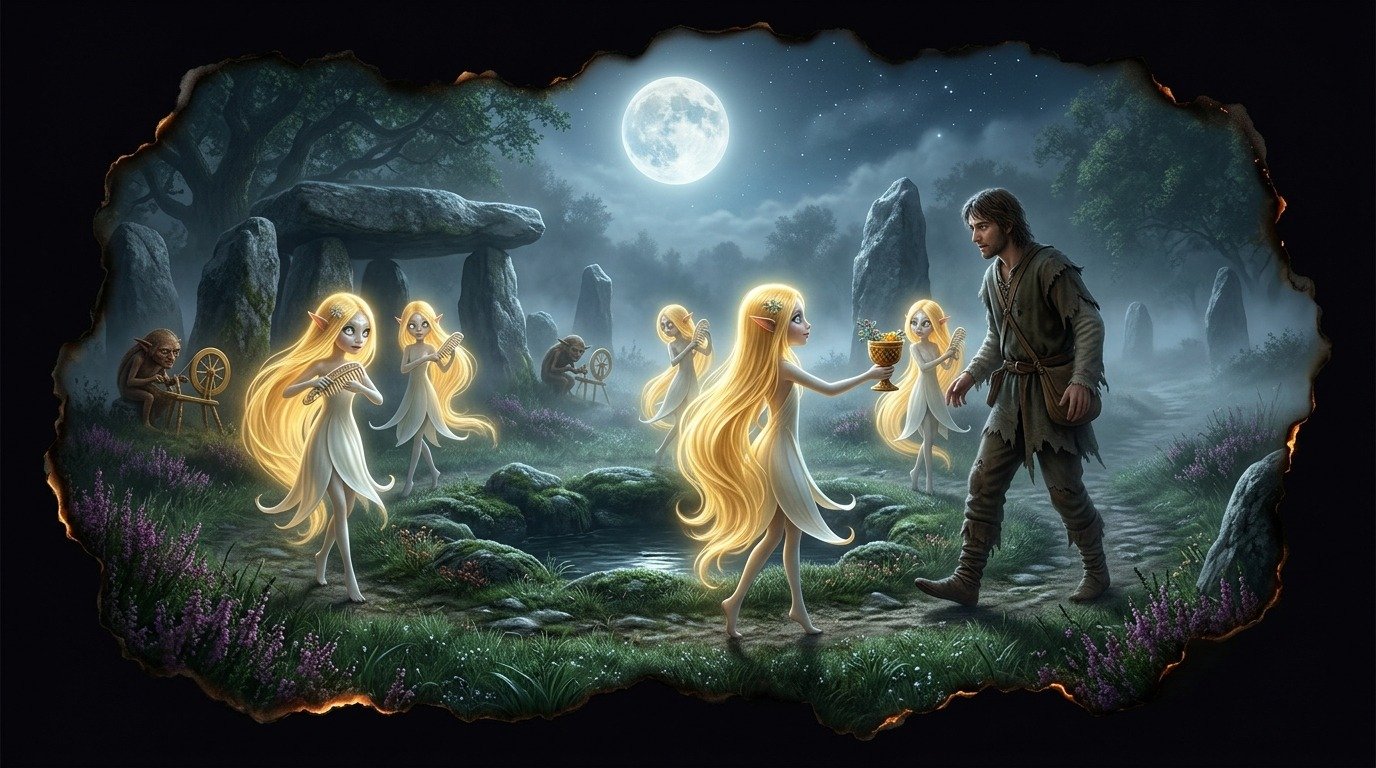
In the misty moors of the Armorican peninsula, where the gray stone menhirs watch over the heather-covered heaths, dwell the Korrigans. They are spirits bound to the water of the purest springs and to the fountains hidden beneath the shade of hazel trees. During the day, they avoid the gaze of men, taking refuge in the crevices of dolmens or in the depths of wells where the water never receives direct sunlight. But when the moon reigns in the sky and the mist creeps over the fields, they emerge to comb their long golden hair with ivory combs and sing with voices that have the fluidity of water running over stones.
Under the moonlight, a Korrigan possesses a devastating beauty. Her body is petite but perfectly proportioned, her skin has the whiteness of a water lily, and her eyes shine with the intensity of stars reflected in a pond. They gather in circles on the damp grass to dance a circular dance, swift and silent, which does not bend a single blade of grass. The night traveler who hears their song is caught in a spell of submission; his feet lead him helplessly toward the circle, where the beautiful ladies will receive him with lilting laughter and cups of a mead that tastes of wild flowers and oblivion.
The Curse of Dawn
However, the beauty of the Korrigan is a mask that fades with the first ray of sunlight. If a mortal manages to resist her charm or observes her when the dawn begins to brighten the horizon, he will see the radiant young woman transform into a tiny, wrinkled, and incredibly ancient-looking creature. Her skin becomes the color of damp peat, her eyes sink into dark sockets, and her beautiful blonde hair transforms into locks of parched horsehair. This duality defines their nature: they are as ancient as the hills, witnesses to an era when the stone gods still received sacrifices, and they resent the fleeting youth of men as much as the iron of their plows.
The Korrigans are jealous guardians of their secrets. They hate the presence of the clergy and the sound of church bells, which they consider an affront to their sovereignty over the springs. If a priest approaches their spring, the water becomes bitter and sterile; if a peasant tries to build near their dolmen, the stones he raises by day will appear scattered on the ground at dawn. However, they are not intrinsically evil; they possess a strict sense of justice and generously reward those who treat them with the respect due to the ancient lords of the land.
The Golden Thread and the Traveler's Trap
In addition to their relationship with water, the Korrigans are master spinners. On winter nights, they can be heard working inside their dolmens; the hum of their golden spinning wheels blends with the whistling of the wind in the chimney. They spin a linen so fine that it is invisible to the human eye, yet so strong that they could bind a giant with it. It is said that if a mortal woman asks them for help to finish her spinning task before dawn, the Korrigans will complete it in the blink of an eye, demanding in return only a bowl of fresh butter or a secret that the mortal keeps in her heart.
For men, the danger is of another kind. If a young man approaches their dance circle, the most beautiful Korrigan will offer him her love and eternal wealth, under the sole condition that he agrees to marry her. If the young man accepts, he will discover his wife's true and monstrous form at dawn, condemned to wither away from sadness in a few days. If he rejects the offer, the scorned creature will condemn him to die before the third cockcrow, or else force him to dance in her circle without rest until his feet are worn to the bone and his heart bursts from exhaustion. On the heath, beauty and death drink from the same spring.
Comments
Share information, an experience, or a source to help enrich this entry. They are automatically reviewed before being published.
Loading comments...