Cernunnos
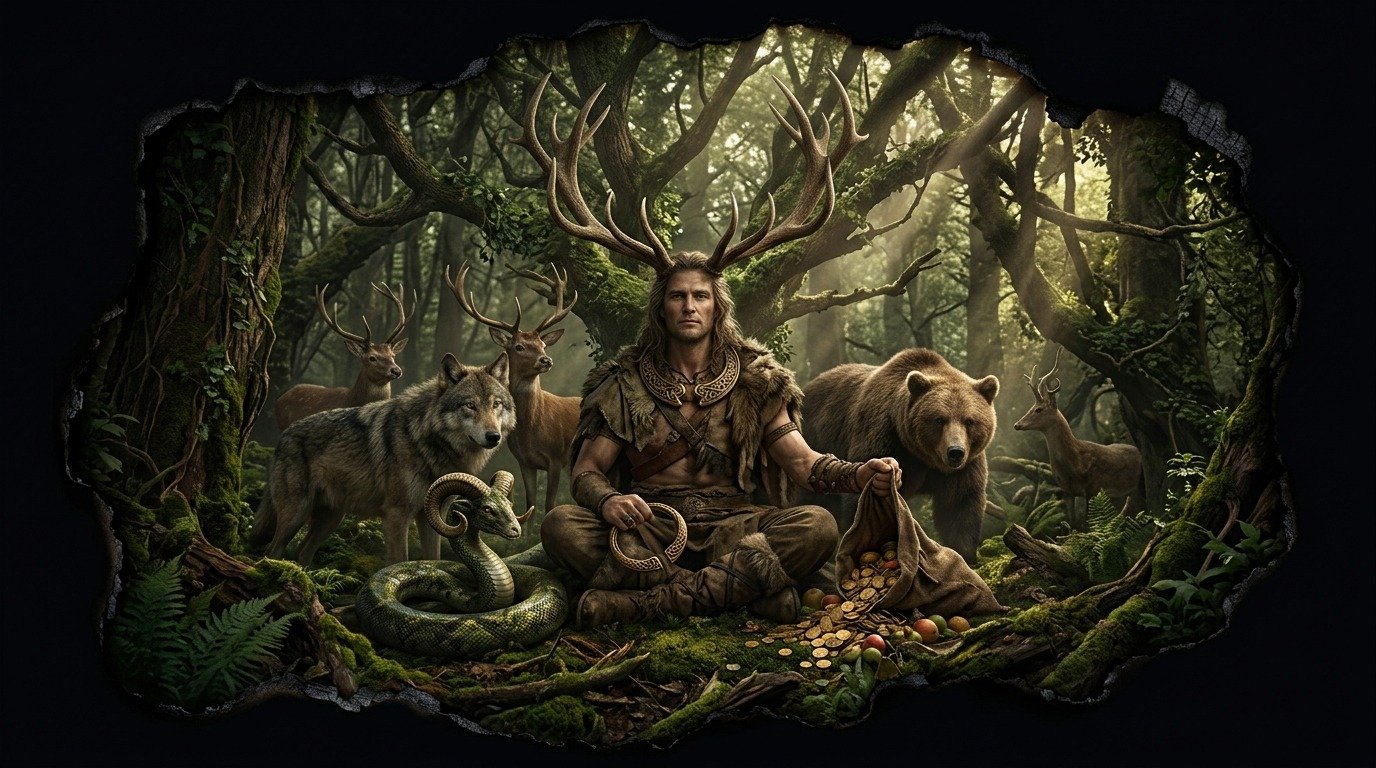
Cernunnos: The Horned Lord of the Green Depths
The Whisper of the Thicket
In the heart of the forest, where the sunlight barely filters through like golden spears amidst the thick foliage, the air smells of humus, resin, and life in constant decay and rebirth. There, where the paths of men fade away and give rise to the tracks of beasts, dwells a presence as ancient as the trees themselves. He is not a specter, nor a destructive force, but the very heartbeat of the wild earth. He manifests as a man of majestic and serene bearing, sitting cross-legged upon a tapestry of moss, crowned by an imposing set of stag antlers that rise toward the treetops, blending with the branches.
Cernunnos does not speak with human words; his voice is the creaking of wood on freezing nights, the bellowing of the stag during the rutting season, and the whisper of the wind among the ferns. He is the horned god, the mediator between the world of civilization and the fertile chaos of untamed nature. In his presence, the most ferocious beasts of creation lose their malice and gather in peace. Beside him usually rests a ram-headed serpent, a hybrid creature that embodies the mystery of regeneration and the life force that surges from the depths of the ground.
The Torc and Abundance
In one of his hands, or sometimes encircling his bronze neck, Cernunnos holds the torc, the sacred collar of Celtic warriors and kings. This ring of precious metal is not only a symbol of divine status, but the key to the sovereignty and wealth that the earth itself grants to those who respect it. With his other hand, he often holds a sack from which flow gold coins, grain, or fruit, demonstrating that abundance does not come from artificial accumulation, but from the natural cycles of sowing, harvesting, and death.
His power extends beneath the roots. As lord of the underground realms, Cernunnos guards the mineral riches of the earth and receives the spirits of the fallen. For the ancients, death was not an end, but the winter of the soul, the necessary step for the seed to sprout once more in the spring under the protective gaze of the stag-horned god.
The Cycle of the Antlers
The myth that defines Cernunnos's existence is that of his own seasonal metamorphosis. Every autumn, when the leaves fall and the cold bites the earth, his antlers shed, symbolizing the withdrawal of life and the beginning of winter dormancy. During these dark months, the god retreats to the caverns of the underworld, where he reigns over the shadows and prepares the rebirth of nature.
With the arrival of spring, the antlers sprout once more from his forehead, covered in a velvet that he rubs against the rocks to reveal sharp and strong points. His return to the outer world unleashes the urgency of life: flowers burst in the meadows, animals surrender to courtship, and sap runs strong once more through the trunks of the oaks. Cernunnos is, thus, the eternal reminder that life and death are two sides of the same coin, an uninterrupted flow that no human wall can contain.
Comments
Share information, an experience, or a source to help enrich this entry. They are automatically reviewed before being published.
Loading comments...