Aengus
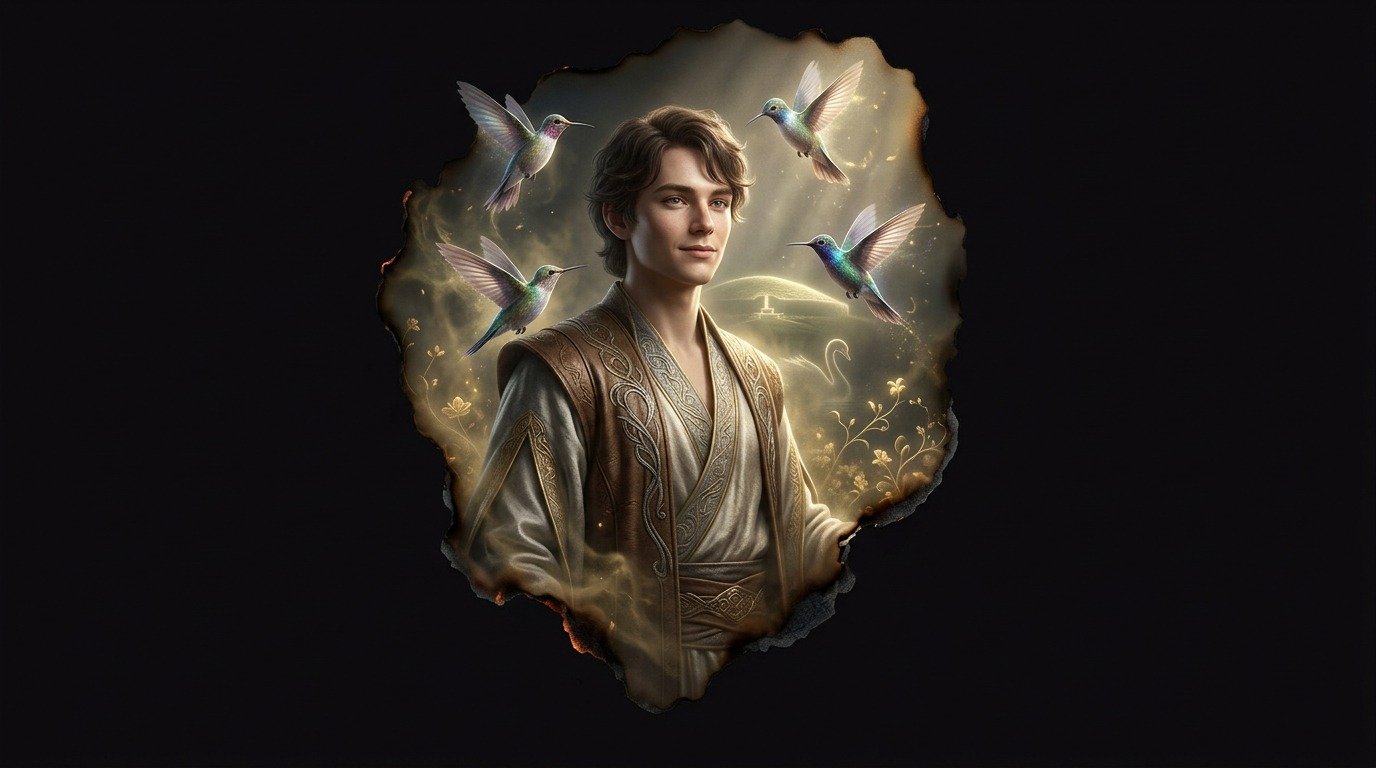
Aengus: The Whisper of Eternal Youth
The Birth Outside of Time
For Aengus to be born, time itself had to stop. The fruit of forbidden love between the Dagda, the great god of wisdom, and Boann, the goddess of the River Boyne, his conception defied the laws of the cosmos. To hide the pregnancy from the eyes of Boann's jealous husband, the Dagda used his magic to suspend the course of the sun. For nine months, the sun king remained motionless at its zenith, so that what was a single, incredibly long day for the rest of the world was, for the lovers, the time necessary to conceive, carry, and give birth to the child of light. Due to this miracle, Aengus was born outside of conventional time. He knew neither decay, old age, nor ugliness. He grew up as the very personification of eternal youth, dazzling beauty, and poetic inspiration. His mere presence causes flowers to bloom out of season and the coldest hearts to ignite with the fire of desire. He dwells in Brú na Bóinne, a mystical palace beneath the hill where winter can never enter and where music resounds without rest.
The Palace Won with Cunning
Aengus's intelligence is as sharp as his appearance is beautiful. Upon reaching maturity, he discovered that his adoptive father and his biological father had distributed all the lands and wealth among the other gods, leaving him without an inheritance. Far from starting a war, Aengus went to the Dagda and asked for permission to dwell in Brú na Bóinne only "for a day and a night." The great god, considering it an insignificant request, agreed immediately. However, when the term expired and the Dagda asked him to vacate the palace, Aengus smiled mischievously. He explained that, in the language of men and gods, "a day and a night" is an expression that encompasses the totality of time, since all the days of existence are nothing more than the endless succession of a day and a night. By having granted him that space for such a period, the Dagda had given him the Brú forever. With this subtle victory of words, Aengus became the absolute lord of the sacred hill.
The Winged Kisses and the Dream of the Swan
Aengus's life is marked by the pursuit of the unattainable. It is said that he is always accompanied by four birds that flutter around his head; these creatures are not ordinary birds, but his own kisses that have taken physical form, singing melodies so sweet that they cause a sweet madness of love in anyone who hears them. His most famous myth tells how he was consumed by fever after dreaming for an entire year of a maiden of incomparable beauty. He fell ill with melancholy at being unable to find her, until he discovered that the young woman's name was Caer Ibormeith and that she lived under a terrible curse: one year she was a woman, and the next, she transformed into a swan alongside one hundred and fifty companions. Aengus traveled to the lake where the birds swam, and upon recognizing his beloved among the multitude of white feathers, he did not hesitate to transform himself into a swan to join her. Together, they sang a song so beautiful that it plunged all of Ireland into a deep sleep for three days and three nights, while they flew free toward the palace on the hill. In this magical union, Aengus proved that true love does not fear transformations or the loss of human form, but rather rises above any earthly bond.
Comments
Share information, an experience, or a source to help enrich this entry. They are automatically reviewed before being published.
Loading comments...