Taranis
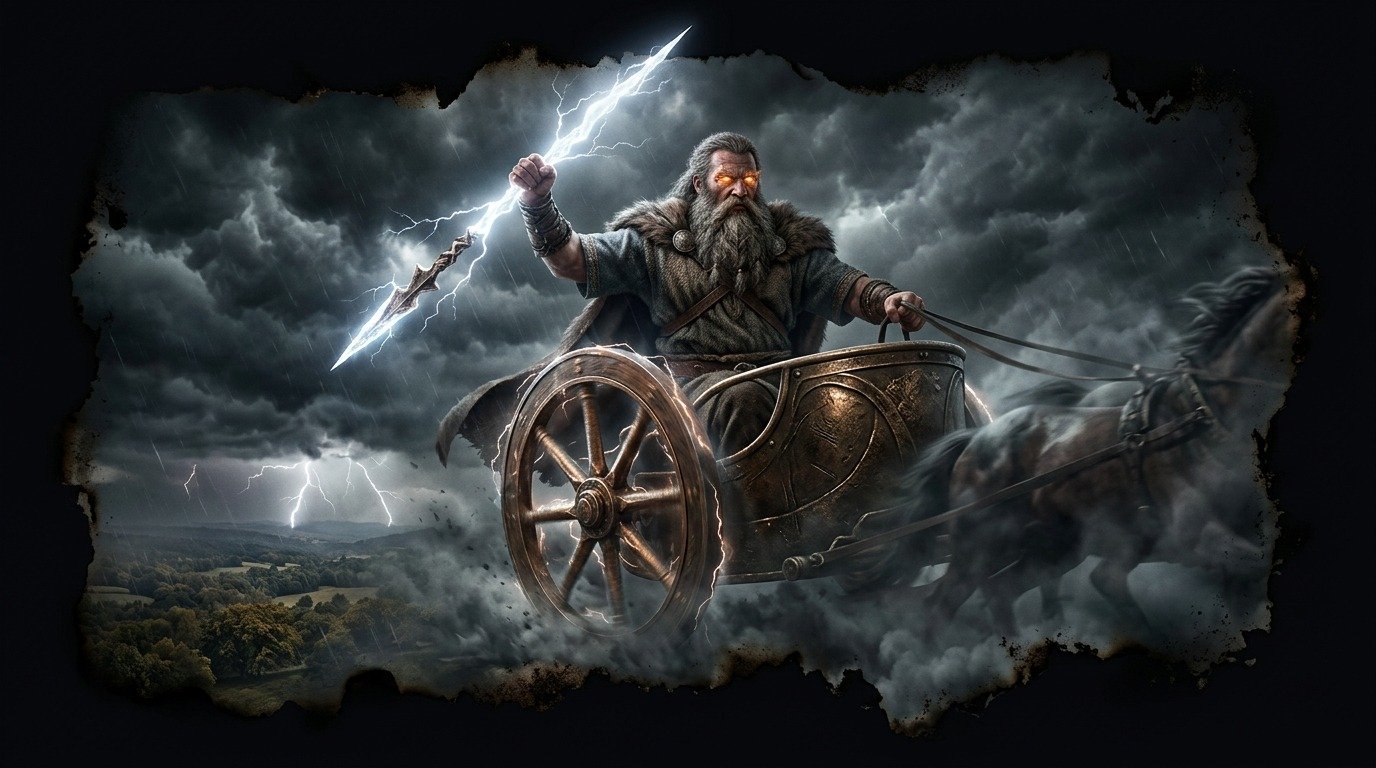
Taranis: The Rumbling of the Celestial Wheel
The Roar in the Storm
The sky above the oak treetops does not darken by chance; it bends under the weight of his stride. When thunder shakes the earth and lightning splits the clouds wide open, mortals know they are not facing a simple change in the weather, but the march of Taranis. He is the storm itself made will, a primal force that knows neither mercy nor fatigue. He is depicted as a giant with a thick beard and a fiery gaze, a celestial warrior who crosses the firmament on a bronze chariot whose rolling produces the rumble that makes the valleys tremble. In one hand he holds the thunderbolt, a twisted dart of pure light that he forges in the heart of the black clouds. In the other, he holds his most sacred and terrible symbol: the eight-spoked cosmic wheel. This wheel is not just a component of his chariot; it is the engine of the universe, the instrument with which Taranis spins the firmament, ordering chaos, alternating day and night, and dragging the seasons behind it. When the wheel turns, the destiny of men is stirred.
The Tribute of Wood and Fire
The power of Taranis demands a brutal symmetry: to maintain the balance of the cosmos and prevent the sky from unleashing its fury upon the villages, the earth must offer him a portion of its warmth. In the clearings of sacred forests, under the gaze of the priests, colossal wicker and wooden structures in human form were erected. These figures, filled with living offerings, were given over to the flames on stormy nights. The smoke that rose from these gigantic bonfires was not an act of wanton cruelty, but a bridge of energy. For the devotees of Taranis, the sacrificial fire fed the god's thunderbolt, ensuring that the subsequent rains would not drown the crops, but fertilize the fields. The storm god returned the tribute transformed into the water of life, proving that his destructive wrath was the prior and indispensable step for the rebirth of the earth.
The Wheel That Does Not Stop
Although the stone temples crumbled and the sacred forests were felled, the presence of Taranis remained etched in the geography of the windswept cliffs and in the memory of metal. Warriors wore small bronze wheels hung around their necks as protective amulets; a reminder that, even in the chaos of battle, the god's wheel turned in their favor, granting them the strength of the thunderbolt. Today, when the sky turns the color of lead and the air fills with static electricity before the storm, the old Celtic god continues to claim his dominion. His footprint is not in texts, but in the reverent awe inspired by the flash that illuminates the horizon and in the deep echo that reverberates in the chests of those who hear, in the distance, the advance of his immortal chariot.
Comments
Share information, an experience, or a source to help enrich this entry. They are automatically reviewed before being published.
Loading comments...