Dagda
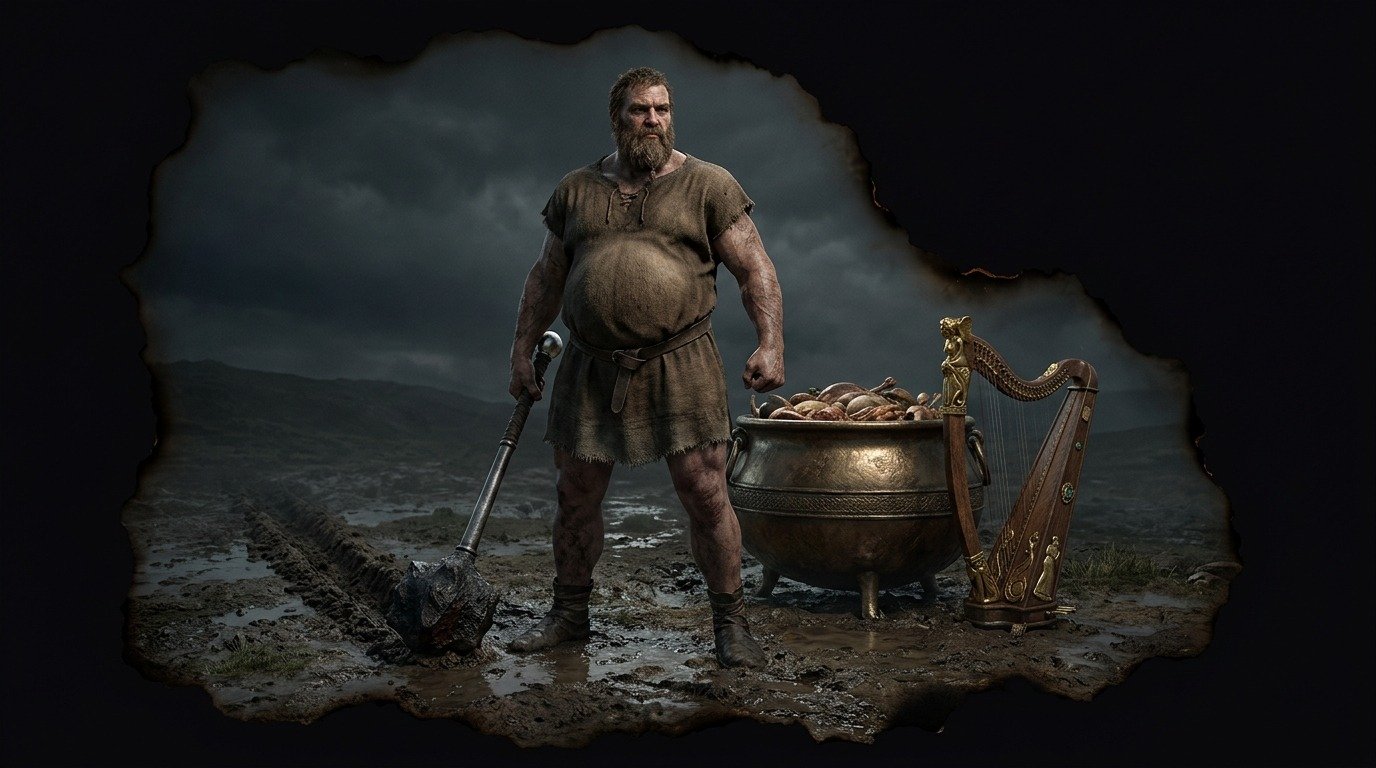
Dagda: The Giant of the Cauldron and the Club
The Lord of Abundance and the Earth
Under the gray and unpredictable skies of the green island, walks a colossal figure who embodies the primal strength of the damp soil and deep forests. He is known simply as the Dagda, the "Good God," not because he lacks malice or is a paragon of moral virtue, but because he is supremely good at everything he does. He is the father of the tribe, the pillar upon which his people lean when war or winter threatens to extinguish life.
His physical appearance defies the solemnity usually attributed to divine kings. He wears a rustic, overly short tunic that barely covers his prominent belly, wears heavy boots of raw hide, and moves with the unhurried ease of one who knows that nothing in this world can bend him. In his figure, the most absolute coarseness and the most refined wisdom merge: he is capable of devouring an entire banquet with the greed of a beast and, the very next moment, intoning a sacred chant that calms storms or alters the course of the seasons.
The Three Relics of Cosmic Order
The power of the Dagda does not manifest in subtle flashes, but through three sacred objects that define his sovereignty over life, death, and time. The first is his colossal iron club, a weapon so heavy that he must transport it on a cart or drag it through the mud, leaving a furrow so deep that it could easily be the bed of a new river. This club possesses a terrible duality: with one of its ends, the rough and dark one, he can take the lives of nine men with a single blow; with the other end, smooth and polished, he restores breath and warm blood to those fallen on the battlefield.
His second possession is the Cauldron of Abundance, a colossal vessel brought from the mysterious cities of the north. From its bronze depths flows inexhaustible sustenance; no company of warriors ever leaves his side hungry, and each man receives exactly the portion he deserves according to his worth. This cauldron is the heart of divine hospitality, the guarantee that, under his guardianship, famine is but a distant nightmare.
Lastly, the Dagda guards Uaithne, an oak harp beautifully carved with figures of gold and precious stones. This instrument is not a simple tool for entertainment, but the metronome of creation. When the god plucks its strings, the order of the year is set in motion: the first chord invokes weeping and plunges the world into the lethargy of winter; the second chord unleashes laughter and the fertility of spring; the third puts men to sleep in a deep, restorative rest that heals all wounds of body and soul.
The Midnight Pact
On the eve of the great Battle of Mag Tuired, when the forces of oppression threatened to sweep his people from the face of the earth, the Dagda walked along the banks of the River Unius. There he met a dark-haired woman washing blood-stained garments in the running waters. She was the embodiment of destiny and war, a fearsome presence who challenged men before combat.
Instead of drawing back, the Dagda joined her in an embrace that fused the strength of the earth with the fury of the storm. That sacred union not only sealed the fate of the coming battle, but also granted the god the military secrets and prophecy necessary to guide his hosts to victory. The Dagda proved that his strength lies not solely in his muscles or his club, but in his ability to make pacts with the darkest and most necessary forces of the cosmos to ensure the survival of his people.
Comments
Share information, an experience, or a source to help enrich this entry. They are automatically reviewed before being published.
Loading comments...