Lugh
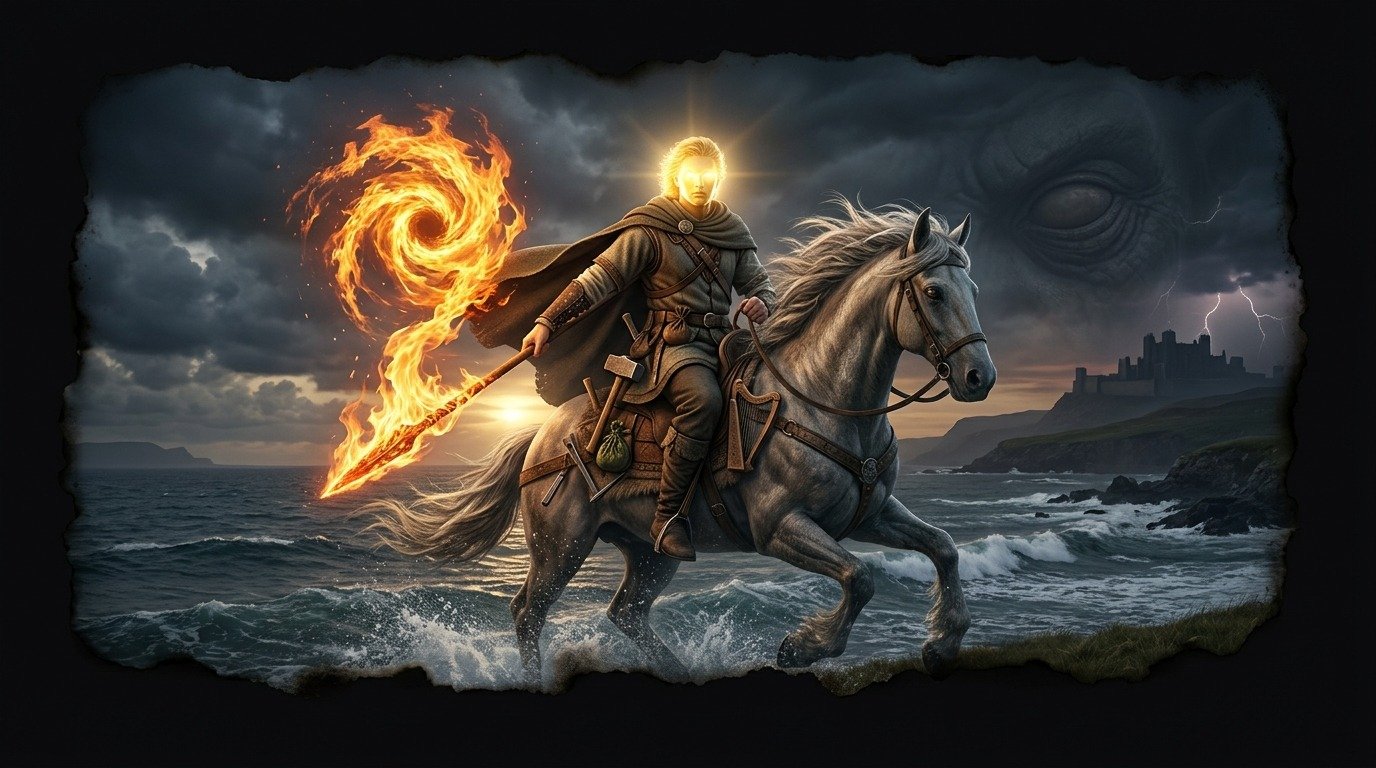
Lugh: The Radiance of the Indomitable Spear
The God of All Arts
When the gates of the great fortress of Tara were closed under the fear of an imminent invasion, a young traveler of noble bearing and luminous gaze presented himself before the sentry. When asked what craft he mastered to earn the right to enter the court of the gods, the young man replied that he was a carpenter. The guard refused his entry, claiming they already had the best craftsman of wood. The young man then offered himself as a smith, then as a champion, harper, poet, historian, healer, and cupbearer. At each refusal from the guard, who assured him they had experts in every field, the stranger smiled and issued a final challenge: "Ask the king if he has a single man capable of performing all these arts at once."
That young man was Lugh, called the *Samildánach*, the master of all human and divine crafts. His arrival at the pantheon was not that of a sovereign by birthright, but that of a necessary savior, a force of light and technical skill capable of breaking the stagnation of a world ruled by the brute force of the ocean giants. Lugh represents applied intelligence, the ingenuity that transforms matter, and the indomitable will that subdues chaos through the discipline of art and war.
The Flaming Spear and the Rider of the Wind
The physical presence of Lugh is comparable to that of a rising sun dispersing the darkness of winter. He rides upon Enbarr, a magical steed with a flowing mane that can run over the waves of the sea as easily as over grassy plains, without sinking a single hoof into the waters. His face shines with such intensity that mortals cannot look directly at him without being blinded by his golden light.
However, his most fearsome attribute is his battle spear, one of the four great relics brought from the mystical northern islands. This weapon possesses a thirst for blood so voracious that it must be kept submerged in a cauldron filled with poppies and cold fluids to prevent it from spontaneously igniting and laying waste to everything in its path. When Lugh wields it on the battlefield, the spear does not need to be thrown with human precision: it flies through the air autonomously, enveloped in a whirlwind of fire, seeking the chests of enemies and returning faithfully to its owner's hand once it has sated its appetite for destruction.
The Eye of the Storm in Mag Tuired
The crowning moment in Lugh's journey occurred during the terrible battle that decided the fate of the island. Facing him stood his own maternal grandfather, Balor, a colossal giant whose single closed eye held a poison capable of incinerating entire armies and withering lands just by lifting the eyelid. When the enemy hosts began to hoist Balor's heavy eyelid with the help of iron hooks, the battlefield seemed to plunge into a gloom of imminent death.
Lugh did not hesitate. He advanced with the agility of lightning cleaving the storm and, using his sling with superhuman strength, cast a carved stone directly at the giant's open eye. The impact was so brutal that Balor's eyeball was driven into the back of his own skull, projecting his destructive gaze toward the ranks of his own army and reducing the oppressors to ashes. With this act of relentless precision, Lugh dispelled the darkness that threatened his home and assumed the high sovereignty of the gods, ushering in an era where light, art, and order ruled over the forces of primitive chaos.
Comments
Share information, an experience, or a source to help enrich this entry. They are automatically reviewed before being published.
Loading comments...