Voodoo
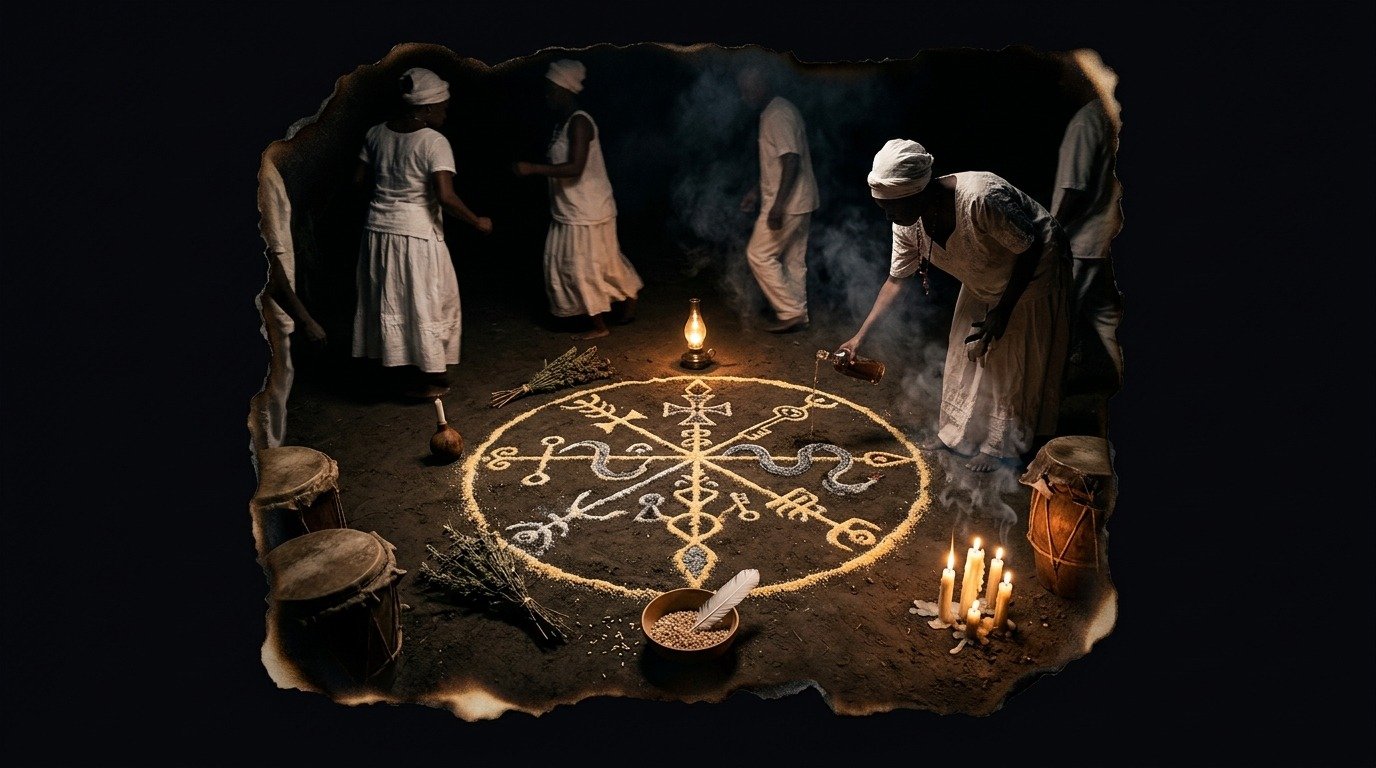
Voodoo: communion with the loas and the forces of nature
Definition and essence
Voodoo is a monotheistic and animistic religion that emerged from the fusion of West African beliefs and Roman Catholicism. Its doctrine establishes the existence of a supreme creator God, inaccessible to humans, who communicates with creation through a court of intermediary spirits. The religion seeks to maintain harmony between the visible and invisible worlds through ancestor worship and the invocation of these spiritual forces.
Origin and historical resistance
Voodoo was born in the 17th century in Saint-Domingue, present-day Haiti, under the French colonial slave regime. The enslaved people, belonging mainly to the Fon and Ewe peoples of the ancient Kingdom of Dahomey, the Yoruba, and the Kongo, preserved their worship by camouflaging it under the iconography of Catholic saints to avoid persecution. The foundational milestone of Haitian Voodoo occurred in August 1791 with the Bois Caïman ceremony, led by the priest Dutty Boukman. This ritual unified the slave populations and marked the beginning of the Haitian Revolution. In parallel, in the 18th century, the slave trade brought these practices to Louisiana, giving rise to New Orleans Voodoo, which incorporated influences from Anglo-Saxon folk medicine, herbalism, and the Catholic religion of French and Spanish colonists.
Cosmology and divine spirits
In Haitian Voodoo, God is called Bondye. Below him are the loas, spirits that embody forces of nature, moral values, and aspects of human life. The loas are divided into nations or families, the main ones being: * **The Rada family:** benevolent spirits, guardians of order and tradition, associated with water and wisdom. Among them, Papa Legba, guardian of the crossroads and gates; Erzulie Freda, loa of love and beauty; and Damballa, the cosmic serpent creator of life, stand out. * **The Petwo family:** spirits of a fiery, dynamic, and aggressive nature, linked to resistance and magical strength. Their main figures are Kalfu, the lord of the night crossroads, and Marinette, spirit of liberation and fury. New Orleans Voodoo shares this structure but pays particular worship to local figures and personifications such as Queen Marie Laveau or the Grand Zombi, a serpent deity.
Practice, liturgy, and community
Worship takes place in temples called *hounfours*, led by priests (*houngans*) or priestesses (*mambos*). The center of the temple features the *poteau-mitan*, a wooden pole that serves as a channel for the descent of the loas. Ceremonies consist of rhythmic chants, collective dances, and the beating of sacred drums that induce states of trance and spiritual possession, a phenomenon known as "being ridden by the loa." To invoke the spirits, the officiants draw *veves* on the ground, geometric diagrams traced with cornmeal or ash that act as beacons of attraction. Offerings are indispensable: they include food, tobacco, alcoholic beverages, and ritual animal sacrifices to feed the vital force of the loas.
Current presence and myths
In 2003, the Haitian state officially recognized Voodoo as a religion, on equal footing with others. Today, it has millions of practitioners in the Caribbean, the United States, and Western Europe. Popular stereotypes about Voodoo stem from colonial propaganda and 20th-century cinematography. The use of dolls to cause physical harm is a practice foreign to original Voodoo; it originates from medieval European sympathetic magic. The concept of the "zombie" arises from Haitian folklore: the zombie is a dead person brought back to life by a sorcerer (*bokor*) to serve them. In the 1980s, ethnobotanist Wade Davis proposed that real cases were explained by a powder containing tetrodotoxin, a neurotoxin that mimics death, used by secret societies as a social punishment; other scientists dispute this hypothesis.
Esoteric connections
Voodoo is directly related to Hoodoo, a North American folk magic system that draws elements from New Orleans Voodoo but lacks its priestly and liturgical structure. It shares cosmological roots with Cuban Santería and Brazilian Candomblé due to the common Yoruba and Fon heritage of the Atlantic slave trade.
Comments
Share information, an experience, or a source to help enrich this entry. They are automatically reviewed before being published.
Loading comments...