Santería
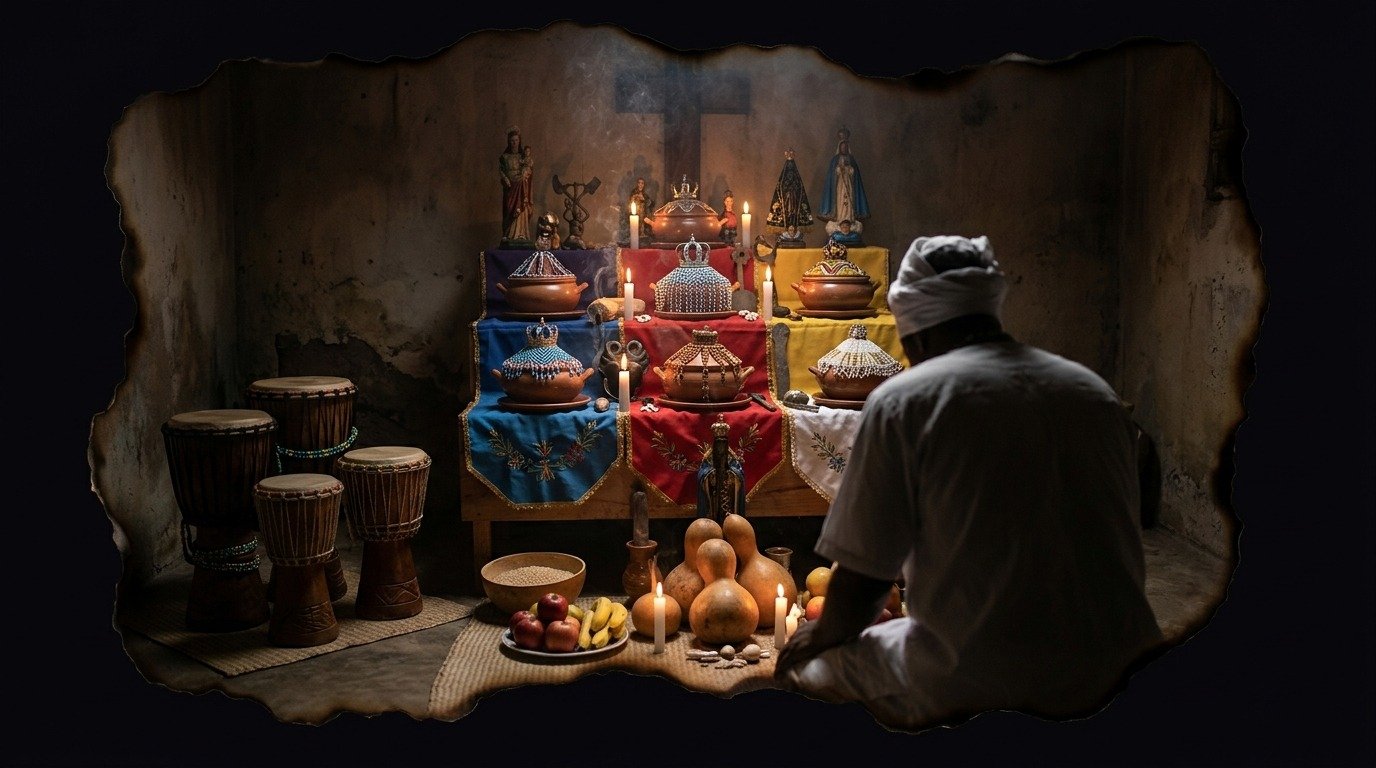
Santería: the Regla de Ocha and the power of Ashé
What it is
Santería, known in its liturgical sphere as the Regla de Ocha-Ifá, is a monotheistic religion of initiatory tradition born from the fusion of the animist beliefs of the Yoruba people and Catholicism. It is not a system of superstition or black magic, but a structured faith that seeks balance between human beings, nature, and the divine. Its central axis is the worship of the Orishas, deities who rule the forces of nature and the paths of human existence.
Origin and history
The Regla de Ocha originated in Cuba during the colonial era, between the 18th and 19th centuries. Slave traders forcibly transported hundreds of thousands of Africans to Cuba, many of them from the Yoruba people, originating from present-day Nigeria and Benin. Upon arriving at the Caribbean plantations, the Spanish colonizers forbade them from practicing their original religion and imposed Catholicism through mandatory baptism. To preserve their faith under persecution, the enslaved people used syncretism. They associated the qualities of their Orishas with those of the Catholic saints from the Spanish calendar of saints. For example, they identified Saint Barbara with Shangó due to the color red and the sword, and the Virgin of Regla with Yemayá because of her connection to the sea. Thus, behind the formal worship of a Catholic image, they continued to pay tribute to their ancestral deities. Following the Cuban Revolution of 1959, mass migration expanded the religion to the United States, Venezuela, Puerto Rico, and the rest of Latin America.
Beliefs
The theology of Santería postulates the existence of a single, supreme creator God named Olodumare (or Olorun). He is a distant entity who does not intervene directly in the daily affairs of humans. To interact with the world, Olodumare delegated his power to the Orishas, deities who represent specific archetypes and natural forces. The fundamental energy that sustains the universe is called Ashé. Ashé is the life force, the creative power present in plants, animals, minerals, words, and people. Religious practice consists of accumulating, balancing, and directing this Ashé to solve problems and fulfill the earthly destiny determined before birth. Likewise, the worship of ancestors, called Eggun, is a priority. No ceremony of the Regla de Ocha begins without paying homage and requesting permission from family and religious ancestors.
Practice and worship
The community structure of Santería is hierarchical and organized into houses of saints or *Ilé*. The highest divinatory authority belongs to the Babalawo, a priest of the Ifá oracular system. The santeros and santeras, called Olorishas or Babalorishas and Iyalorishas, guide devotees and perform initiation ceremonies. The main initiation rite is *Kariocha*, commonly called "making saint." In this private process, the initiate receives the energy of their tutelary Orisha in their head, becoming their consecrated child. During the following year, called *Iyaworaje*, the initiate dresses strictly in white and follows rigorous rules of conduct and purity. Communication with the deities is carried out through specific divination systems: the Diloggún (cowrie shell reading), the Obi (coconut reading), and the Ifá board. Festive ceremonies, called *Bembés* or drums, employ consecrated percussion music (the Batá drums) and songs in the Yoruba language to induce trance states where the Orishas descend to possess their priests. Offerings (*Adimú*) include flowers, fruits, candles, and food. When it is necessary to restore a serious spiritual imbalance, animal offerings are made in a ritual and sober manner, and their meat is usually consumed afterward by the community.
Today
Currently, Santería has millions of practitioners distributed throughout the Caribbean, the United States (with large communities in Miami and New York), Mexico, Venezuela, and Spain. Anthropology and sociology recognize its status as an organized religion with a complex theology and strict ethical codes. Historical prejudice and a lack of information have generated misleading stereotypes that associate Santería with destructive sorcery or animal cruelty. These perceptions ignore the fact that the ethics of the Regla de Ocha forbid using the religion to cause unjustified harm, as every negative action breaks the devotee's balance with their own destiny (*Ori*) and draws the disapproval of the Orishas.
Connections
Santería shares theological roots and practices with Candomblé in Brazil, Vodou in Haiti, and Palo Mayombe (of Bantu origin, with which it is sometimes combined in Cuba, as well as with so-called crossed spiritism). The Ifá divination system directly connects its priests with the traditional metaphysical knowledge of West Africa. The use of magical and medicinal herbs links this faith with Yoruba botanical healing, where each plant belongs and responds to the specific power of an Orisha.
Comments
Share information, an experience, or a source to help enrich this entry. They are automatically reviewed before being published.
Loading comments...