Vetala
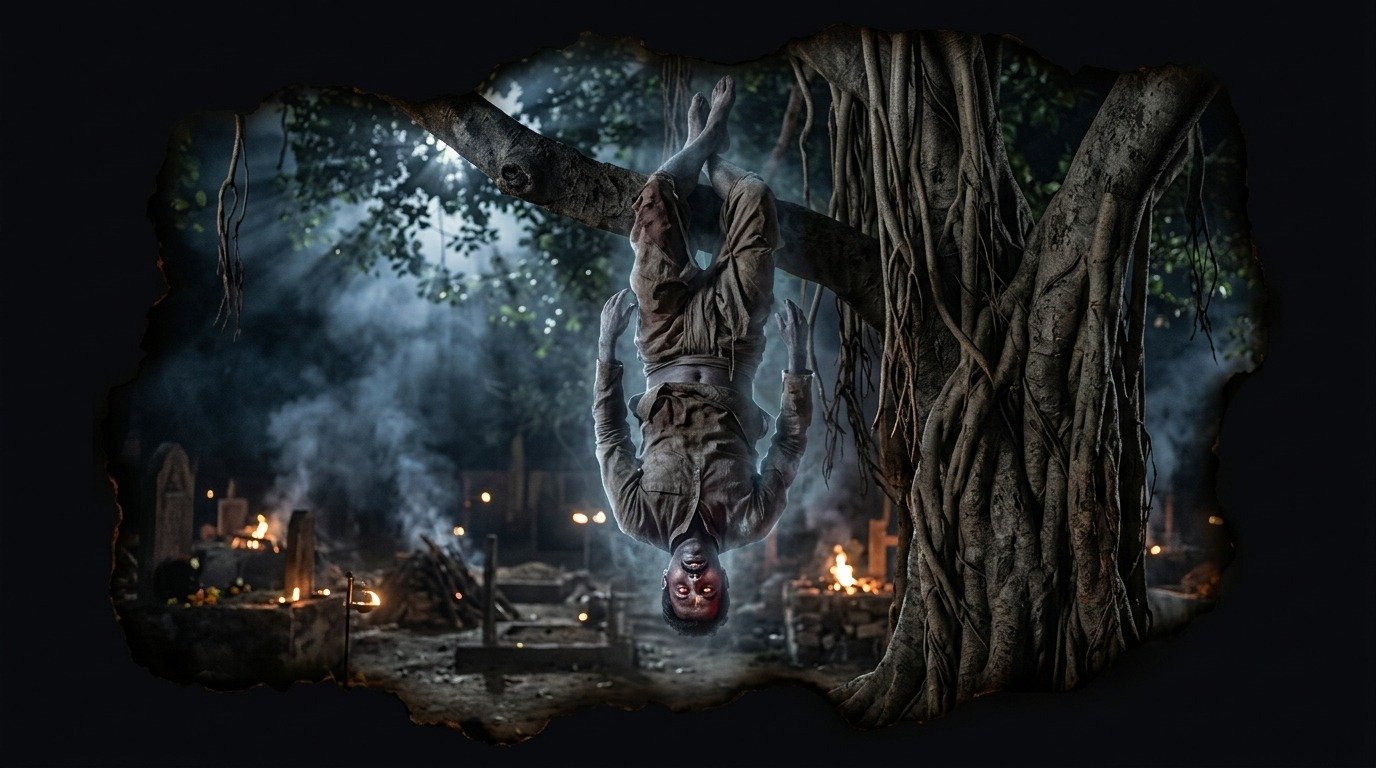
Vetala: the wandering spirit of the crematorium
Origin and Legend
The Vetala (Sanskrit: वेताल) is not strictly a demon or an autonomously reanimated corpse, but rather a necrophagous spirit or class of astral being (associated with the category of the bhūta or preta) that takes temporary possession of unburied corpses or those that have not received proper funerary rites (śrāddha). The most prominent written testimony about this entity is found in the Kathāsaritsāgara (The Ocean of the Streams of Story) by Somadeva (11th century), within the famous section Vetālapañcaviṃśati (The Twenty-Five Tales of the Vetala). In the late Vedic and Puranic tradition, the Vetala inhabits cremation grounds (śmaśāna), suspended from banyan or mimosa trees in an inverted position, similar to a bat. The corpse possessed by a Vetala does not undergo natural decomposition while the spirit resides in it; however, it does not possess vital life, but rather a cold animation sustained by mantric power or by the Vetala's devotion to deities of the fierce tantric pantheon, such as Bhairava and Kali.
Historical and Regional Evolution
Over the centuries, the perception of the Vetala varied significantly depending on the current of Hinduism and the geography of the Indian subcontinent: Tantric and Mahāvidyā Dimension: In the left-hand tantric traditions (Vāmācāra), the Vetala is not a mere folkloric monster, but a servant entity and a guardian of the boundaries between the physical and astral planes. Sadhus and kāpālikas performed nightly rituals in the śmaśāna to subdue a Vetala and turn it into a sādhaka-sahāyaka (an assistant in spiritual practice) capable of revealing the past, the future, and hidden treasures. Popular Folklore and Adaptations: In the popular tradition of Maharashtra and Goa, the entity adopted the form of Vetal or Betal, rising in some local cults to the status of a protective village deity (Gramadevata). It is worshipped in open-air shrines using large stones anointed with vermilion (sindoor), where symbolic sacrifices are offered to it in exchange for protection against other evil spirits. Continental Variants: The figure of the Vetala migrated with Vajrayana Buddhism toward the Tibetan plateau, where it is known as Rolang (the corpse that rises). In the Tibetan tradition, the Rolang has several subclasses (of blood, of bone, of mole) and its touch or breath can transmit the state of possession to the living.
Esoteric and Symbolic Meaning
The Vetala embodies the limbo state of consciousness bound to inert matter. It represents the unliberated mind which, after the death of the physical vehicle, refuses to accept dissolution and seeks to cling to the remains of the ego. From the perspective of Western esotericism and analytical psychology, the Vetala is the personification of the Intellect Disconnected from Spirit: a cold, sharp, and sarcastic intelligence that dwells in the decay of form. In the Vetālapañcaviṃśati, the entity subjects King Vikramāditya to a series of extremely complex ethical and philosophical riddles. Each time the king answers correctly, he breaks the vow of silence required for the ritual, allowing the Vetala to escape back to the tree. It thus symbolizes the dialectical paralysis of reason when it is not illuminated by direct wisdom.
Manifestation and Practice
The manifestation of a Vetala in a corpse is distinguished by several signs perceptible to the experienced practitioner: Thermal Immobility: The body regains joint flexibility but retains an extreme, icy coldness. Inverted Gaze: The eyes of the corpse turn upward or remain fixed without blinking, reflecting a faint reddish or golden light in the darkness. Voice of Metallic Resonance: The Vetala's speech does not come from the vocal apparatus of the dead in a biological way, but rather resounds like an echo without human breath. In the esoteric tradition, subduing a Vetala demands absolute equanimity (Upekṣā). The practitioner must not yield to fear, anger, or the intellectual temptation to debate outside the ritual framework. Control is achieved by capturing the possessed body, maintaining strict ritual silence, and using mantras consecrated to Bhairava to fix the entity's mind and direct its perceptive power toward the practitioner's enlightenment.
The parasite of the cremation grounds
The Vetala does not belong to the realm of the living nor to that of the purified ancestors (*pitris*). Its natural habitat is the *shmashanas* — the cremation grounds on the banks of sacred rivers — where the ashes of the dead cover the earth and the remains of bodies not consumed by the sacred fire lie exposed to the elements. The Vetala is not a common immaterial ghost; it is a demonic intelligence, a parasitic entity that desperately seeks a physical receptacle to manifest in the material plane. Since it lacks a biological body of its own, it seizes fresh corpses that have not yet been completely consumed by fire or that have been buried without the correct Vedic funerary rituals (*Samskara*). By possessing a corpse, the Vetala reanimates it, halting the natural process of decay and turning it into a physical vehicle of immense strength and agility.
Physiology of the necromantic parasite
The skin of the inhabited corpse adopts an ashen gray or greenish color; its nails and hair grow excessively in a matter of hours; its eyes glow with an inner fire of copper or emerald green color; and its joints can rotate at impossible 360-degree angles, allowing it to climb trees upside down like a bat or move at high speed in grotesque body positions. Unlike the zombies of Caribbean mythology or the ghouls of Arabic folklore, the Vetala retains and increases the intellectual faculties of the body it inhabits. It possesses telepathy, the ability to see the past, present, and future of any mortal who approaches it, and a sharp, wicked wit that it uses to tempt, confuse, and destroy those who venture into its domains without proper spiritual preparation.
The Vetala Sadhana
In the plane of tantric esoteric practice (left-hand *Tantra* or *Vamachara*), the Vetala is not seen solely as a monster to be avoided, but as a guardian of hidden mysteries and a source of immense siddhic power. Practitioners of the currents of the Kapalika or Aghori school actively seek these entities in cremation grounds at midnight. The ritual known as *Vetala Sadhana* is one of the most dangerous necromantic practices in Eastern esotericism. It consists of sitting on the chest of a corpse possessed by a Vetala and performing complex meditations, protection mantras, and specific offerings (blood, meat, wine, and red flowers). If the sadhaka (practitioner) maintains absolute mental control and does not yield to the physical and psychological terror that the Vetala unleashes, they can subdue the entity. A dominated Vetala becomes a devoted servant for life, granting the magician the ability to fly, find hidden treasures, predict the future, cure incurable diseases, or destroy enemies at a distance. However, if the practitioner shows the slightest hint of fear or doubt during the ritual, the Vetala will instantly devour their vital energy, leaving an empty shell to be its new physical puppet.
Exorcism rituals
To defend against the destructive influence of a Vetala that plagues a community or a cemetery, Puranic and Tantric scriptures prescribe a series of liturgical countermeasures: - **The use of fire mantras:** Mantras dedicated to wrathful deities like Bhairava (the terrifying manifestation of Shiva) or the goddess Kali are fundamental to drive the spirit away. The vibrational sound of the *Bhairava Mantra* acts as an unbearable energetic barrier for the Vetala, forcing it to abandon the corpse it inhabits. - **Complete ritual cremation:** If a corpse is suspected of being inhabited by a Vetala, it must be consumed by the sacred fire of sandalwood consecrated with ghee (clarified butter) and black mustard seeds. The consecrated fire destroys the material bond that allows the spirit to anchor itself to the physical plane. - **The offering of appeasement (*Bali*):** Before performing any direct exorcism ritual, tantric priests offer the Vetala a diversionary banquet consisting of rice mixed with goat's blood, strong liquors, and cut lemons smeared with vermilion. By accepting this low-frequency offering, the entity usually withdraws peacefully to the subtle planes of the underworld (*Patala*).
Comments
Share information, an experience, or a source to help enrich this entry. They are automatically reviewed before being published.
Loading comments...