Preta
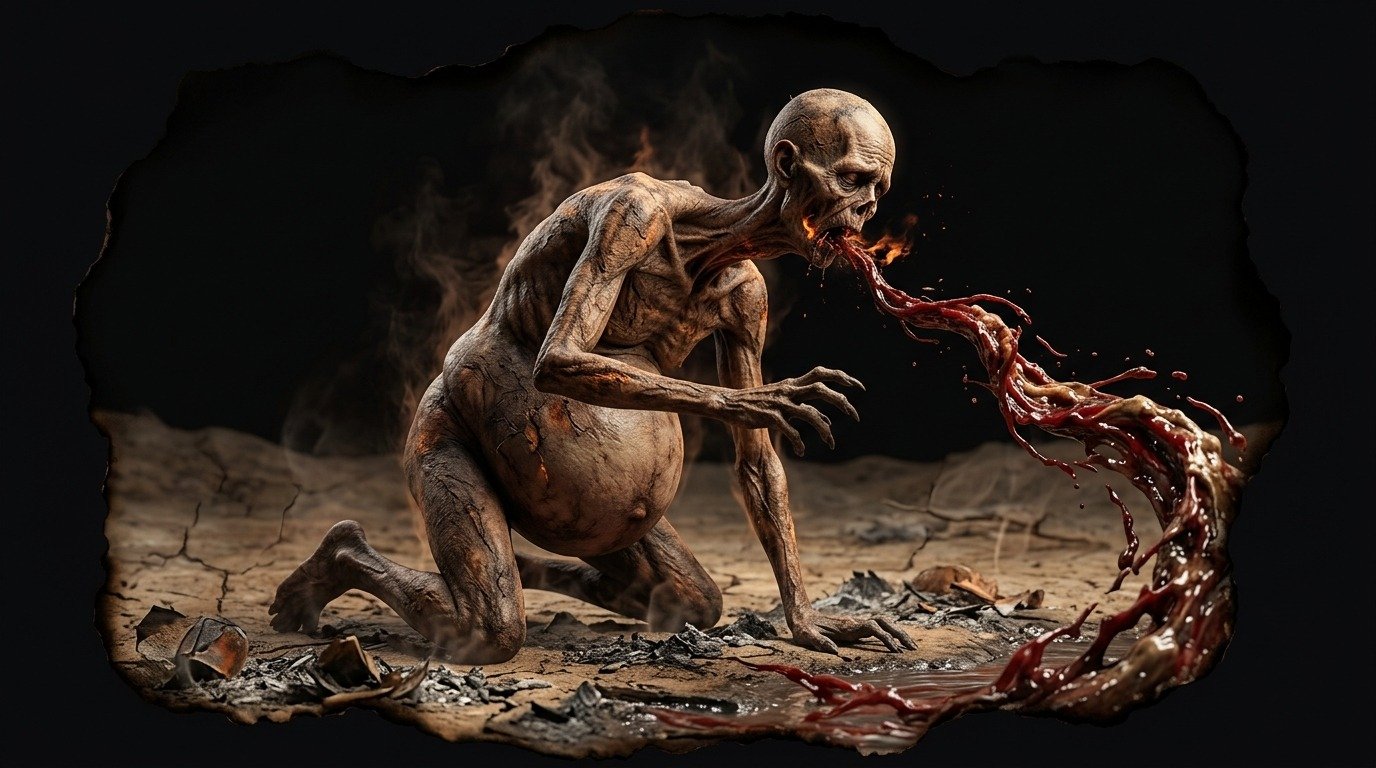
Preta: The Torment of Insatiable Thirst
Vedic Roots and the Cosmology of Samsara
The term *preta* (from the Sanskrit प्रेत, "the departed") originally designated the transient spirit of a deceased person in the early Vedic era. During the period immediately following death, before the performance of the funeral rites (*Śrāddha*) and the assimilation of the ancestor (*pitṛ*) into the realm of the fathers, the soul wandered in a state of dispossession and vulnerability. However, with the systematization of Buddhist, Hindu, and Jain cosmology in the texts of the *Puranas* and the *Abhidharma-kośa*, the *preta* underwent an ontological transmutation. It shifted from being a transitional state to becoming a fixed existential category within *Pretaloka*, one of the three lower realms of existence (*gatis*) of *Samsara*.
In the Pali Buddhist canon, particularly in the *Petavatthu*, this realm is mapped as a dimension superimposed on the human plane, yet invisible to ordinary, unpurified senses. The *preta* is the direct result of *karma* accumulated through obsessive greed, extreme avarice, material attachment, and active stinginess during incarnate life. It is not a punishment imposed by a judging deity, but rather the physical and mental crystallization of a psychological inertia that deforms the subtle body of the dying person until confining them to a physiology of torment.
Anatomy of Lack: Morphology and Variants
Iconography and esoteric treatises describe the body of the *preta* as a literal representation of its spiritual pathology. Their physiognomy is grotesque and disproportionate: they possess gigantic abdomens, bloated and tense like balloons of ash, while their necks and throats are as thin as the eye of a needle or a hair (*sūcimukha*). Their limbs are skeletal, their skin is dry, cracked, and emits a scorching heat, reflecting the internal fire that consumes them.
This anatomy makes the satisfaction of their needs physically impossible. If they find water or food, the obstruction of their narrow esophagus prevents them from swallowing; if they manage to pass a tiny particle, their cavernous stomachs never fill. Furthermore, due to their karmic obscuration (*āvaraṇa*), they perceive reality altered by a systematic illusion: * **Pretas of external obstruction (*bāhyāvaraṇa*):** When they gaze upon a crystal-clear river, it transforms before their eyes into a stream of pus, blood, urine, or molten metal. Food turns into burning embers or ashes the instant they attempt to touch it. * **Pretas of internal obstruction (*ābhyantarāvaraṇa*):** They possess mouths that exhale flames and throats so narrow that the very air burns their entrails as they breathe. Any substance that manages to pass through their throat ignites inside their stomachs, charring them from within. * **Pretas of specific obstruction (*viśeṣāvaraṇa*):** Creatures such as the *Śasāda* or *Kunapabhakṣa*, which can only feed on excreted substances, carrion, hair, urine, or the remains of desecrated ritual sacrifices.
In the Asian cultural diaspora, this entity diversified. In China, it is known as *egui* (饿鬼, "hungry ghost"), where they are classified in detail in the *Saddharmasmṛtyupasthāna Sūtra* into thirty-six distinct classes, ranging from those that feed on the vital energy of sleepers (*vātabhakṣa*) to those that devour the excrement of infants. In Japan, the concept crystallized into the *gaki* (餓鬼), immortalized in the 12th-century illuminated scrolls *Gaki Zōshi*, where they are depicted wandering invisibly among the living, licking blood spilled in battles or drops of water falling from domestic wells.
The Karmic Mechanism: Esoteric Meaning
From the perspective of Eastern-style depth psychology and Buddhist esotericism (especially in the Vajrayāna school), the *preta* is not merely an external entity, but an archetype of the neurotic mind trapped in the loop of insatiable desire. It represents the existential emptiness that desperately attempts to fill itself through external objects, a dynamic where the act of consuming only increases the scale of hunger.
The fire that burns the *preta*'s throat is the fire of *tṛṣṇā* (thirst or clinging), the root of all suffering (*duḥkha*). In the wheel of life (*Bhavacakra*), the realm of the *pretas* is presided over by the Bodhisattva Avalokiteśvara, who manifests before them carrying a vessel of celestial nectar (*amṛta*) to soothe their archetypal thirst. Esoterically, this nectar represents the *Dharma* or the wisdom of equanimity, the only force capable of dissolving the illusion of fundamental lack. The transformation of the *preta* occurs when it understands that the scarcity it perceives in the external world is a projection of its own mental stinginess; pure generosity is the sole ontological antidote to this state.
Liturgies of Relief and Mitigation
Since *pretas* are trapped in a dimension of constant pain and cannot generate spiritual merit on their own, they depend on the intercession of the living to alleviate their condition and facilitate their rebirth in higher realms. This has given rise to complex ritual liturgies throughout Asia: * **The Segaki Ritual (施餓鬼) in Zen Buddhism:** Translated as "feeding the hungry ghosts." It is performed by placing an offering table outside the main altar (since *gakis* do not dare to enter high-vibration sacred spaces). Clean food, rice, and purified water are offered through the recitation of specific mudras and mantras (such as the *Kanro Mon* or "Nectar Gate"), which spiritually transmute the physical food so that their throats open and they perceive the food as pure and digestible substances. * **The Hungry Ghost Festival (Zhongyuan / Ullambana):** Celebrated on the fifteenth day of the seventh lunar month in East Asian cultures. It is based on the *Ullambana Sūtra*, where the disciple Maudgalyāyana seeks the Buddha's help to save his mother, who had been reborn as a *preta* due to her selfishness. The Buddha instructed him to offer food and clothing to the monastic Sangha at the end of the rainy retreat; the merit accumulated by this act of collective generosity was so immense that it instantly freed his mother from the lower realms. * **The Practice of Sur (Tibet):** In Tibetan Buddhism, the daily or weekly practice of *Sur* involves burning roasted barley flour (*tsampa*), mixed with pure substances (the "three sweet substances" and the "three white ingredients") along with incense. The resulting aroma, consecrated through tantric visualizations and purification mantras, becomes an immaterial feast that *pretas* and other wandering spirits can absorb through their sense of smell, immediately soothing their suffering.
Comments
Share information, an experience, or a source to help enrich this entry. They are automatically reviewed before being published.
Loading comments...